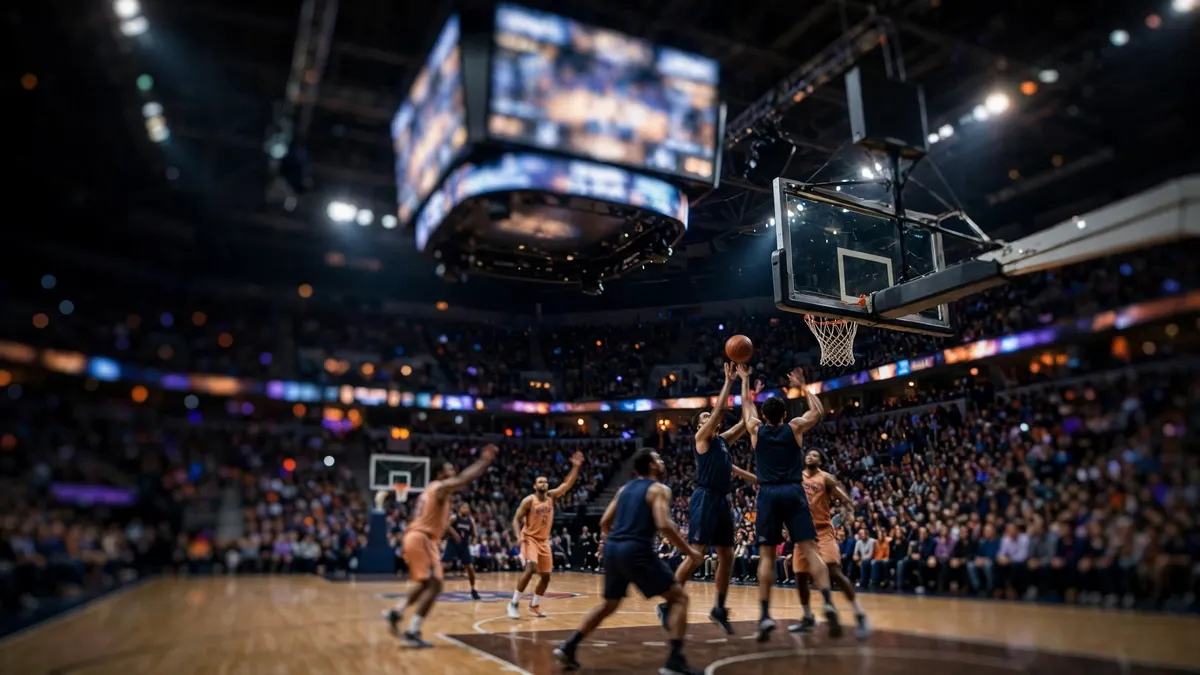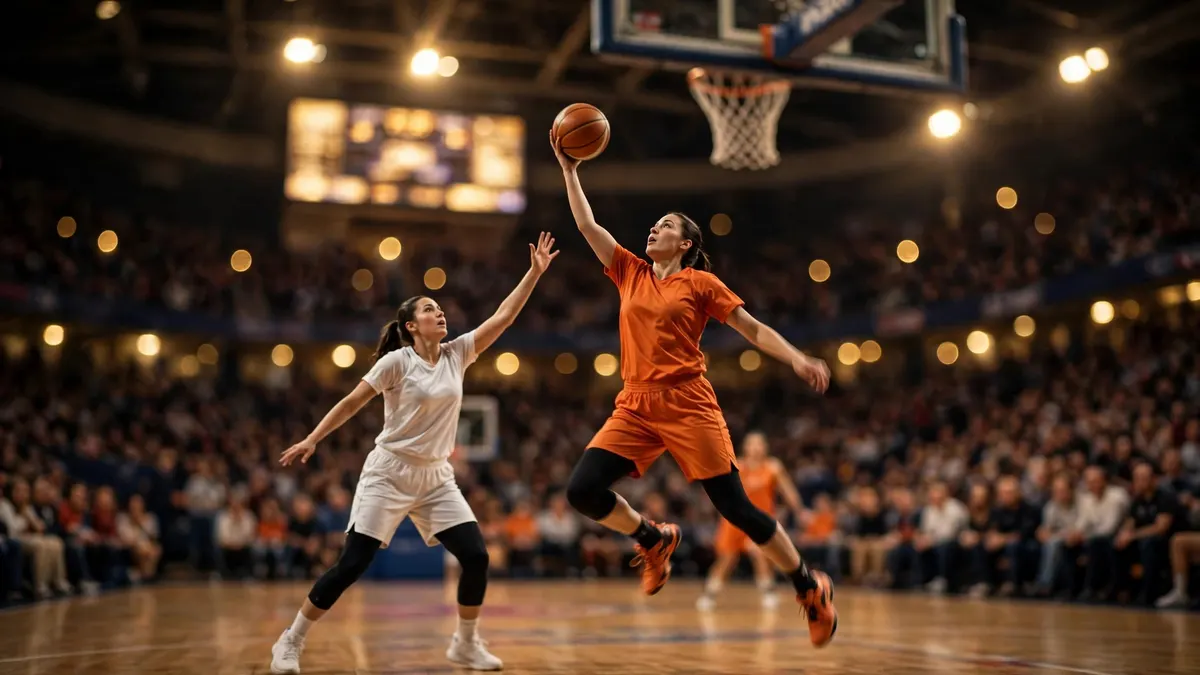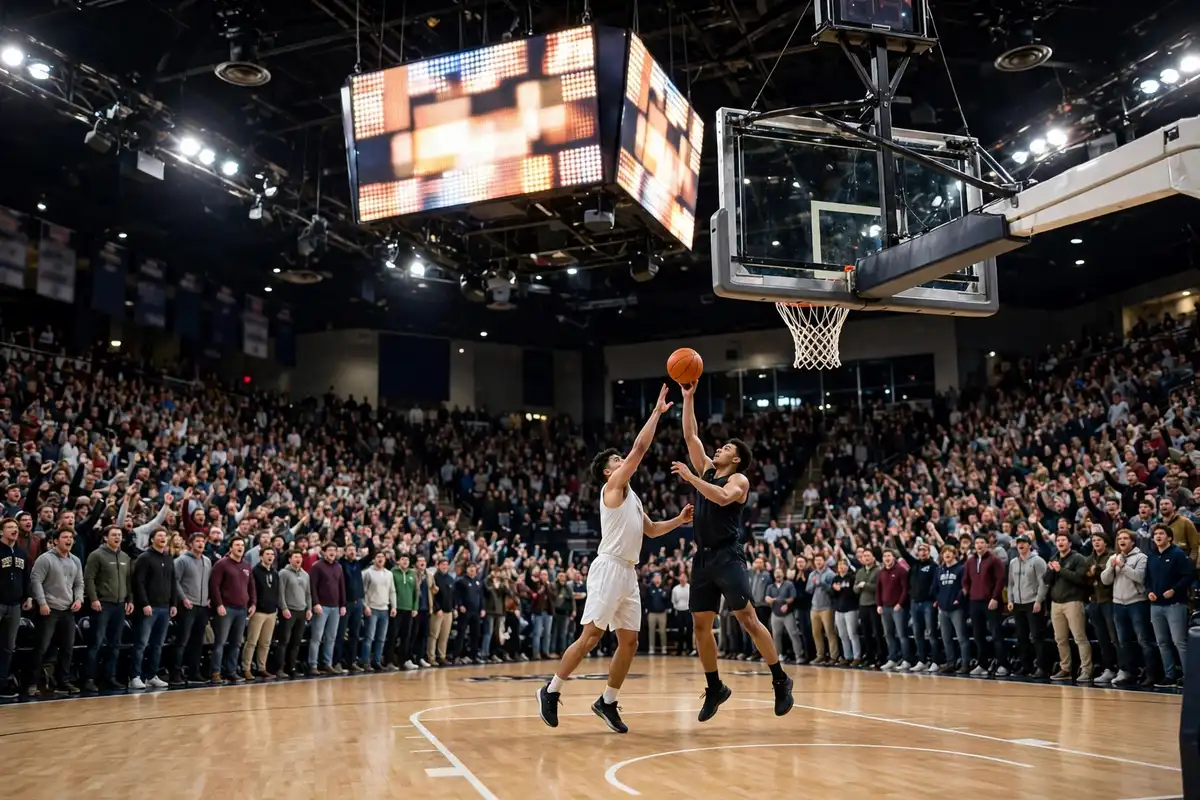



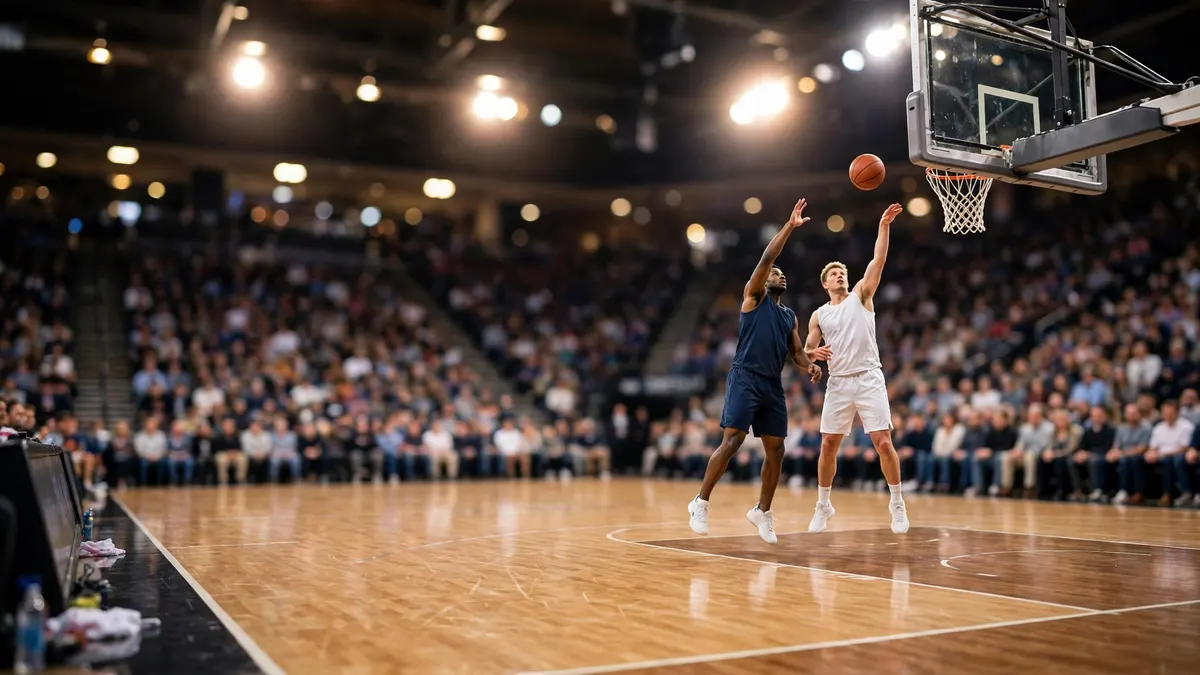
Basketball looks fast and chaotic the first time you watch it. Ten players sprint up and down the court, the ball changes hands every few seconds, and whistles blow at moments that seem random. The core rules are simple, though, and once you know them the game opens up fast. This guide covers the court, scoring, fouls, and how to enjoy a full game.
What are the basic rules of basketball?
Two teams of five players try to score by shooting a ball through the opponent’s hoop. Players move the ball by dribbling or passing, cannot run while holding the ball, and score 2 points inside the arc, 3 points beyond it, or 1 point per free throw. The team with the most points when time runs out wins.
The Basics: What Basketball Is
Basketball is played by two teams of five players on a rectangular court, with a hoop at each end. The goal is straightforward: put the ball through the other team’s basket more often than they put it through yours.
A game starts with a jump ball at center court. The referee tosses the ball up, one player from each team jumps for it, and the team that gains possession heads toward the basket they are attacking. From there, possession flips every time a shot goes in or a team turns the ball over.
The ball is round, orange, and roughly the size of a small melon. Players advance it by bouncing it on the floor — dribbling — or by passing it to a teammate. They cannot simply tuck it under their arm and run. That is the single most important rule to grasp, and almost everything else in the rulebook builds on it. Each team also has substitutes on the bench, and coaches can swap players in and out during stoppages, with no limit on substitutions.
Check the latest NBA scores after games, or follow the boxing schedule and UFC schedule between games.
The Court: Lines, Zones, and What They Mean
An NBA court is 94 feet long and 50 feet wide, with slightly smaller dimensions in college and high school. The lines on the floor are not decoration — each one marks a boundary or a zone that affects play.
The three-point line is the big arc around each basket. Shots from beyond it are worth three points; shots from inside it are worth two. In the NBA the line sits 23 feet 9 inches from the basket at its farthest point, and 22 feet in the corners.
The free-throw line sits 15 feet from the backboard. Players stand behind it to take free throws after certain fouls. The rectangular area between the free-throw line and the basket is called the paint or the key, where most of the physical play happens.
The half-court line divides the court in two. Once a team brings the ball across it into the attacking half, they cannot take it back — doing so is a backcourt violation, and possession goes to the other team. The center circle is where the opening jump ball takes place, and the sidelines and baselines mark the edges of the court. Step on or over them while holding the ball and the ball is out of bounds.
How high is a basketball hoop?
A regulation basketball hoop is 10 feet above the floor at every level of the sport, from youth leagues to the NBA. The rim is 18 inches in diameter.
How a Game Is Structured: Quarters, Halves, and the Clock
Game length depends on the level. The NBA plays four 12-minute quarters, for 48 minutes of game time. College basketball plays two 20-minute halves. High school plays four 8-minute quarters, and international play under FIBA rules uses four 10-minute quarters.
The game clock stops constantly — after fouls, when the ball goes out of bounds, during free throws, and during timeouts. That is why a 48-minute NBA game usually takes about two and a half hours in real time. The final two minutes of a close game can stretch for twenty minutes or more.
Between quarters there is a short break, and at halftime teams get about 15 minutes to rest and adjust. If the score is tied at the end of regulation, the game goes to overtime: five extra minutes in the NBA, with teams playing extra periods until someone wins. There are no draws in basketball.
Scoring: How Points Work
There are only three ways to score in basketball.
Two-point field goals. Any shot made from inside the three-point arc is worth two points: layups at the rim, mid-range jump shots, dunks, and bank shots off the backboard. Most points in a game come this way.
Three-point field goals. Any shot made from beyond the three-point arc is worth three points. The three-pointer has become a huge part of modern basketball, and teams build entire offenses around creating open looks from deep. A player must have both feet behind the line when the shot leaves their hands for it to count as three.
Free throws. Each successful free throw is worth one point. Free throws are unguarded shots from the free-throw line, awarded after certain fouls. They look easy, but even the best players in the world miss them sometimes, and free-throw shooting often decides close games.
After a made basket, the other team takes the ball out and brings it up the court — no kickoff, no reset. To track scoring across leagues, check the latest NBA scores, the NFL scores, and the MLB scores.
How many points is a free throw worth?
One point. Free throws are awarded after certain fouls and are taken unguarded from the free-throw line, 15 feet from the basket.
Dribbling: How Players Move With the Ball
Dribbling is the skill that makes basketball work. A player who has the ball must bounce it on the floor while moving. The moment they stop dribbling and hold the ball with both hands, they must either shoot or pass — they cannot start dribbling again.
A player can dribble with either hand and switch hands to get around a defender. The ball must be pushed down toward the floor, not carried or palmed. Carrying the ball — letting it rest in the hand too long — is a violation, though referees allow some leeway on this call.
Dribbling is also the main way teams bring the ball up the court. The point guard, usually the team’s best ball-handler, dribbles past half court and starts the offense. From there the ball moves through passes: chest passes, bounce passes, overhead passes, and alley-oops, where a pass is thrown near the rim for a teammate to catch and dunk in mid-air.
Traveling, Double Dribble, and Other Violations
Basketball has a set of rules called violations. These are not fouls — nobody gets a free throw, and nobody is punished personally. The penalty is simply a loss of possession: the other team gets the ball.
Traveling. A player cannot take more than two steps without dribbling the ball. Picking up your dribble and then running with the ball, or shuffling your feet after stopping, is traveling.
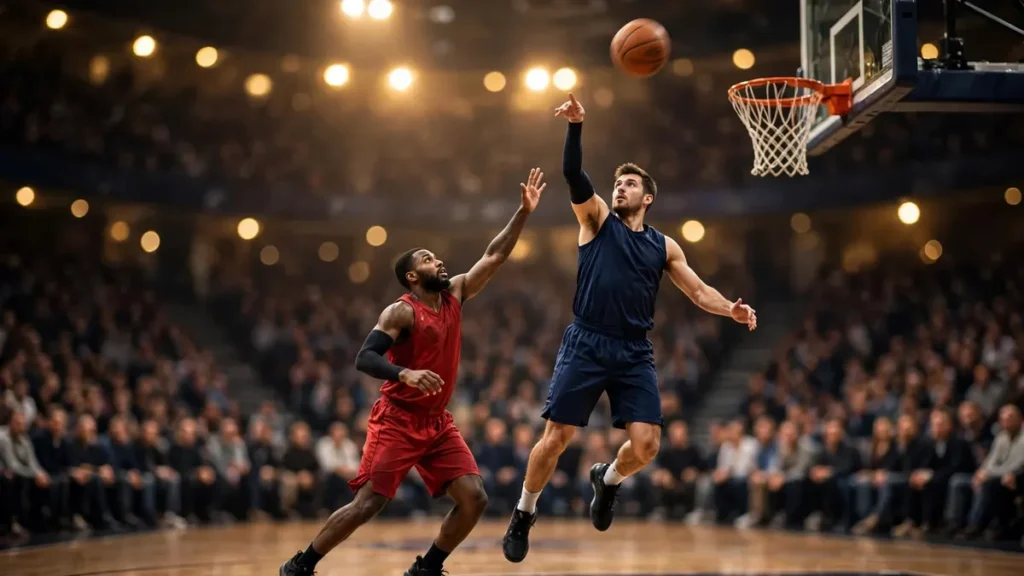
Double dribble. Once a player stops dribbling and holds the ball with both hands, they cannot start dribbling again. Dribbling with both hands at once is also a double dribble.
Backcourt violation. Once the offense crosses the half-court line with the ball, it cannot go back into its own half. If it does, the defense gets the ball.
Shot clock violation. The offense has a limited time to attempt a shot — 24 seconds in the NBA and international play, 30 seconds in college. If the ball does not hit the rim before the clock expires, possession changes hands.
Goaltending. A defender cannot touch the ball on its way down toward the basket or while it sits on the rim. The shot counts automatically.
Out of bounds. If a player steps on the line, or the ball touches the floor, a player, or anything outside the court boundaries, the ball is out. The team that did not touch it last gets possession.
Three seconds in the key. An offensive player cannot stand in the painted area for more than three consecutive seconds while their team has the ball. This keeps big players from camping under the basket all game.
What is traveling in basketball?
Traveling is taking more than two steps without dribbling the ball. When a player picks up their dribble and runs with the ball, or moves both feet after stopping, the referee calls traveling and the other team gets possession.
Fouls: Personal, Technical, and Flagrant
Fouls are different from violations. A foul involves illegal physical contact or unsportsmanlike behavior, and the penalty is more serious — usually free throws for the other team.
Personal fouls. The most common foul is a personal foul: illegal contact with an opponent, such as pushing, holding, or hitting a shooter’s arm. A player fouled while shooting gets free throws — two for a two-point attempt, three for a three-point attempt. If the shot goes in anyway, they get one extra free throw, an “and-one.” Each player is allowed a limited number of personal fouls before being disqualified: six in the NBA, five in college and high school. This is called “fouling out.”
Shooting fouls vs. non-shooting fouls. A foul on a shooter means free throws. A foul on a non-shooter usually means the fouled team takes the ball out of bounds — unless the fouling team is over the team foul limit for the quarter, in which case it is free throws anyway. That is the “bonus” rule.
Offensive fouls. The offense can foul too. The most common is a charging foul, where a ball-handler runs into a defender who has established a legal guarding position — feet set, standing still, facing the ball-handler. The penalty is a loss of possession, with no free throws.
Technical and flagrant fouls. A technical foul is called for unsportsmanlike behavior: arguing with a referee, taunting, or hanging on the rim after a dunk. The other team gets one free throw plus possession, and two technicals mean ejection. A flagrant foul involves excessive contact, such as a hard shove in mid-air. Flagrant 1 gives the other team two free throws and possession; flagrant 2 means automatic ejection.
Fouls are a judgment call, and fans argue about them constantly. The NASCAR schedule and the NHL scores pages are handy if you follow racing or hockey alongside basketball.
How many fouls before a player fouls out?
Six personal fouls in the NBA. In college and high school, a player fouls out after five personal fouls. Once a player fouls out, they must leave the game and cannot return.
Free Throws: The Quiet Points That Decide Games
Free throws are the most underrated part of basketball. They look routine — a player standing alone at the line, no defender, 15 feet from the basket — but they decide a huge number of games.
A player gets free throws after being fouled in the act of shooting, after a technical or flagrant foul, or when the other team is over the foul limit. The shooter gets one, two, or three attempts depending on the situation, and each made free throw is worth one point. The shooter must stay behind the free-throw line until the ball leaves their hands, while other players line up along the sides of the paint, ready to rebound if the shot misses.
Here is why free throws matter: late in a close game, the trailing team often fouls on purpose. They stop the clock, send the other team to the line, and hope for misses. A team that shoots free throws well can close out games; a team that shoots them poorly hands opponents a way back in.
The Bonus and the Double Bonus
When a team commits its fifth foul in a quarter, the other team enters the “bonus” and shoots free throws on every foul after that, even non-shooting fouls. In college, the bonus starts at the seventh team foul of a half, and the “double bonus” starts at the tenth.
Positions: The Five Roles on the Court
Every basketball team puts five players on the floor, and each one has a traditional role. Modern basketball has blurred these lines — players now do a bit of everything — but the five positions are still the best way to understand who does what.
Point guard. The team’s floor general. They bring the ball up the court, run the offense, and set up teammates for shots. Usually the smallest players on the team, but the best passers and ball-handlers — think of them as the quarterback of the offense.
Shooting guard. The team’s scorer from the perimeter. Usually the best outside shooter, running off screens and looking for open three-pointers or mid-range jumpers. Many of the game’s most famous scorers have played this position.
Small forward. The most versatile player on the court — a mix of scoring, defense, rebounding, and playmaking. Typically tall and athletic, able to guard multiple positions and score from anywhere.
Power forward. Plays near the basket, rebounding, defending bigger players, and scoring from close range. Traditionally the toughest, most physical player on the team, the modern power forward also needs to shoot from outside to stretch the defense.
Center. Usually the tallest player on the team. They protect the rim on defense, grab rebounds, block shots, and score close to the basket on offense. Many modern centers can also shoot and pass, but their main job is still controlling the paint.

The Shot Clock: Why Basketball Never Stalls
The shot clock is one of the best rules in sports. The offense has 24 seconds in the NBA (30 in college, 24 in international play) to attempt a shot that hits the rim. If they don’t, the buzzer sounds and the other team gets the ball.
The shot clock was introduced in the 1950s because teams used to stall, holding the ball for minutes once they had a lead. Now every possession has urgency built in, and the final seconds of the clock produce some of the most exciting plays in the sport.
Watching the shot clock is a great habit for new fans: when it drops below five seconds, something interesting is about to happen — a rushed shot, a desperate drive, or a buzzer-beater.
How long is the shot clock in basketball?
24 seconds in the NBA and international play, and 30 seconds in college basketball. The offense must attempt a shot that hits the rim before the clock expires, or possession goes to the other team.
How to Follow a Game Like a Fan
You know the rules now. Here is how to put them together while watching.
Watch the ball, then watch away from it. New fans follow the ball everywhere, and that is fine at first. But the real game happens off the ball: screens being set, players cutting, defenses rotating.
Count the fouls. Glance at the scoreboard and note how many team fouls each side has. When a team hits five fouls in a quarter, every touch becomes a free-throw risk.
Follow the shot clock. It tells you the urgency of every possession. A team that takes ten seconds to bring the ball up court has less time to run a play.
Learn one team’s players. Pick a team and learn their five starters: who scores, who passes, who defends. Familiar players make every game easier to follow.
Keep the scores handy. The latest NBA scores page is the simplest way to catch up, and the same hub carries the MLS scores and NHL scores for nights when you want to check other sports too. If you enjoy learning the rules of other games the same way, the baseball rules for beginners guide covers that sport in the same plain style. The Sports Flash Daily blog is a good place to keep learning, with explainers and news across basketball and the other major sports.
How long is an NBA game?
An NBA game is 48 minutes of playing time — four 12-minute quarters. Because the clock stops for fouls, timeouts and other stoppages, a full game usually takes about two and a half hours in real time.
Frequently Asked Questions
How many players are on a basketball team?
Five per team are on the court at a time, plus substitutes on the bench. Coaches can swap players during stoppages, and a full NBA roster carries 15 players.
What is the difference between a violation and a foul?
A violation is a rule break with no illegal contact — like traveling — and the penalty is losing possession. A foul involves illegal contact, and the penalty usually includes free throws.
How many points is a three-pointer worth?
Three points, as long as the shooter has both feet behind the three-point line when the shot leaves their hands. Shots from inside the line are worth two points, and free throws are worth one point each.
What happens if a basketball game is tied at the end of regulation?
The game goes to overtime: five-minute periods in the NBA until one team is ahead when a period ends. There are no tied games in basketball.
Can a player come back after fouling out?
No. Once a player reaches the foul limit — six personal fouls in the NBA, five in college and high school — they must leave the game and cannot return.
What is a jump ball?
A jump ball starts the game. The referee tosses the ball up at center court, and one player from each team jumps to tap it to a teammate. They are also used when two players gain simultaneous possession.
How does the shot clock work?
The offense has 24 seconds in the NBA (30 in college) to attempt a shot that hits the rim. If the clock runs out first, it is a shot clock violation and the other team gets the ball. The clock resets after a change of possession or an offensive rebound.
What is the key in basketball?
The key, also called the paint, is the rectangular area between the free-throw line and the basket. Offensive players cannot stand in it for more than three seconds at a time.