




Boston Bruins Lines: How to Read Them Like a Fan
Hockey moves fast, and the lineup moves with it. A fan who opens a game page and sees names grouped in threes and pairs can feel lost at first. Those groups are the lines, and they shape almost everything that happens on the ice. Once you know how to read them, you can follow the game with far more confidence.
This guide explains Boston Bruins lines in plain language. It covers what forward lines and defensive pairs are, how coaches build them, what the order on a line chart means, how lines change during a game, and where to check for the latest version before puck drop. It stays general on purpose, because line combinations change from game to game.
What Are Hockey Lines?
A hockey line is a small group of players who skate together as a unit. Forwards work in groups of three. Defencemen work in pairs. Goaltenders are listed separately, because only one plays at a time. When a coach talks about lines, he is talking about these units, the jobs each one does, and the order in which they take the ice.
If you are new to the sport, a short refresher helps. The ice hockey rules for beginners guide explains positions, shifts, and penalties in plain terms, and it pairs well with this guide when a term here feels unfamiliar.
Forward Lines
A forward line has three players: a centre, a left winger, and a right winger. The centre takes face-offs, supports the play in both ends of the rink, and often acts as the link between attack and defence. The wingers play along the boards, drive toward the net, and cover their side of the ice when the other team has the puck.
Teams normally dress twelve forwards, which makes four lines of three. The first line is often called the top line. It usually carries the strongest scoring threat and gets the most ice time at even strength. The second line is the next scoring group. The third line is often a checking line, built to shut down the other team’s best players. The fourth line is often called the energy line, bringing physical play and pace in short shifts.
- A forward line has a centre, a left winger, and a right winger.
- Twelve forwards make four lines, listed from first to fourth.
- The top two lines usually carry most of the scoring job.
- The third line often focuses on checking and defensive play.
- The fourth line usually brings energy and physical play in short shifts.
Defensive Pairs
Defencemen work in pairs rather than in threes. A team normally dresses six defencemen, which makes three pairs. Each pair has a left-side defenceman and a right-side defenceman, although some players can play on either side when the team needs it. The pair defends its own zone, moves the puck out of trouble, and supports the attack from the blue line.
The first pair usually plays the most minutes and faces the other team’s best forwards. The second pair takes the next hardest job and often joins the attack more freely. The third pair plays fewer minutes, brings fresh legs, and gives the top pairs a rest. The order on the chart is a guide to trust and ice time, not a strict ranking of talent.
- A defensive pair has two defencemen, one on each side of the ice.
- Six defencemen make three pairs, listed from first to third.
- The first pair usually plays the most minutes against top opponents.
- The second pair often balances defence with joining the attack.
- The third pair provides fresh legs and depth across a long game.
Goaltenders and Scratches
A line chart also lists goaltenders, usually two. One is the starter for the game, and the other is the backup. The starter plays unless he is pulled for poor form, injury, or a tactical change. The backup sits on the bench, ready to step in, and he may start the next game in a back-to-back set.
How Coaches Build Lines
Coaches build lines around roles, balance, and trust. They want each group to have a clear job, and they want the four forward lines and three defensive pairs to fit together as a whole. A team with four lines that all try to do the same thing is easy to play against.
The process often starts with the centre. A line grows around a centre who can win face-offs, carry the puck through the middle, and support both wingers. The wingers are then chosen to fit that centre. One winger may be a finisher who scores from close range. The other may be a playmaker who creates space, wins battles, and sets up chances.
Roles Inside a Line
Every line needs a mix of roles. The scorer finishes chances. The playmaker creates them. The forechecker wins the puck back and sets the tone with hard work. The defensive forward covers back, supports the defencemen, and helps kill plays before they become chances. Most players do more than one of these jobs.
The same thinking applies across the whole lineup. A look at the NHL scores page over several weeks shows how teams with balanced depth win games even when their top line has a quiet night, because another line steps up and fills the gap.
Chemistry and Trust
Chemistry is the part of line building that numbers cannot fully capture. Two players may look perfect on paper and still not click. Another pair may seem mismatched and yet read each other’s moves without a word. Chemistry grows from shared habits, and it builds over weeks of practice and games.
Balance Across the Lineup
A coach does not build four lines in isolation. He builds one lineup. If the top line takes most of the attacking zone starts, the third line may need to take most of the defensive zone starts. If the first pair plays heavy minutes, the third pair may need to be ready to step up when injuries or penalties shorten the bench.
Salary and roster rules shape this balance too. The NHL salary cap guide explains how teams fit a full roster under a spending limit, and that limit is one reason depth lines are often built from younger players and value signings rather than stars.
How to Read a Line Chart
A line chart is a simple document once you know the layout. Forwards are listed first, in four rows of three. Defencemen follow, in three rows of two. Goaltenders come last, with the starter normally named first. Some charts use a diagram of the rink, with each player placed at his position. Others use a plain list.
Read the chart from top to bottom. The first forward row is the first line. The second row is the second line, and so on. The first defensive row is the first pair. The order tells you the coach’s plan for that game, not a permanent ranking. A player can move up a line after a strong run, or down a line after a quiet spell.
Check the date and the game on every chart you read. A chart from last week may already be out of date. Injuries, trades, call-ups from the minor leagues, and simple coaching choices can change the groups. A chart is a snapshot, and a fresh snapshot is the only one worth trusting for the next game.
Positions, Notation, and Abbreviations
Line charts use short labels for positions. C means centre. LW means left wing. RW means right wing. LD means left defence. RD means right defence. G means goaltender. Some charts add extra notes, such as a player who is day-to-day, a player returning from injury, or a player who has been called up. Those notes sit beside the name or in a footnote.
What the Order Really Means
The order on a chart means trust and expected ice time, not a verdict on who is the best player. A first-line winger is expected to play the most and to face the toughest opponents. A fourth-line winger is expected to play less and to bring energy in short bursts. Both jobs matter, and a player can be excellent in a fourth-line role without being a lesser player.
| Group | Players | Usual job | Typical ice time |
|---|---|---|---|
| First forward line | Centre, left wing, right wing | Top scoring threat | Most among forwards |
| Second forward line | Centre, left wing, right wing | Secondary scoring | Second most among forwards |
| Third forward line | Centre, left wing, right wing | Checking and defensive work | Moderate, matchup dependent |
| Fourth forward line | Centre, left wing, right wing | Energy and physical play | Least among forwards |
| First defensive pair | Left defence, right defence | Top opponents, most minutes | Most among defencemen |
| Second defensive pair | Left defence, right defence | Balanced defence and attack | Second most among defencemen |
| Third defensive pair | Left defence, right defence | Depth and fresh legs | Least among defencemen |
| Goaltenders | Starter, backup | Starter plays, backup ready | Starter plays most games |
Reading Special Teams Within the Chart
Some line charts show power-play and penalty-kill groups as well as even-strength lines. Those groups are not the same as the regular lines. A power-play unit pulls the best attacking players from different lines into one group. A penalty-kill unit pulls the best defensive forwards and defencemen into another group.
How Lines Change During a Game
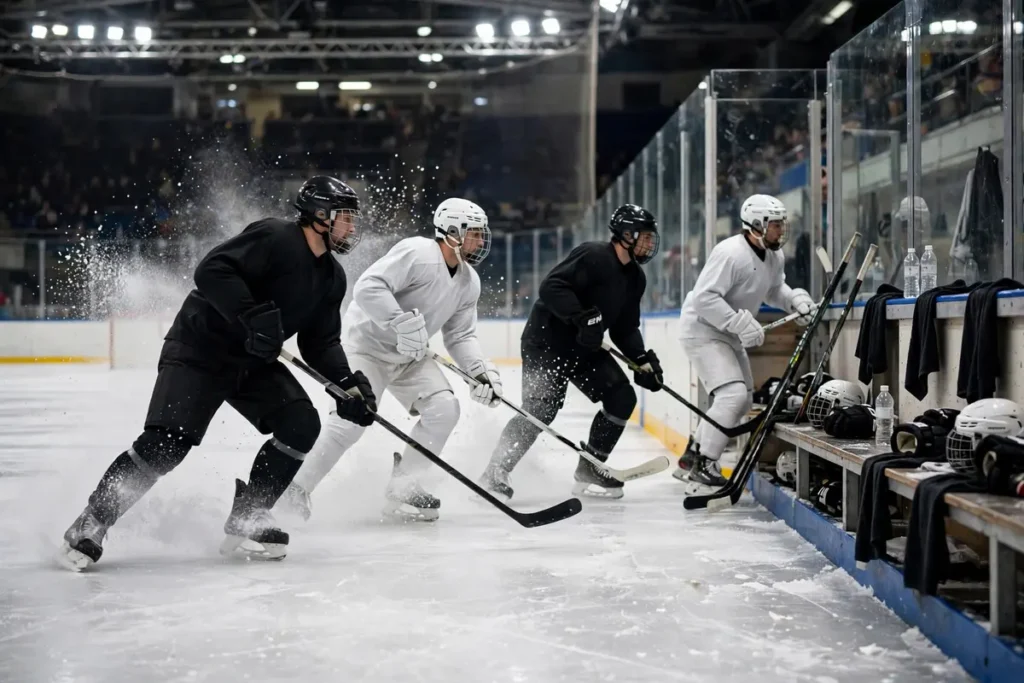
Lines are not fixed once the puck drops. Coaches change them during a game for many reasons. A line that is struggling may be split up after a few shifts. A line that is flying may be kept together and given extra shifts. A player who is having a strong night may be moved up to skate with better linemates.
Injuries force changes too. If a forward leaves the game, the coach may shorten the bench, using three lines instead of four, or he may move a player from another line to fill the gap. If a defenceman leaves, the remaining five defencemen take extra shifts, and the pairs are reshuffled on the fly.
In-Game Adjustments
The most common in-game adjustment is a simple swap. The coach moves one winger from the second line to the first line, and the player he replaces drops down. The swap may last for one shift, for the rest of a period, or for the rest of the game. It is a low-cost way to test a new look without breaking up every group at once.
Line Matching and Matchups
Line matching is the chess match inside the game. The home coach gets the last change after a stoppage, which means he can choose which line goes out after seeing the other team’s choice. The visiting coach must send his line out first. That small edge matters, because it lets the home coach put his checking line against the other team’s top line.
For a sense of how quickly a game can turn, the NBA scores page shows teams changing momentum in a single quarter, and hockey coaches face the same need to adjust before a small gap becomes a big one.
Fans who follow the full sports calendar see the same pattern elsewhere. The tennis scores page shows form shifting from week to week, and a hockey coach must read that kind of shift inside a single game, not just across a season.
Special Teams Lines
Special teams are the groups used when one team has a man advantage or a man short. They are listed separately from even-strength lines, and they have their own logic. A player who is a regular on the third line can be a key penalty killer. A player who is a regular on the fourth line can be a useful net-front presence on the power play.
The power play is the attacking group used when the other team takes a penalty. It usually has five skaters: three forwards and two defencemen, or four forwards and one defenceman. The group sets up in the attacking zone, moves the puck quickly, and looks for a shot from a dangerous area. The penalty kill is the defensive group used when the team is short-handed, usually four skaters.
Power Play Units
A power-play unit is built around puck movement and shooting. The coach usually puts his best passers and shooters together, even if they play on different lines at even strength. One player may work the half-wall, controlling the puck and choosing when to pass or shoot. Another may work the point, taking shots from the blue line. Another may stand in front of the net, screening the goaltender.
Penalty Kill Units
A penalty-kill unit is built around hard work, positioning, and courage. The forwards pressure the puck carrier, cut off passing lanes, and look for a chance to clear the puck down the ice. The defencemen block shots, win battles in front of the net, and help the goaltender see the puck. The goaltender is the last line, and he needs a clear view to make saves.
Where to Find the Latest Lines
The latest lines are normally published close to game time, after the morning skate and after the coach confirms who is in and who is out. A chart published in the morning may change by the evening if a player is a game-time decision. A chart published the day before is a guess, not a fact. Always check the time on the chart and look for a newer version if the game is close.
- Check the team’s official channels first for the most direct news.
- Look for beat writers who attend practice and the morning skate.
- Compare two sources when a player is listed as a game-time decision.
- Note the time on the chart, and refresh it close to puck drop.
- Treat a chart from the day before as a guide, not as the final lineup.
Minor league call-ups can change the lines at short notice. The American Hockey League tickets guide is about watching the minor league live, but it is a useful reminder that players move between levels, and a call-up can put a new name into the lineup on the same day.
Rival news can also hint at changes, although it is not a source for the Bruins chart itself. The Pittsburgh Penguins rumors page shows how trade talk and roster news circulate around the league, and the same kind of talk can surround any team when injuries or slumps hit.
Common Mistakes When Reading Lines
The most common mistake is treating one chart as permanent. Lines change. A player who is on the first line today may be on the third line next week. A pair that looks settled may be split after a poor stretch. A fan who memorises one chart and stops checking will soon be reading an old lineup. The fix is simple: check a fresh chart for each game.
A second mistake is judging a player only by his line. A third-line forward can be a vital player, especially if he kills penalties, wins face-offs, and shuts down top opponents. A fourth-line forward can change a game with one big hit or one timely goal. A third-pair defenceman can play a quiet, steady game that keeps the team in front. The line tells you the role, not the value.
- Do not treat one chart as permanent; check a fresh version each game.
- Do not judge a player only by his line; judge him by how well he fills his role.
- Do not confuse power-play and penalty-kill groups with even-strength lines.
- Do not overreact to a single move; look for a pattern across several games.
- Do not trust a chart without a date; an undated chart may already be out of date.
Fans who follow other sports make the same errors. A look at the PGA Tour schedule shows how a field changes from event to event, and a hockey lineup changes in the same way from game to game.
A late change can also undo a careful plan. The boxing schedule page shows how a card can change late, and a line chart can change late too, so a final check before the event starts is always worth it.
Frequently Asked Questions
What are Boston Bruins lines?
Boston Bruins lines are the forward lines, defensive pairs, and goaltenders the team uses in a game. The team normally lists four forward lines of three players, three defensive pairs of two players, and two goaltenders. The chart shows the planned groups for a specific game, and it changes often as coaches adjust roles, cover injuries, and match up against different opponents.
Where can I find the latest Bruins lines?
The latest lines are usually posted by the team, by beat writers who cover the club, and by sports news sites and apps in their game preview. Check a source close to puck drop, note the date and time on the chart, and look for any game-time decisions. A chart from the morning skate may change by the evening, so a fresh check before the game starts is the safest habit.
What does the first line mean in hockey?
The first line is the group the coach plans to use most at even strength, and it usually carries the strongest scoring threat. It often faces the other team’s best players and gets the most attacking zone starts. The label is about trust and ice time for that game, not a permanent ranking, and a player can move up or down the lineup as form and matchups change.
How often do hockey lines change?
Lines can change from game to game and from shift to shift. Coaches adjust them for injuries, poor form, strong form, matchups, and score. A line may stay together for weeks when it works, or it may be split after a few shifts when it does not. That is why a line chart is a snapshot for one game, and why fans should check a fresh version each time.
Do lines include power play and penalty kill groups?
Some charts list special teams groups alongside even-strength lines, but they are separate lists. A power-play unit pulls attacking players from different lines into one group, and a penalty-kill unit pulls defensive players into another group. A player can be on the third line at even strength and on the first power-play unit, so read each list on its own terms.
Reading Boston Bruins lines is a skill that grows with use. Start with the shape of the chart, learn the roles inside each group, and check a fresh version before each game. Over time, you will spot the patterns that matter: which line the coach trusts in a tight game, and which pair takes the hardest minutes. The WNBA scores page shows how lineup news shapes expectations in another league, and hockey works the same way.



















