





Hockey looks chaotic the first time you watch it. Players fly across the ice at full speed, the puck is small and hard to track, and the whistle seems to blow for reasons nobody explains. Stick with it for one period, though, and the game starts to make sense.
This guide covers the ice hockey rules for beginners in plain language. Just what you need to understand a game the next time you sit down to watch one.
What are the basic rules of ice hockey?
Two teams of six players skate on an ice rink and try to shoot a rubber puck into the other team’s net. A game has three 20-minute periods. The team with more goals wins. Play stops for offside, icing, and penalties, and restarts with a faceoff.
What Is Ice Hockey?
Ice hockey is a team sport played on ice. Two teams skate around a rink, pass a small black rubber puck with sticks, and try to score by shooting it into a net guarded by a goalie. The team that scores the most goals by the end of the game wins.
The sport is huge in Canada, the northern United States, and northern and eastern Europe. The NHL is the top professional league in North America.
What makes hockey different from most other team sports is the pace. There are no long pauses between plays. Players swap on and off the ice while the game is still going, the puck moves fast, and a goal can come out of nowhere. That speed is exactly why people love it.
Here is the good news: you do not need to understand every rule to enjoy a game. Learn the rink, the positions, the clock, and the main whistles, and you will follow about 90 percent of what happens. For a quick look at what else is happening across the sports world, our blog covers the latest scores and stories every day.
The Rink: Where the Game Happens
A hockey rink is a sheet of ice surrounded by boards and glass. In the NHL, it measures 200 feet long and 85 feet wide.
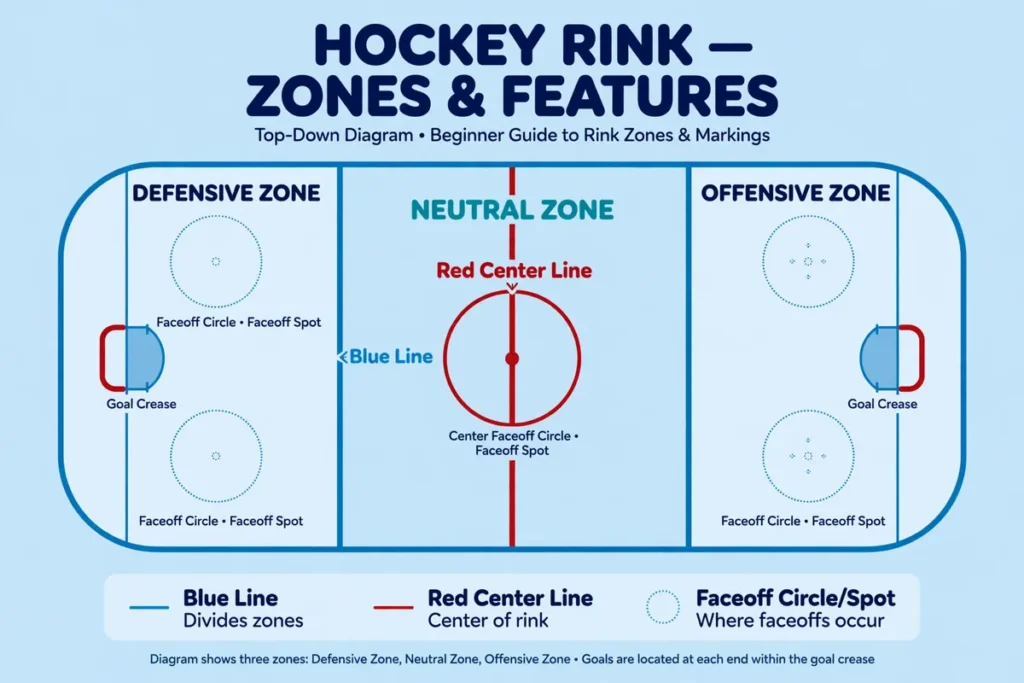
The rink is split into three zones by two blue lines. The middle section between the blue lines is the neutral zone. Each team’s defensive zone sits behind its own blue line, in front of its own net. The attacking zone is the other end, where a team tries to score.
At each end sits a goal, six feet wide and four feet tall. In front of each goal is a red crease, a half-circle painted on the ice. That is the goalie’s area.
There is a red line at center ice, which plays a role in icing calls. There are also nine faceoff spots painted on the ice: one at center ice, two in each end zone, and four in the neutral zone.
The boards around the rink are part of the game. Players bounce the puck off them on purpose, check opponents into them, and use them to keep the puck in the zone. Every sport has its own playing surface with its own lines and zones — if you have ever read a volleyball rules guide, you will recognize the idea.
How big is a hockey rink?
An NHL rink is 200 feet long and 85 feet wide. It has three zones — two end zones and a center neutral zone — separated by two blue lines, with a goal and a crease at each end.
Teams and Positions
Each team has six players on the ice at a time: one goalie and five skaters. The five skaters are three forwards and two defensemen. Teams also carry extra players on the bench and swap them in and out constantly.
Forwards
The three forwards are the center and two wingers, left wing and right wing. The center takes faceoffs and usually handles a lot of the playmaking. Wingers play along the sides and drive to the net. Forwards do most of the scoring, but they also have to backcheck when the other team has the puck.
Defensemen
The two defensemen play closer to their own goal. Their main job is to stop the other team’s forwards, block shots, clear the puck out of the defensive zone, and protect the goalie. Modern defensemen also jump into the attack, especially on the power play.
The Goalie
The goalie is the last line of defense and the only player allowed to use their hands to stop the puck, within limits. Goalies wear bigger pads, a wider stick, and a mask, and they play inside the crease. Goalies get pulled sometimes when the team is losing late and wants an extra attacker on the ice.
Line Changes
Here is something that surprises new fans: players change lines while the game is running. Hockey uses rolling substitutions, so a forward can hop over the boards and head to the bench while a teammate jumps on, all without a stoppage. A typical shift lasts 30 to 45 seconds, because skating at full speed is exhausting. Positions in hockey work a lot like softball positions in one way: every spot has a clear job, and the team falls apart when someone forgets theirs.
How many players are on the ice in hockey?
Six per team: one goalie, three forwards (a center and two wingers), and two defensemen. Teams rotate extra players on and off the ice during play in shifts that usually last 30 to 45 seconds.
Periods, Overtime, and the Clock
A hockey game has three periods, each 20 minutes long, with intermissions of about 15 to 18 minutes between them. The clock counts down and stops whenever play stops. Because the clock stops so often, a 60-minute game usually takes about two and a half hours in real time.
Between periods, the teams switch ends.
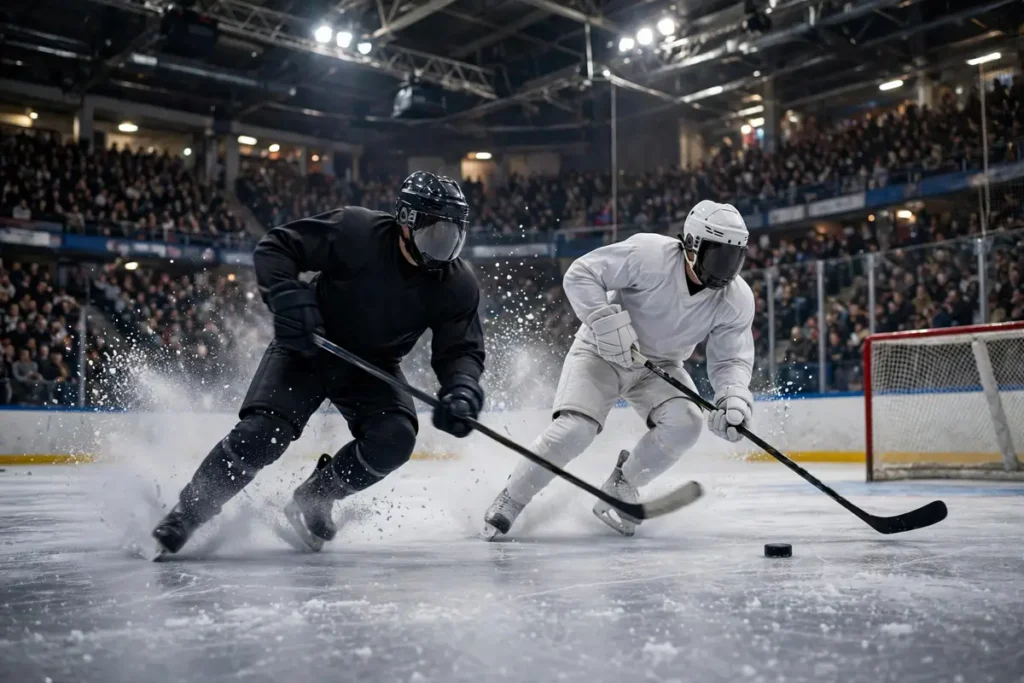
If the game is tied after three periods, it goes to overtime. In the NHL regular season, overtime is a five-minute period of 3-on-3 hockey, The first team to score wins, so it is sudden death. If nobody scores, the game goes to a shootout, where each team picks three shooters to take one-on-one shots against the goalie.
In the playoffs there is no shootout — teams play full 20-minute overtime periods until someone scores. A team that is losing late will pull its goalie for an extra attacker, gambling the extra skater is worth the empty-net risk. Check the NHL scores page for the latest results and upcoming games.
Faceoffs: How Play Restarts
Every period starts with a faceoff at center ice. Play also restarts with a faceoff after goals, penalties, icing, offside, and any other stoppage.
Two opposing centers stand on either side of a faceoff dot. The referee drops the puck between them, and both players try to win it — by pulling it back to a teammate or tying up the other center’s stick.
Where the faceoff happens depends on why play stopped. After a goal, it is center ice. After an icing call, it is in the offending team’s defensive zone. After a penalty, it is usually in the penalized team’s zone. Winning a draw in the attacking zone is a real scoring chance.
Centers practice faceoffs obsessively. A center who wins 55 percent of their draws instead of 45 percent gives their team a small edge dozens of times a game.
What is a faceoff in hockey?
A faceoff restarts play after a stoppage. Two centers stand at a faceoff dot, the referee drops the puck, and each tries to win it to a teammate. Faceoffs happen at center ice, in the end zones, or in the neutral zone depending on the stoppage.
Goals and Scoring
A goal counts when the puck fully crosses the goal line and goes into the net. That is the rule in its simplest form.
A goal does not count if it is kicked in, thrown in, or batted in with a hand. A player can deflect the puck with their stick or their body. A high stick above the crossbar that knocks the puck into the net does not count either.
Every goal is worth one — there are no two- or three-point goals. Assists are tracked too. Up to two players can be credited with an assist if they touched the puck in the sequence leading to the goal. Points are goals plus assists, and that combined number is how most forwards are judged.
One more scoring wrinkle new fans should know: the empty-net goal. When a team is losing late, it pulls its goalie for an extra attacker. If the other team gets the puck and shoots it into the empty net from far away, it counts just like any other goal.
Offside and Icing: The Two Whistles You Will Hear Most
Offside and icing cause more stoppages than anything else in hockey.
Offside
Offside happens when an attacking player crosses the blue line into the attacking zone before the puck does. The puck has to enter the zone first. If a player jumps the gun and enters early, the linesman blows the whistle, play stops, and there is a faceoff in the neutral zone.
Offside stops cherry-picking: without it, a forward could camp by the other team’s net waiting for a long pass.
Icing
Icing is called when a player shoots the puck from behind the center red line all the way down past the other team’s goal line, and the puck is not touched by anyone on the way. The play is whistled dead, and the faceoff comes back into the offending team’s defensive zone.
Without icing, a team under pressure could just fire the puck away every time things got tough. There are exceptions. If a team is killing a penalty, icing is allowed — shorthanded teams can clear the puck down the ice without punishment. If you have ever read a baseball rules guide, the idea will feel familiar — every sport has a rule like this that stops teams from stalling the game.
What is icing in hockey?
Icing is when a player shoots the puck from behind the red line past the opponent’s goal line without anyone touching it. Play stops and the faceoff moves to the icing team’s defensive zone. Shorthanded teams are allowed to ice the puck.
What is offside in hockey?
Offside is when an attacking player crosses the blue line into the attacking zone before the puck. Play stops and the faceoff moves to the neutral zone.
Penalties and Power Plays
Hockey is a physical sport, and the rules draw a line between hard, legal play and fouls. When a player crosses that line, the referee calls a penalty, and the player sits in the penalty box for a set amount of time while their team plays shorthanded.
The penalties you will see most often are tripping, hooking, slashing, holding, and interference. Tripping is knocking an opponent down. Hooking is using the stick to slow or grab an opponent. Slashing is swinging the stick at an opponent. Holding is grabbing a player or their stick. Interference is hitting a player who does not have the puck.
A minor penalty lasts two minutes. A major penalty lasts five minutes. A misconduct penalty lasts ten minutes but does not leave the team shorthanded, since another player can serve the time on the ice.
When a team has a player in the box, the other team gets a power play: a 5-on-4 advantage, or sometimes 5-on-3 if two opponents are penalized. The shorthanded team is on the penalty kill. Their job is to block shots, clear the puck, and run out the clock.
A minor penalty ends early if the power-play team scores. A major penalty does not end early, even if the other team scores twice. Penalties work a bit like fouls in other sports — a basketball rules guide covers the same idea — but in hockey the punishment is time on the bench and a man down on the ice.
Equipment: What Players Wear and Carry
Hockey players wear a lot of gear, and every piece has a job. The skates are the foundation — sharp steel blades that let players turn, stop, and accelerate on ice.
The stick is made of wood or composite material, with a flat blade at the bottom. Forwards use shorter, more curved sticks for shooting; defensemen use longer ones for reach. Goalies use a wider, heavier stick with a big paddle for blocking shots.
Protective gear includes a helmet, shoulder pads, elbow pads, gloves, shin guards, and padded pants. Goalies wear the heaviest gear: big leg pads, a chest protector, a blocker, a catching glove, and a mask.
The puck is a flat rubber disc, one inch thick and three inches across, weighing about six ounces. When a player shoots it well, it can travel over 100 miles per hour. That is why the glass is there.
How to Follow a Game
Watching hockey gets easier when you know what to look at. First, watch the puck, but do not stare only at it. The best play often happens away from the puck, so once you get comfortable, start watching the player without it.
Second, keep an eye on the score bug. It shows the score, the period, the time left, and how many players each team has on the ice. 5-on-4 means a power play is on; 6-on-5 late means a goalie has been pulled.
Third, learn the goalie’s name on your team. Goalies shape games more than any other single player.
Fourth, follow the scores around the league. You can check the NHL scores here, and the NBA scores, NFL scores, MLB scores, tennis scores, and MLS scores pages keep you caught up across sports. College fans can check the college football scores and college basketball scores pages too.
How do you follow a hockey game as a beginner?
Watch the puck, then start watching players without it. Check the score bug for the period, time left, and power-play situation. Learn your goalie’s name, and follow the standings night to night — the playoff race changes fast.
Beginner Tips for New Hockey Fans
Pick a team and stick with it. Fandom is more fun when you have a team to root for, and you will learn the game faster when you know the same players night after night.
Watch with someone who already knows the game, at least once. A friend who can explain a weird whistle in ten seconds will teach you more than an hour of reading.
Do not worry about the advanced stats yet. Goals, assists, saves, and the standings will carry you for your first season. The fancy numbers can wait.
Go to a live game if you can. Minor league and college games are cheap, the seats are close, and the speed hits differently in person. TV is great, but live hockey is a different sport.
Learn the rivalries — rivalry games have a different edge, with harder hits and louder crowds. Keep the sports calendar in mind: hockey shares the winter and spring with plenty of other events. The PGA Tour schedule, boxing schedule, UFC schedule, NASCAR schedule, and Major League Cricket schedule pages can help you plan your sports watching around hockey nights. If you ever want to see how the rest of the women’s game is going, the WNBA scores page is there too.
Hockey rewards patience. The first game feels fast and confusing; by the tenth, you will be yelling at the referee over an icing call like you have watched for years.
Frequently Asked Questions
How long is a hockey game?
A regulation game is 60 minutes of play, split into three 20-minute periods. With the clock stopping for whistles, a full game usually takes about two and a half hours.
How many periods are in ice hockey?
Three periods of 20 minutes each. If the game is tied after three periods, it goes to overtime. In the NHL regular season, overtime is five minutes of 3-on-3 sudden death, then a shootout if needed. Playoff games use full 20-minute overtime periods until someone scores.
What is the easiest way to learn ice hockey rules for beginners?
Watch a few full games with this guide nearby. Focus on the rink zones, offside, icing, and penalties first — those four things explain most stoppages.
Can players change during play in hockey?
Yes. Hockey uses rolling substitutions, so players swap on and off while the game is running. Shifts usually last 30 to 45 seconds.
What happens if a hockey game ends in a tie?
In the NHL regular season, a tied game goes to five minutes of 3-on-3 overtime, then a shootout. In the playoffs, there is no shootout — teams play full overtime periods until someone scores.
Why do hockey players fight?
Fighting is penalized with five-minute major penalties for both players in the NHL. Some fans see it as a way for players to police dangerous play and protect teammates; others think it has no place in the modern game. Either way, it is far less common now than it used to be.


















