


The Whole Game in Plain English
Baseball looks slow from the outside. A pitcher stares in, a batter wiggles his bat, and thousands of fans wait. Then the ball moves, and in two seconds everything changes — a swing, a sprint, a catch at the wall, a slide into home. Once you know what to watch for, the game stops feeling random.
This guide covers baseball rules for beginners from the ground up. No jargon without an explanation, no assumed knowledge, no need to memorize a rulebook before your first game. By the end you will know how innings work, what a strike really is, how outs are made, how runs score, what each position does, and which calls confuse new fans the most.
Baseball is a bat-and-ball game between two teams of nine players. The batting team scores runs by hitting the ball and running around four bases. The fielding team tries to get three outs to end the half-inning. A standard professional game lasts nine innings, and the team with the most runs wins.
What Is Baseball and How Do You Win?
Two teams take turns. One team bats, the other fields. The batting team sends one player at a time to home plate to hit the ball thrown by the pitcher. The fielding team spreads out across the diamond and the outfield, trying to catch the ball or throw it to a base before the runner gets there.
The goal is simple: score more runs than the other team. A run scores when a batter becomes a runner and touches first, second, third, and home plate, in that order, without being put out — while nine defenders and a hard-throwing pitcher try to stop him.
Each team gets the same number of chances to bat. Those chances are called innings, and they are the backbone of the sport. A game is not played against a clock. It is played until both teams have had their turns, which is why baseball can feel calm one minute and tense the next. A team behind in the ninth inning still has its final at-bats, and a single swing can change everything.
Baseball rewards patience. A batting average of .300 — three hits in every ten at-bats — marks an excellent player. Teams play for one run at a time and trust that pressure builds over nine innings. Give the game a full nine innings before you judge it.
If you follow other American sports, the rhythm will feel familiar once you settle in. Checking the latest MLB scores after a game is a good habit, and the same scoreboard logic you see in football or basketball applies here too, just without a game clock.
The Baseball Field: Diamond, Bases, and Outfield
The field is called a diamond, even though it is really a square turned on its corner. Home plate sits at one corner. First base is 90 feet away, second base is 90 feet past that, third base is 90 feet past that, and home plate is 90 feet past third. Those four points form the infield.
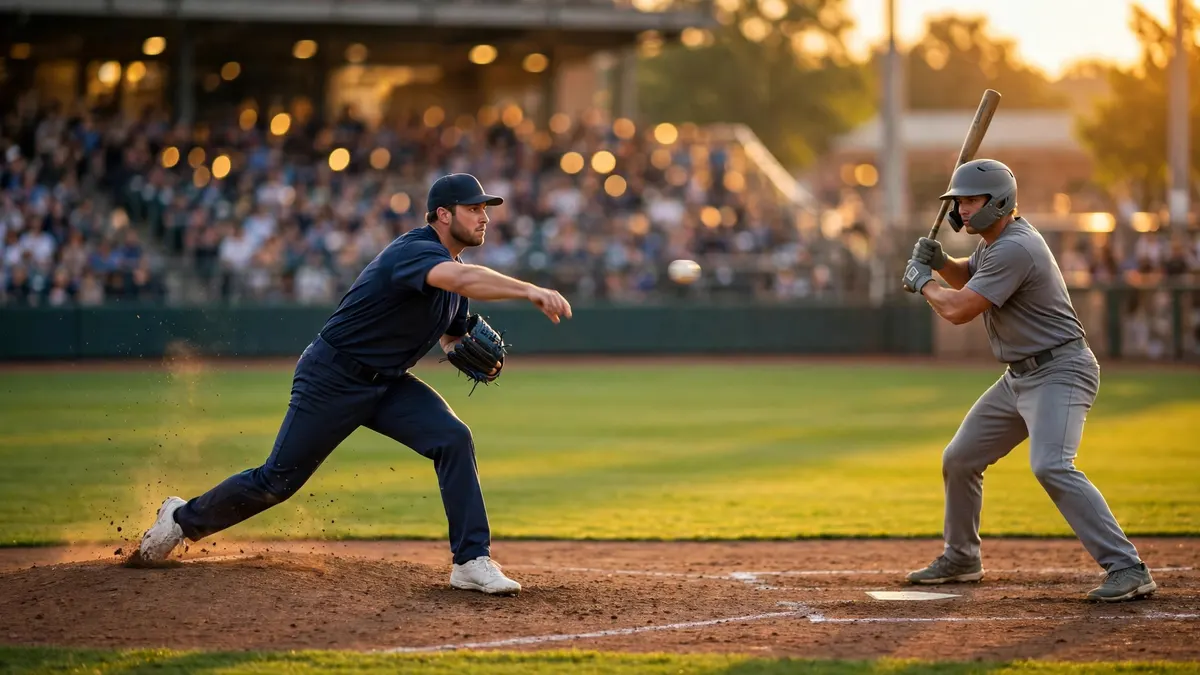
Inside the diamond sits the pitcher’s mound, 60 feet 6 inches from home plate. That distance gives a fast pitch just enough time to reach the batter, and it gives the batter just enough time — barely — to decide whether to swing. The mound is slightly raised, which helps the pitcher throw downhill and adds speed and movement.
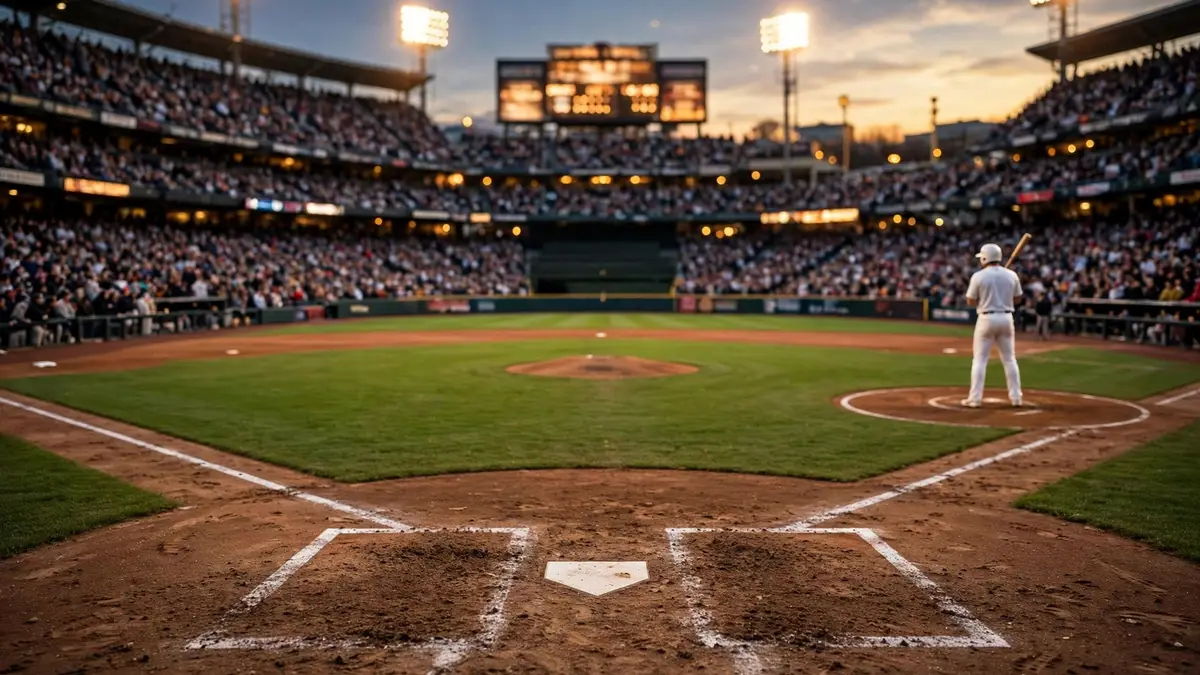
The baseball diamond has four bases 90 feet apart: home plate, first base, second base, and third base. The pitcher’s mound sits 60 feet 6 inches from home plate. The infield is the dirt area around the bases; the outfield is the grass beyond it, bordered by a wall or fence.
The infield is the dirt area around the bases; the outfield is the large grass area beyond it, patrolled by the left, center, and right fielders. Foul lines run from home plate past first and third base to the outfield wall. A ball hit inside those lines is fair. A ball hit outside them is foul, and in most cases it counts as a strike, not a live ball runners can advance on.
The outfield wall marks the boundary for home runs. If a fair ball clears it in the air, the batter and any runners on base all score. The distance varies from park to park, so a fly ball that is a home run in one stadium is a routine catch in another.
Innings: How a Baseball Game Is Structured
A standard professional baseball game lasts nine innings. Each inning has two halves. In the top of the inning, the visiting team bats and the home team fields. In the bottom of the inning, the teams switch. Each half-inning ends when the fielding team records three outs.
A baseball game has nine innings. Each inning has a top half and a bottom half. Each half-inning ends when the fielding team gets three outs. The visiting team bats first in the top of each inning; the home team bats in the bottom.
The home team bats last, which gives it a small edge. If the home team is ahead after the top of the ninth inning, the game ends — there is no need to play the bottom of the ninth. If the home team is behind or tied, it gets its final turn at bat, and a run in the bottom of the ninth can win the game on the spot. That walk-off moment, when the game ends the instant the winning run scores, is one of the most exciting finishes in sports.
Youth and amateur games are often shorter — six or seven innings is common. Some leagues use a run rule, sometimes called a mercy rule, to end a game early when one team leads by a large margin after a set number of innings. Professional major league games do not use a mercy rule.
If the score is tied after nine innings, the game goes to extra innings, with a runner placed on second base to start each half-inning in the major leagues to speed up the finish. Teams keep playing full innings until one team leads at the end of an inning. Rain can also shorten a game. A called game is official in the major leagues once five innings are complete, or four and a half if the home team is ahead.
Outs: The Three Ways a Half-Inning Ends
Three outs end a half-inning, and everything the defense does is aimed at collecting them. A strikeout happens when the batter collects three strikes. A flyout happens when a fielder catches a batted ball in the air before it touches the ground. A groundout happens when a fielder picks up a ball hit along the ground and throws it to first base before the batter-runner arrives.
A force out happens when a runner is forced to advance because the batter became a runner, and a fielder with the ball touches the base the runner must reach before the runner gets there. A tag out happens when a fielder touches a runner with the ball, or with the glove holding the ball, while the runner is not touching a base.

An out is recorded by a strikeout (three strikes), a caught fly ball, a throw beating the runner to a base, or a tag with the ball. Three outs end the half-inning, and the teams switch between batting and fielding.
The double play is the defense’s best friend. With a runner on first and fewer than two outs, a ground ball can turn into two outs on one play: a throw to second forces out the lead runner, then the relay to first retires the batter-runner. A triple play — three outs on one ball — is rare.
Runners are not out just because a fielder has the ball nearby. On a force play, the fielder must touch the base before the runner arrives. On a tag play, the defense must touch the runner with the ball. Watch for it on a fly ball with a runner on third: the runner waits for the catch, then sprints home, and the catcher must tag him if the throw arrives in time.
Strikes, Balls, Walks, and Strikeouts
The duel between pitcher and batter is the heart of baseball. The pitcher throws, the batter decides in a fraction of a second whether to swing, and the umpire behind home plate judges every pitch that is not swung at. The count — balls and strikes — tells you where that duel stands.
The strike zone is the area over home plate between the batter’s knees and the midpoint between his shoulders and the top of his pants. A pitch that passes through that zone and is not swung at is a strike. A pitch outside the zone that is not swung at is a ball. The zone is judged at the batter’s stance, so it is slightly different for a tall batter and a short one, which is why borderline pitches cause so much argument.
A strike is a pitch in the strike zone that is not hit, a swing and a miss, or a foul ball (with exceptions). A ball is a pitch outside the strike zone that the batter does not swing at. Three strikes is a strikeout; four balls is a walk to first base.
A swing and a miss is a strike, no matter where the pitch is. A foul ball — a ball hit outside the foul lines — also counts as a strike, except that a batter cannot strike out on a foul ball. If a batter already has two strikes, he can foul off as many pitches as he likes and stay alive. That is why long at-bats with foul ball after foul ball are so tense.
Three strikes and the batter is out. Four balls and the batter walks to first base, a base on balls. A walk is free, and it does not count as a hit, but it puts a runner on base and moves any forced runners up one base. Pitchers try to avoid walks because free runners tend to score. Batters with a good eye take close pitches, work the count in their favor, and wait for a pitch they can drive.
The count is always said as balls first, then strikes. A 3-1 count favors the hitter, because the pitcher must throw a strike or walk the batter. An 0-2 count favors the pitcher, because the batter must protect the plate and swing at anything close. A 3-2 count is a full count: the next pitch decides the at-bat.
A hit by pitch also sends the batter to first base, unless the umpire judges he leaned into it. The free base keeps pitchers honest about throwing inside.
Hitting, Running the Bases, and Advancing Runners
Once the batter puts the ball in play fairly, he becomes a batter-runner and sprints toward first base. If the ball is caught in the air, he is out. If it lands fair and stays in play, he tries to reach base safely before the defense can throw him out. A single means he reached first base. A double means he reached second. A triple means he reached third. A home run means he rounded all the bases and scored.
Runners already on base move up when they are forced to, or when they judge they can take an extra base safely. On a hit to the outfield, runners often advance one or two bases. On a ground ball with a runner on first, the runner must run to second because the batter is coming to first behind him. That forced movement is what makes double plays possible. With no runner behind him, a runner is not forced, and he can choose to stay or go.
A batter who hits a fair ball runs to first base. A single reaches first, a double reaches second, a triple reaches third, and a home run circles all four bases and scores. Runners advance on hits, walks, and some outs, and they must touch each base in order.
Stealing a base is one of the boldest plays in baseball. A runner takes off for the next base while the pitcher delivers, betting he can arrive before the catcher can throw him out. A successful steal puts a runner in scoring position — second or third, where a single can bring him home. A caught stealing is an out that kills a rally, so managers pick their spots.
Runners must touch each base in order, and they must retouch their base after a fly ball is caught before advancing — that is tagging up. If a runner leaves early and the defense appeals, he is out. You see it most with a runner on third and fewer than two outs: a deep fly ball is caught, the runner tags third and sprints home as the throw comes in.
A sacrifice is a deliberate out that moves a runner: a bunt lets the batter be thrown out at first while a runner advances, and a sacrifice fly is a deep caught ball that lets a runner tag up and score from third. Neither counts as an official at-bat. These small-ball tactics matter most in close games, where one run can decide it.
How Scoring Works: Runs, Hits, and Errors
A run scores when a player legally touches first, second, third, and home plate, in that order, and crosses home plate before the third out of the inning is recorded. If the third out is a force out, no run scores on that play, even if the runner crossed the plate first. If the third out is a tag play and the runner crossed home before the tag, the run counts. Like the points race you track in the NBA scores, the running total is what matters — but here every run is earned one base at a time.
A home run with no runners on is a solo shot, worth one run. With the bases loaded, it is a grand slam, worth four. A bases-loaded walk also forces in a run. The scoreboard shows runs, hits, and errors (R, H, E). An error is charged when a fielder mishandles a ball he should have handled. Errors do not count as hits, and a team can outhit its opponent and still lose if it strands runners on base when the third out is made.

The Nine Positions and What Each Player Does
Every team fields nine players, each with a number scorers use to record plays: pitcher (1), catcher (2), first baseman (3), second baseman (4), third baseman (5), shortstop (6), left fielder (7), center fielder (8), and right fielder (9). A play scored 6-4-3 means shortstop to second baseman to first baseman — a classic double play, written in numbers.
The pitcher throws from the mound and starts every play. The catcher crouches behind home plate, calls the pitches with hand signals, and throws out runners trying to steal. The first baseman catches throws from infielders. The second baseman and shortstop cover the middle infield and turn double plays. The third baseman, at the hot corner, reacts to hard-hit balls with very little time. The center fielder covers the most ground, and the right fielder usually has the strongest arm. Team sports all assign set roles this way — if you want the comparison, our guide to basketball rules for beginners shows how five positions share the court in a similar pattern.
In the major leagues, the designated hitter bats in place of the pitcher. Defensive shifts are now limited: two infielders must stand on each side of second base when the pitch is thrown.
Pitching Rules, Balks, and Common Penalties
The pitcher must start with both feet on the rubber and come to a set position before delivering. With runners on, the motion is shorter and quicker, and he is limited to two pickoff attempts or step-offs per plate appearance. Pitchers mix fastballs, curveballs, sliders, and changeups — throwing the same pitch in the same spot will get hit hard, no matter how fast it is.
A balk is an illegal motion that deceives the runners, such as starting a delivery and stopping, or faking a throw to first base. The penalty is automatic: every runner advances one base. Other common calls: interference, when a batter or runner illegally hinders a fielder, and obstruction, when a fielder without the ball blocks a runner. A pitch clock limits the time between pitches — 15 seconds with the bases empty, 20 seconds with runners on.
How to Follow a Game Like a Fan
Start with the scoreboard: inning, score, count, outs, and runners on base. That one line tells you almost everything. Then watch the count — a 3-1 count favors the hitter, an 0-2 count favors the pitcher, and a full count means the next pitch decides the at-bat. Watch the runners, not just the batter: a runner on second with one out is a scoring chance, and a runner on third with fewer than two outs can score on a deep fly ball.
Baseball is a daily sport in season, so following it becomes a routine. Many fans check the NFL scores, NHL scores, and MLS scores alongside baseball, and keep an eye on the boxing schedule, the UFC schedule, and the NASCAR schedule too. For more explainers and guides across every league, browse the Sports Flash Daily blog.
Frequently Asked Questions
How long does a baseball game last?
A nine-inning professional game usually lasts around two and a half to three hours. Extra innings, rain delays, and high-scoring games can make it longer.
How many innings are in a baseball game?
Nine innings in professional and college baseball. Youth games are often six or seven innings, and tied games go to extra innings until one team leads.
What is a strike in baseball?
A pitch through the strike zone that is not hit, a swing and a miss, or a foul ball. Three strikes is a strikeout. Four balls is a walk to first base.
How many outs are in an inning?
Three outs per half-inning. Each team bats once per inning, so a full nine-inning game has 54 outs in total.
What is a home run?
A fair ball hit over the outfield wall in the air, or a ball hit so far the batter circles all four bases. It scores the batter plus every runner on base. A grand slam, with the bases loaded, scores four runs.
Can a baseball game end in a tie?
Not in the major leagues. Tied games go to extra innings until one team leads at the end of an inning. Some amateur and youth leagues allow ties or use time limits.