





Basketball moves fast, and women’s basketball moves even faster. A ten-point lead can vanish in two minutes, and a game that looked settled at halftime can come down to one final possession. If you are new to the league, that speed can feel confusing. The numbers flash across your screen, the abbreviations look like a secret code, and everyone else seems to know exactly what just happened.
This guide covers what the WNBA is, how its season works, how to read a score line and a box score, where to follow games live, and what to watch once the ball goes up. No prior knowledge needed.
If you like learning a sport from the ground up, our blog has the same style of plain-English explainers for other leagues too.
What are WNBA scores?
WNBA scores are the live and final results of Women’s National Basketball Association games. A score line shows each team’s total points, usually broken down by quarter. You can follow them live on the league’s site and app, on major sports apps, and on TV broadcasts during the May-to-September regular season and the October playoffs.
What Is the WNBA?
The WNBA is the top professional women’s basketball league in the United States, and the most prominent women’s basketball league in the world. It was founded in 1996 and played its first season in 1997, with backing from the NBA. The 2026 season was the league’s 30th. It has grown from eight teams to a 15-team league with its own stars, its own rivalries, and a fan base that keeps growing.
That growth shows up in the league’s size. Golden State joined as the 13th team in 2025, and Toronto and Portland joined in 2026, taking the league to 15 teams. Three more franchises are already planned, in Cleveland, Detroit, and Philadelphia, which will bring the total to 18 by 2030. For a new fan, that expansion is good news: more teams means more games, more local rivalries, and more chances to find a team that feels like yours.
WNBA Teams and Conferences
Fifteen teams play in the WNBA, split into two conferences: seven in the East and eight in the West. The Eastern Conference is home to the Atlanta Dream, Chicago Sky, Connecticut Sun, Indiana Fever, New York Liberty, Toronto Tempo, and Washington Mystics. The Western Conference has the Dallas Wings, Golden State Valkyries, Las Vegas Aces, Los Angeles Sparks, Minnesota Lynx, Phoenix Mercury, Portland Fire, and Seattle Storm.
Conferences matter for the schedule and for the Commissioner’s Cup, the league’s in-season tournament, but they do not decide who makes the playoffs. Playoff spots go to the eight best teams in the whole league, regardless of conference.
How the WNBA Season Works
The WNBA season runs from May through September, with the playoffs stretching into October. Each team plays 44 regular-season games, 22 at home and 22 on the road, for 330 games across the league. Most teams play three or four games a week in the summer months, so there is almost always a game worth watching on any given night from late May onward.
The season has a few landmarks. It tips off in May, and the first weeks are about figuring out who is real: new rosters, new coaches, and rookies finding their feet. In the middle of the season comes the Commissioner’s Cup, an in-season tournament built out of selected regular-season games, with a Cup title and prize money on top of the regular-season record. The All-Star break lands in mid-summer, and the last month of the season is a race for playoff seeding.
The playoffs settle the season’s story. The top eight teams in the overall standings qualify, seeded one through eight by record alone. The first round is a best-of-three series, the semifinals are best-of-five, and the WNBA Finals are a best-of-seven series, a format the league moved to in 2025. The higher seed hosts the extra home game in each series, so finishing higher in the standings carries a real reward.
One change is already on the calendar: the regular season grows to 50 games per team starting in 2027. For now, 44 is the number to remember. You can check our NBA scores page for the men’s pro game in winter and spring, then switch to the WNBA when summer arrives.
How a WNBA Game Works
A WNBA game is played in four quarters of ten minutes each, for forty minutes of game time. That is the first big difference from the NBA, where quarters run twelve minutes. Forty minutes sounds short, but with stoppages, free throws, and timeouts, a game usually takes about two hours from tip-off to final buzzer.
The shot clock is 24 seconds, the same as the NBA. Once a team gains possession, it has 24 seconds to attempt a shot that hits the rim, and the clock resets to 14 seconds after an offensive rebound.
Scoring works the way you would expect if you have watched any basketball. A basket inside the three-point line is worth two points, a shot from behind the line is worth three, and a free throw is worth one. The WNBA three-point line sits 22 feet 1.75 inches from the basket at its farthest point, with shorter corner threes. Free throws come after shooting fouls, and they loom large in close games: late in a tight fourth quarter, the game often turns into a free-throw contest, and the team that makes its foul shots usually wins.
Fouls follow rules close to the NBA’s. A player fouls out after six personal fouls, and a team enters the bonus after five team fouls in a quarter, which means the other team shoots free throws on most fouls from that point on. Overtime is five minutes, and if the score is still tied, they play another five, as many as it takes.
If the rules of basketball itself feel new to you, our basketball rules for beginners guide walks through the full rulebook in plain English.

How to Read a WNBA Score Line
How do you read a WNBA score line?
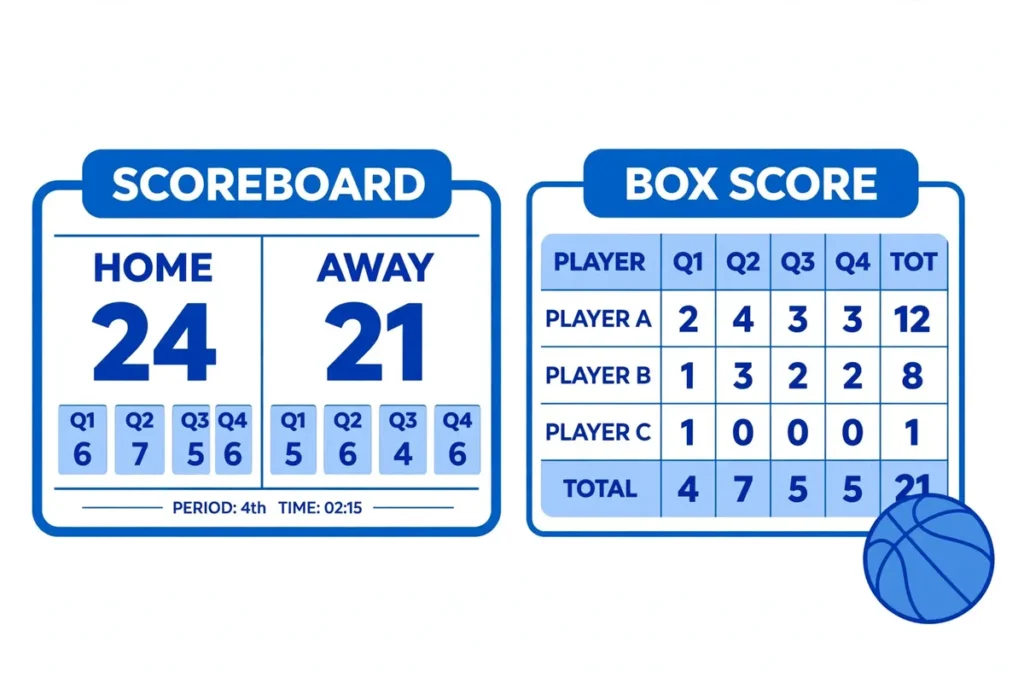
A score line lists the away team first, then the home team, with each team’s total points. Under each total you will usually see the score by quarter (Q1, Q2, Q3, Q4). “Final” means the game is over; “Q3 4:12” means the third quarter has 4 minutes and 12 seconds left. The team with the higher total wins.
The standard score line is simple once you know the pattern. The away team is listed first, on top or on the left, and the home team second. Each team has a total next to its name, and the winner’s total is higher. On most scores pages and apps, you will also see the quarter-by-quarter breakdown: four small numbers under each team’s total showing what they scored in each quarter. That breakdown is more useful than the final total on its own, because it tells the story of the game. A team that won the first three quarters and lost the fourth by two still won the game, but the quarter scores tell you it nearly slipped away.
Live scores add a clock and a quarter marker. “Q2 6:30” means the second quarter is in progress with six and a half minutes left on the game clock. “Halftime” means the first two quarters are done. “Final” means the game is over, and “Final/OT” means it went to overtime.
Standings are the other table you will see next to scores. W is wins, L is losses, PCT is winning percentage, and GB is games behind the first-place team. A team listed as 24-12 has won 24 games and lost 12. Streaks show up as W4 or L2, meaning four straight wins or two straight losses. Home and road splits tell you whether a team wins mostly at home or anywhere.
How to Read a Box Score
The box score is where a basketball game becomes a story in numbers. It lists every player who appeared, how long they played, and what they did. The columns look intimidating the first time, but you only need a handful of them to understand most of what happened.
Start with the basics. MIN is minutes played. PTS is points scored. REB is rebounds. AST is assists, the passes that lead directly to a basket. STL is steals, BLK is blocks, and TO is turnovers, the times a player gave the ball away. A player with 24 points, 11 rebounds, and 8 assists had a big night in every part of the game.
Shooting numbers come next, and they explain how a player got their points. FG is field goals made and attempted, written as something like 9-17, which means nine baskets from seventeen shots. 3P shows three-point shooting the same way, and FT shows free throws. A shooter who goes 5-8 from three had a hot night. A team that shoots 28% from the field as a group probably lost.
What is a good box score line in the WNBA?
A strong all-around game is around 20 points, 7 rebounds, and 5 assists, or a double-double: double digits in two categories, most often points and rebounds. Elite scorers can top 30 points on a hot night. For teams, shooting above 45% from the field, winning the rebound battle, and keeping turnovers under 13 usually means a win.
Where to Follow Games Live
You have more ways to follow the league than ever, and the best setup is usually a mix of two or three of them. The league’s own site and app are the natural starting point: live scores, schedules, standings, and stats all live there, and the app can send you alerts when your team tips off or when a game goes final. It is the most direct source, and it is free.
Major sports apps are the second piece. Apps like ESPN, theScore, and Bleacher Report carry live scores with play-by-play, box scores, and push alerts, and they let you follow several leagues in one place. You can check NFL scores on a Sunday, tennis scores during a Grand Slam, and the WNBA on a summer weeknight, all from the same app. Our MLB scores, NHL scores, and MLS scores pages cover the other big leagues in the same plain style.
TV is still where the biggest games live. National broadcasts carry marquee matchups and the playoffs, and local broadcasts cover most regular-season games for each team’s home market. Streaming has made this easier: league passes and sports streaming services carry out-of-market games, so you can watch any team even if you do not live in its city.
What to Watch During a Game
Watching basketball is more fun when you know what to look for beyond the ball going through the hoop. The first thing to track is pace. Some teams push the ball up the floor after every rebound and try to score before the defense sets up. Others slow the game down, run set plays, and grind out possessions. A fast team playing a slow team is a clash of styles, and the score line will tell you who imposed their pace.
Shooting is the second thing to watch. Threes have changed the women’s game just as they changed the men’s, and a team that gets hot from deep can erase a deficit in minutes. But watch how the threes come: open looks from ball movement are a good sign, while forced shots early in the clock are a sign a team is rattled. Free throws are the quiet decider. In a game that ends within five points, look at the free-throw line first. The team that made more of its free chances usually won.
Turnovers and foul trouble are the third thing. A team that turns the ball over 18 times is giving the other side 18 extra chances, and most of those turn into points. A star in foul trouble changes the whole shape of a game, because her coach has to choose between risking her sixth foul and sitting her while the game slips away. The minutes with a star on the bench are often where games are won or lost.
If you enjoy learning how other sports handle the same ideas, the patterns carry over. Our guides to volleyball rules for beginners and softball rules for beginners show how rotations and innings shape those games, and the ice hockey rules for beginners guide explains a sport where line changes play the same role as basketball’s bench.
Beginner Tips for Following the League
Pick one team first. Trying to follow all fifteen at once is a fast way to follow none of them well. Choose a team for any reason that feels right: your city, a player you liked in college, a style of play that caught your eye, or even just a jersey color you love. Learn its five starters, its coach, and its biggest rival. Once you have a home base, the rest of the league will make sense much faster, because every other team will be measured against yours.
Watch two or three full games before you form strong opinions. Highlights show you the big shots and the buzzer-beaters, but they skip the stretches that decide games: the defensive stands, the smart passes, the bench minutes. A full game teaches you how a team actually plays, and it teaches you the rhythm of the sport in a way that clips never will. After three games, you will know your team’s strengths, its weaknesses, and the players you trust in a close finish.
Learn five players who are not on your team. The league’s stars drive the storylines: the MVP race, the scoring title, the rookie of the year conversation, and the playoff matchups. Knowing the best players on other teams makes every game more interesting, because you will recognize the matchup problems they create.
Check the standings once a week, not once a night. The season is long, and one loss in June does not define a team. Weekly check-ins show you the real trends: who is climbing, who is fading, and which teams are fighting for the last playoff spots. The playoff race usually tightens in August, and that is when the standings become appointment viewing. If you also follow the men’s college game, our college basketball scores page is a good winter companion to the WNBA summer, and college football scores cover the fall.
Finally, talk about it. Basketball is better as a shared habit. Find a friend, a group chat, or an online community and argue about the MVP race, the playoff picture, and the best team in the league. The debates are half the fun, and they will teach you the league faster than any guide can, because someone will always disagree with you and show you something you missed.
FAQ
How can I follow WNBA scores live?
You can follow live scores on the league’s official site and app, on major sports apps like ESPN and theScore, and through TV broadcasts and streaming services. Most sports apps let you set alerts for your favorite team.
When does the WNBA season start and end?
The regular season runs from May through September, with each team playing 44 games. The playoffs follow in late September and run into October, ending with the WNBA Finals. The Commissioner’s Cup and the All-Star break both fall in the middle of the summer schedule.
How many teams are in the WNBA?
There are 15 teams, split into seven in the Eastern Conference and eight in the Western Conference. Toronto and Portland joined in 2026, and three more teams are planned in Cleveland, Detroit, and Philadelphia, which will bring the league to 18 teams by 2030.
How long is a WNBA game?
A game has four quarters of ten minutes each, for forty minutes of playing time. With stoppages, free throws, timeouts, and halftime, a full game usually takes about two hours. Overtime periods last five minutes each, and they repeat until someone wins.
How do WNBA playoffs work?
The top eight teams in the overall standings qualify, seeded by record regardless of conference. The first round is best-of-three, the semifinals are best-of-five, and the Finals are best-of-seven. The higher seed hosts the extra home game in each series, and there is no reseeding between rounds.
What is a double-double in basketball?
A double-double is when a player reaches double digits in two statistical categories in one game, most often points and rebounds, or points and assists. A triple-double means double digits in three categories. Both are signs of a big all-around performance.
Where can I find WNBA standings and stats?
Standings and stats are available on the league’s official site and app and on major sports apps during the season.


















