





Volleyball Rules for Beginners: What the Game Is All About
Volleyball is one of the easiest team sports to watch and one of the hardest to master. Two teams stand on opposite sides of a high net. The goal sounds simple: send the ball over the net so it lands on the other team’s side of the court, while stopping them from doing the same to you. Rallies are short and sharp, and a single point can turn on one great serve, one clean block, or one dive that keeps the ball alive.
The sport was invented in 1895 in Holyoke, Massachusetts, by William G. Morgan, who wanted a less physical alternative to basketball. It has grown into a global game played in schools, colleges, clubs, and parks, plus at the Olympic level for men and women.
What is volleyball? Volleyball is a team sport played across a high net. Each team tries to ground the ball on the opponent’s side of the court while preventing the opponent from doing the same. A team gets a maximum of three hits to return the ball over the net.
If you enjoy learning how one sport works, our sports blog has the same kind of plain-English guide for other games.
Volleyball Rules for Beginners: Court Size and Net Height
An indoor court is a rectangle 18 meters long and 9 meters wide, about 59 feet by 29.5 feet. A center line divides it into two equal halves, one for each team. An attack line sits 3 meters (about 10 feet) back from the net on each side and marks the front zone from the back zone. That line matters a lot for back-row players, as we will see when we get to positions.
The net stretches across the middle. For men’s volleyball, the top of the net is 2.43 meters high, or about 7 feet 11 5/8 inches. For women’s volleyball, it is 2.24 meters high, or about 7 feet 4 1/8 inches. Youth and recreational leagues often lower the net further.
How big is a volleyball court? An indoor volleyball court is 18 meters (59 feet) long and 9 meters (29.5 feet) wide. The men’s net is 2.43 meters high and the women’s net is 2.24 meters high.
The ball is in if it lands inside the lines, and out if it lands outside them — except that a ball touching a line is in, just like in tennis. If the court layout sounds like other net sports, that is no accident, and our tennis scores page shows how another net sport keeps score and decides close calls.
Teams and Positions on the Court
Indoor volleyball is played six against six. Each team has six players on the court, arranged in two rows of three: three front-row players near the net and three back-row players near the end line. The players rotate around the court in a clockwise direction, which the next section explains, so everyone takes a turn in each spot over the course of a set.
The six positions have names that describe where a player stands and what they do. The setter is the playmaker, taking the second touch and setting the ball up for an attacker. The outside hitter, also called the left-side hitter, usually gets the most sets and attacks from the left side. The opposite hitter attacks from the right and often blocks against the other team’s outside hitter. The middle blocker plays in the center of the front row, blocks a lot, and hits quick sets in the middle. The other spots are back-row roles filled by defensive specialists and the libero, a defensive player in a different-colored jersey covered in its own section below.
Front-row players can attack and block at the net. Back-row players cannot attack the ball above net height from in front of the attack line, and they cannot block. The idea of a specialist who only plays defense, or a playmaker who sets up everyone else, shows up in basketball too, and our beginner’s guide to basketball rules explains how roles work on a basketball court in the same plain style.
How Rotation Works
Rotation is the rule that confuses new fans more than any other. At the start of a set, each team lines up in a set order: six players in two rows of three, and that order stays fixed for the whole set. Whenever a team wins back the serve from the other team — called a side-out — the players rotate one spot clockwise before they serve. The player in the front-right spot moves to the back-right spot to serve, the back-right player moves to back-middle, and so on around the court.
What is rotation in volleyball? When a team wins back the serve, its players rotate one position clockwise. The player in the front-right spot moves to the back-right spot and serves. The rotation order stays the same for the whole set.
A team that is serving well can score several points in a row without rotating, because it keeps the serve as long as it keeps winning rallies. If you follow live scores in other sports, you will notice the same kind of momentum swings, and our live NBA scores page is a good place to see how a run can change a game in minutes.
Scoring: Rally Scoring, Sets, and Winning a Match
Volleyball uses rally scoring: a point is scored on every rally, no matter which team served. Under the old side-out system, only the serving team could score, and matches could drag on for hours. Rally scoring, adopted at the international level in 1999, made the game faster, fairer, and much easier to follow. Now every serve matters and every mistake costs a point.
A standard indoor match is best of five sets. The first four sets are played to 25 points, and a team must win by at least two points. If the score reaches 24-24, play continues until one team leads by two, so a set can end 26-24, 27-25, or even higher. If the match is tied at two sets each, a deciding fifth set is played to 15 points, again with a win-by-two rule. The first team to win three sets wins the match.
How does scoring work in volleyball? Volleyball uses rally scoring: a point is scored on every rally. Sets are played to 25 points (15 in a deciding fifth set), and a team must win by at least two points. A match is best of five sets.
For a new fan, watch the server and the set score together: a match that reads 2-1 in sets and 18-15 in points tells you the leading team is one set from victory. If you want to practice reading live scores, our live NFL scores page shows a running-total sport, and comparing the two helps the volleyball format click.
Serving Rules You Need to Know
Every rally starts with a serve. The server stands behind the end line, tosses the ball up, and hits it over the net into the opponent’s court. A serve that hits the net and drops on the server’s own side is a fault, and the other team gets the point. A serve that hits the net and trickles over is legal, as long as it lands in.
There are two main types of serve. The underhand serve is the classic beginner serve: the player holds the ball in one hand, swings the other hand in a pendulum motion, and hits the ball from below. It is easy to control, which is why coaches teach it first. The overhand serve is more powerful: the player tosses the ball up, swings over the top, and strikes it with the palm. Within the overhand family, the topspin serve dips and dives as it crosses the net, and the float serve barely spins and wobbles unpredictably in the air. At the highest level, many players use a jump serve, running up and jumping to hit the ball at the top of their reach.
What are the serving rules in volleyball? The server must stand behind the end line and hit the ball over the net into the opponent’s court. A serve that lands in, or hits the net and drops in, is legal. A serve into the net or out of bounds gives the point to the other team.
A few serving rules catch beginners out. The server has a limited time to serve after the referee whistles, usually about eight seconds. In baseball, the pitcher starts every play, and our beginner’s guide to baseball rules walks through it in the same step-by-step way.
The Three Hits: Pass, Set, and Spike
Each team is allowed a maximum of three hits to return the ball over the net. The classic pattern is pass, set, spike. The first hit is usually a pass, also called a bump or a dig. The second hit is a set. The third hit is usually an attack, most often a spike. A team does not have to use all three hits, but it cannot use a fourth. If it does, the other team gets the point.
The pass is the foundation. The receiving player joins their forearms together to form a flat platform and lets the ball bounce off it toward the setter. A good pass is soft, high, and right on target, giving the setter time and options. A bad pass flies off in the wrong direction, forces the setter to chase it, and turns a planned attack into a scramble. Coaches will tell you that volleyball is won and lost on passing, and they are right.
What are the three hits in volleyball? The three hits are the pass (or bump), the set, and the spike (or attack). A team may use up to three hits to return the ball over the net, and it cannot use a fourth.
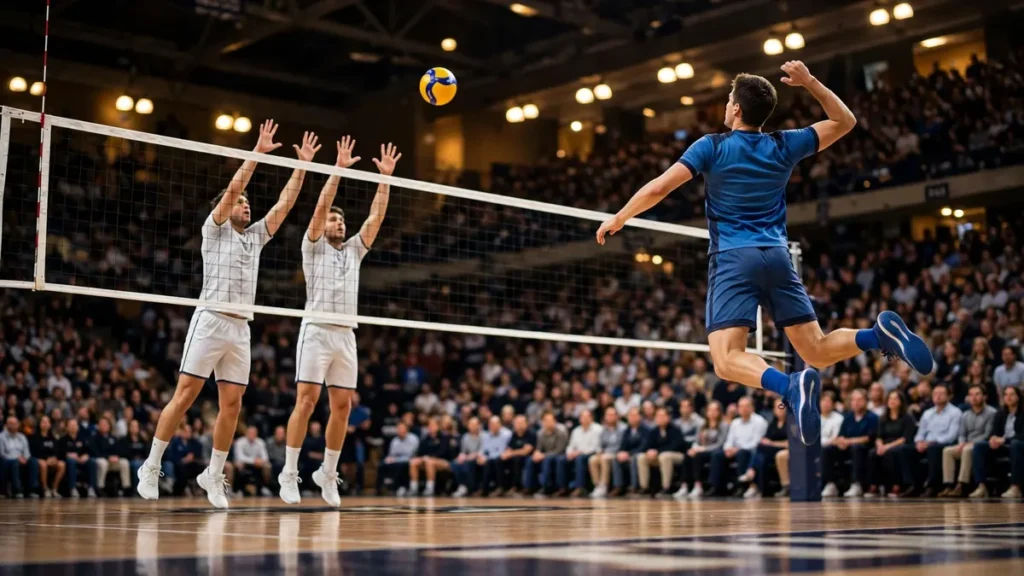
The spike is the third hit and the most spectacular. An attacker approaches the net, jumps, and hits the ball down hard into the opponent’s court, aiming at an open spot — the deep corner, the line, or the seam between two defenders. There is one more touch worth knowing: the block. A block does not count as one of the three hits, so a team still gets three hits after a block. If you want to see how another sport builds its attacks in stages, our guide to softball rules for beginners shows a different kind of team offense with its own rhythm and roles.
Faults and Violations: What Stops Play
A fault is any violation that ends the rally and gives a point to the other team. Common faults include hitting the ball out, a double hit, a lift or carry (letting the ball rest in the hands instead of rebounding off them), touching the top of the net while playing the ball, using more than three hits, and being out of rotation at the moment of the serve. A back-row player also faults by attacking above net height from in front of the attack line or by blocking. Line judges watch the lines, the first referee watches the net and the ball, and the second referee watches substitutions and rotation. If you are new to the sport, do not try to call every fault yourself — watch the referee’s signal and check which way the point went. The same approach works for learning any sport’s whistle: our beginner’s guide to ice hockey rules shows how penalties and stoppages work in a much faster, more physical game.
The Libero: The Player in the Different Jersey
The libero is a back-row defensive specialist who wears a different-colored jersey. The libero can replace any back-row player without counting as a substitution, and can come in and out freely between rallies. In exchange, the libero never plays in the front row, never attacks above net height, and never blocks. Liberos are usually the best passers and diggers on the team, and they are often shorter than the hitters around them. What they lack in height, they make up for in quickness and a willingness to dive. Watch the libero on serve receive: they usually take the biggest share of the court, because the team trusts them to pass the most serves. Every sport has a role like this — a player whose job is not to score, but to make scoring possible — and our live WNBA scores page is a good place to watch how defensive specialists shape a game usually described by its scorers.

Beach Volleyball vs Indoor Volleyball
Beach volleyball and indoor volleyball share the same roots, but they play like cousins rather than twins. Beach volleyball is played outdoors on sand, usually two against two, with no shoes, no substitutions, and the sun and wind as extra opponents. The beach court is smaller — 16 meters by 8 meters, compared with 18 by 9 meters indoors — and the net height is the same. Beach matches are usually best of three sets: the first two to 21 points, a deciding third to 15, all win by two. The rules on touches are stricter on the beach: an open-hand tip is not allowed, and sets must be cleaner. Beach is a great way to learn every skill, because you have to do everything; indoor is a great way to learn teamwork, because you play one role and trust the players around you. The same contrast shows up across sports, which you can follow on our live college basketball scores page.
How to Follow a Match
Start with the scoreboard: sets won, points in the current set, and who is serving. Then watch the serve, the first pass, and the set. A good pass and a good set usually lead to a good attack; a bad pass usually leads to a scramble. Next, watch the block — when the front-row players jump as a unit and seal the net, the attack has nowhere to go — and then the defense behind it, where digs keep the ball alive and stretch rallies out. Pay attention to timeouts and substitutions too: a coach who calls a timeout after the other team scores three points in a row is trying to break their momentum. Learn the common referee signals — in, out, net fault, double hit, four hits — and you will follow the whistle without waiting for the announcer. If you want to keep up with scores across sports while you learn, our live MLB scores page and live NHL scores page show how other sports present a live scoreboard.
Beginner Tips for Playing and Watching
Learn to pass first. Stand with your feet shoulder-width apart, knees bent, arms together, and let the ball come to you. Do not swing wildly — let the platform do the work and aim for the setter’s hands. Next, learn to serve underhand and get it over the net consistently; a serve that lands in is worth more than a powerful serve that lands out. When you play, talk to your teammates: call “mine” for balls you will take and “free” when the other team sends over an easy ball. Communication prevents collisions and makes the whole team faster. Watch a lot of volleyball, too: pick one player to follow for a whole set — the setter, the libero, or an outside hitter — and watch only them. If you are watching with friends who are new to the sport, share the simple version first: three hits, rally scoring, first to 25, win by two, best of five. You can also keep up with the wider sports world while you learn: our live MLS scores page and PGA Tour schedule page are good places to see how other sports structure a season.
Frequently Asked Questions
How long does a volleyball match last?
A typical indoor match lasts 60 to 90 minutes, though a five-set match can run longer.
How many sets are in a volleyball match?
An indoor match is best of five sets; the first team to win three sets wins.
Can you kick the ball in volleyball?
Yes, under most modern rule sets, a player can legally play the ball with any part of the body, including the foot, as long as the contact is clean and the ball is not caught or thrown.
What happens if the ball hits the net on a serve?
A serve that hits the net and drops over into the opponent’s court is legal, as long as it lands in bounds. A serve that hits the net and falls back on the server’s side is a fault.
Can a back-row player spike the ball?
Yes, but only from behind the attack line if the ball is above net height at contact. A back-row player cannot attack a ball above net height from in front of the attack line, and cannot block.
What is a rally in volleyball?
A rally is the sequence of play from the serve until the ball is dead — when it lands on the floor, goes out, or a fault is called. Under rally scoring, the winner of each rally scores a point, no matter which team served.


















