



College Basketball Scores
College basketball has a rhythm all its own. One night a ranked team cruises at home, the next night an unranked underdog hits a late three and the whole building erupts. If you are new to the sport, learning how to read college basketball scores will change how you watch. A final score tells you who won, but the live score, the halftime split, the foul count, and the pace tell you how it happened.
This guide is for fans who check their phone between errands, students following their school, and bracket fans who want context before March. You will learn how a college game is scored, how to follow a game live, how standings and rankings fit together, and what overtime really means. No single night defines a season: a team can lose in November, learn from it, and peak in March.
How the Scoreboard Works in a College Game
A Division I men’s game lasts 40 minutes, split into two 20-minute halves. Women’s Division I games use four 10-minute quarters, which still adds up to 40 minutes. The clock stops often — for fouls, timeouts, out-of-bounds plays, and free throws — so a game usually takes about two hours from tip-off to the final buzzer.
Points come in three sizes: two for a regular basket inside the arc, three for a shot from behind the three-point line, and one for a free throw after a foul. That simple setup creates most of the late-game drama. A team trailing by six can tie with two three-pointers, and a team leading by three can lose on a single shot.
The shot clock is 30 seconds: teams must attempt a shot that hits the rim in that time, or the other team gets the ball. That rule keeps the game moving, though smart teams still slow the pace when they have a lead late.
Fouls shape the score in a quiet way. Each player is allowed five personal fouls before fouling out. Team fouls build up across a half, and once a team reaches the bonus, the other side shoots free throws on most fouls. That is why a close game often ends at the free-throw line. A team that shoots free throws well can protect a lead; a team that struggles there can watch a lead vanish without the other side ever making a field goal.
How long is a college basketball game? A Division I men’s game is 40 minutes of playing time, split into two 20-minute halves. Women’s Division I games use four 10-minute quarters. With stoppages for fouls, timeouts, and free throws, most games take about two hours in real time.
Halftime is a natural checkpoint: the team ahead at the break is comfortable, not safe. See the basketball rules for beginners guide for fouls, violations, and positions in plain language.
Following College Basketball Scores Live
Dozens of games can tip off on the same night, and on a busy Saturday top-25 teams, conference rivals, and early-season tournaments all overlap. Pick your games first, then let the live scoreboard do the sorting: start with your school, a ranked matchup, or a rivalry game, and follow specific teams in your score app so their games rise to the top of your feed.
Live numbers update possession by possession, but the most useful ones move slowly: the margin, the time left, and the foul count. A five-point lead with two minutes left is real, but not safe. A ten-point lead with five minutes left is strong, yet teams have erased it with three-pointers and forced turnovers. The final four minutes are where most games are won or lost.
Pay attention to runs, not just the current score. A 10-0 run can flip a game in three minutes. If you see a team go from down eight to up four, something changed — a defensive switch, a hot shooter, or a star picking up fouls. Check the box score for who is scoring during the run.
What is the best way to follow a game live? Pick one or two games to track closely, follow your team so its score stays at the top of your feed, and watch the margin, time left, and foul count. Check the box score during timeouts to see who is scoring and who is in foul trouble.
Live win probability, shown on some score pages, is a handy shortcut, but treat it as a guide rather than a promise. A team at 90 percent with three minutes left is likely to win, while a team at 60 percent with ten minutes left is barely ahead. When several games finish around the same time, check the upset first — a ranked team losing on the road — then check your conference. The blog on this site rounds up the night’s talking points if you want a quick recap.
Reading Standings, Rankings, and the AP Poll
Standings and rankings measure two different things, and mixing them up is the most common mistake new fans make. Standings show wins and losses inside a conference. Rankings, like the AP Top 25, are a national opinion poll voted on by media members. A team can lead its conference and sit outside the Top 25, or be ranked in the top ten while sitting second in its own league. Both numbers matter, but they answer different questions, and that split shows up every week in college basketball scores.
Conference standings are the simplest read: wins and losses side by side, with home and road splits underneath. Road wins carry extra weight, because college crowds are loud, travel is tiring, and young teams often play differently away from home. A team that only wins at home may struggle when the conference tournament moves to a neutral court.
The AP Top 25 comes out weekly during the season. Voters rank teams from first to 25th, and points are awarded for each ballot position. The poll moves fast after a big weekend: a team that beats two ranked opponents can jump ten spots, while a ranked team that loses at home to an unranked opponent can fall out completely.
Neither poll decides who makes the NCAA Tournament. That job belongs to the selection committee, which uses its own metrics, including the NET rankings, strength of schedule, and quality wins. The NET, short for NCAA Evaluation Tool, ranks teams using game results, strength of schedule, scoring margin, and efficiency numbers. A win over a top-50 NET team is a quality win, and a loss to a team ranked outside the top 150 is a bad loss that the committee will remember.
Home, Road, and Neutral-Court Splits
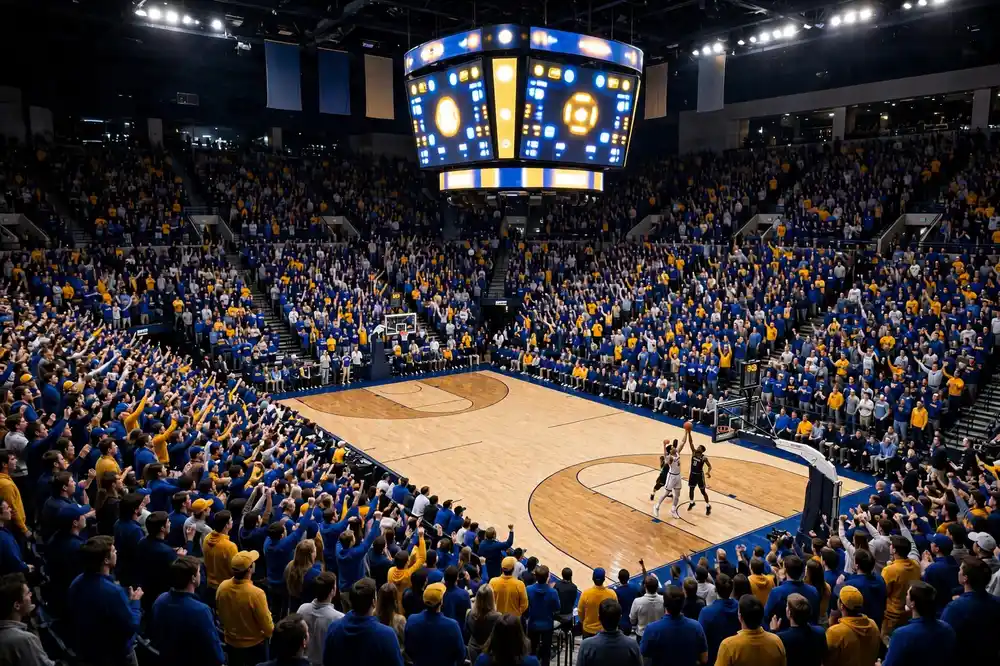
Splits tell you where a team actually wins. Home records are often strong, because students sit close to the court and crowd noise affects free throws. Road records separate good teams from great ones: a team that is 12-1 at home and 4-5 on the road has a real problem to fix before March, when every game is away from home. Neutral-court wins at early-season holiday tournaments also help a tournament resume, because they test teams on a level floor.
Conference Play and Tournament Seeding
Non-conference play in November and December is about testing and building a resume. Conference play, which usually starts around the turn of the year, is about survival. Teams play each other home and away in most leagues, and the standings tighten fast. A two-game swing in a week can move a team from first to fourth, and tiebreakers — head-to-head results, then record against the next-best team — decide seeding when records are equal.
Conference tournaments at the end of the regular season are a second season. Most leagues give the top teams a bye, while lower seeds have to win extra games. Winning a conference tournament usually earns an automatic bid to the NCAA Tournament, which is why a team with a losing conference record can still reach March Madness if it gets hot for four days.
Seeding inside a conference tournament matters more than it looks. The top seed plays the weakest surviving team, gets extra rest, and avoids the early rounds. The middle seeds face the hardest path, often playing on consecutive days against fresh opponents. When you check a final score in late February, ask what it did to the standings, not just who won. A road win that locks up a top-four seed and a double bye can matter more than a home win in November. Rivalry games deserve special attention, too: form and rankings often go out the window when two rivals meet. Fans who follow other sports will recognize the pattern — the rhythm of a conference race works much like the chase you see when checking college football scores in the fall, where one Saturday can reorder a whole division.
March Madness and the Bracket
March Madness is the NCAA Division I men’s basketball tournament, a 68-team single-elimination event that crowns the national champion; the women’s tournament follows the same 68-team format. Single elimination means every game can end a season. Lose once, go home. That is why the tournament produces so many upsets, and why a No. 15 seed beating a No. 2 seed can become part of the sport’s history.
The bracket is built by a selection committee on Selection Sunday. Thirty-two teams earn automatic bids by winning their conference tournaments, and the other 36 are at-large picks, chosen on resume: quality wins, strength of schedule, NET ranking, and record against top competition. Four teams play in the First Four to decide the final spots in the main bracket, which then runs through the first and second rounds, the Sweet 16, the Elite Eight, the Final Four, and the championship game.
Seeds run from No. 1 to No. 16 in each of four regions. A No. 1 seed is expected to win its early games, and historically most of them do, though a No. 16 seed has won before. The middle of the bracket — seeds five through twelve — is where the most chaos lives, and a No. 12 seed beating a No. 5 seed has become so common that fans watch those games first.
How many teams make March Madness? The NCAA Division I men’s and women’s tournaments each include 68 teams. Thirty-two earn automatic bids by winning their conference tournaments, and 36 are at-large selections. Four teams play in the First Four to fill the last spots in the main bracket.
Bracket context changes how you read a score in February. A team on the bubble needs wins that help its resume: beating a ranked team at home helps, while losing to a weak team at home hurts more than losing to a ranked team on the road. If you fill out a bracket, start with the matchups rather than the seed numbers, and look at pace, three-point shooting, and foul trouble. The same single-elimination tension shows up in other sports on this site, whether you are tracking a major league cricket schedule or a playoff race in the pros.
Overtime, Buzzer-Beaters, and Close Finishes
Overtime in college basketball lasts five minutes, and it repeats as many times as needed until someone leads at the end of a period. There is no sudden death, no shootout, and no tie. Teams start each overtime with the score carried over, and fouls carry over, too, which is why overtime often turns into a free-throw contest. A star with four fouls has to play carefully, and a team already in the bonus can send the other side to the line on almost any foul. That extra period can swing the night’s college basketball scores more than any single play in regulation.
Do not assume the team that forced overtime has the momentum. Sometimes a team that erased a late deficit carries that energy into the extra period; sometimes the team that blew the lead regroups, wins the tip, and scores first. Overtime is a fresh five minutes, not a reward for the comeback. Watch the first two minutes: the team that scores first and gets a stop usually controls the rest of it.
Buzzer-beaters follow a pattern worth knowing. A tied game with under ten seconds left usually ends with one team holding for the final shot. The offense wants a clean look — a three if it trails by two or less, or a drive if it needs two points — while the defense wants to force a tough shot without fouling. A foul in that spot is a gift: it stops the clock and sends a shooter to the line.
Close finishes also reveal a team’s free-throw shooting. In the final minute, the trailing team fouls on purpose to stop the clock and force free throws, hoping for a miss. That strategy, often called the foul game, can stretch the last 30 seconds of game time into ten minutes of real time. A team that makes its free throws closes the game out; a team that misses them invites chaos.
How long is overtime in college basketball? Overtime lasts five minutes, and extra periods repeat until one team leads at the end of a period. The score and fouls carry over from regulation, and there is no sudden-death rule.
That late-game tension feels familiar if you have ever tracked NBA scores on a busy night, and the women’s game brings the same drama, which you can follow through WNBA scores once the college season ends.
What the Numbers Behind a Score Tell You
A final score is the headline, but the box score is the evidence. Start with field-goal, three-point, and free-throw percentages. A team that shoots 50 percent from the field usually wins, unless it turns the ball over too much. A team that shoots 25 percent from three on a night when it took 30 threes probably lost because it kept shooting from deep instead of attacking the basket. Check attempts as well as makes: five-for-six from three is a hot night, while five-for-25 is a problem.

Turnovers are the next number to check. A turnover gives the other team a possession without a shot, and live-ball turnovers — steals that lead to fast breaks — are the most damaging kind. A team that turns it over 18 times and loses by 20 did not give itself a chance. Young teams, especially early in the season, often struggle with turnovers on the road.
Rebounds tell you who controlled the game physically. Offensive rebounds create second chances, and a team that grabs 15 offensive boards can win even on a poor shooting night. Check the rebound margin: a plus-10 margin usually means one team was bigger or tougher, while a minus-10 margin is a warning sign unless the coach fixes it.
Pace and Individual Lines
Pace is the hidden number behind many college basketball scores. A fast team might take 70 shots a game; a slow team might take 55, and both can score 75 points. A 78-72 final in a slow game featured efficient offense, while the same score in a fast game featured many possessions and missed shots. Individual lines matter, too: a starter who played 38 minutes and scored 24 points carried a heavy load, while a bench player who scored 15 in 18 minutes changed the game. The same habit works in every sport — see the PGA Tour schedule for golf’s slower rhythm, and tennis scores for nightly momentum swings.
Common Mistakes When Checking Scores
The first mistake is treating an early-season score as a final verdict. November games are played with new rosters, freshmen learning systems, and teams still finding their rotation. A top-ten team can lose in November and win the national title in April, and a team that starts 8-0 against weak opposition may not be tested yet. Give a team ten games before you decide what it is.
The second mistake is overreacting to a single blowout. A 30-point win over a weak opponent says more about the schedule than the team. A 30-point loss to a ranked team on the road says more about the matchup than the season. Look at the opponent, the location, and the context before you draw a line under a result. A blowout is useful data only when you know who it came against and where it was played.
The third mistake is checking only the final score. A 68-65 final could have been a wire-to-wire battle, a comeback from 15 down, or a game tied with a minute left and decided at the line. The final tells you the outcome; the halftime score, the run chart, and the box score tell you the game. That discipline applies across the sports calendar. Fans who check NFL scores on a Sunday know a blowout in September means less than a division win in December, and the same patience pays off in college basketball. Baseball fans learn the same lesson over a long season, and you can follow that grind through MLB scores once spring arrives.
Frequently Asked Questions
Where can I find live scores?
Most major sports sites and score apps carry live college basketball scores with play-by-play, box scores, and standings. Pick one that lets you follow your team, set alerts for close finishes, and check conference standings in the same place.
How do I read a box score?
Start with the final score, then check field-goal and three-point percentages, turnovers, rebounds, and free throws. Look at the leading scorers, who was in foul trouble, and which bench players made an impact.
What does AP Top 25 mean?
The AP Top 25 is a weekly poll of media voters who rank the best teams in the country. It reflects opinion and recent results, and it moves quickly after big wins and losses. It does not decide NCAA Tournament bids, which are chosen by the selection committee using resumes, NET rankings, and strength of schedule.
How does March Madness seeding work?
The selection committee seeds 68 teams from No. 1 to No. 16 in four regions, based on resume, quality wins, NET ranking, and strength of schedule. Higher seeds play lower seeds early, and one loss ends a team’s season.
Why do scores change so fast late in games?
The clock stops on fouls, timeouts, and free throws, and trailing teams foul on purpose to extend the game. A two-point game with 30 seconds left can include several possessions and free throws, so the score can swing several times in the final minute.
What is a good score to expect in a game?
Most Division I games land in the 65 to 80 point range per team, though slow, defensive teams can finish in the 50s and fast teams can reach the 90s. Pace, three-point shooting, and fouls all push the total up or down, so compare a score to the teams involved.