


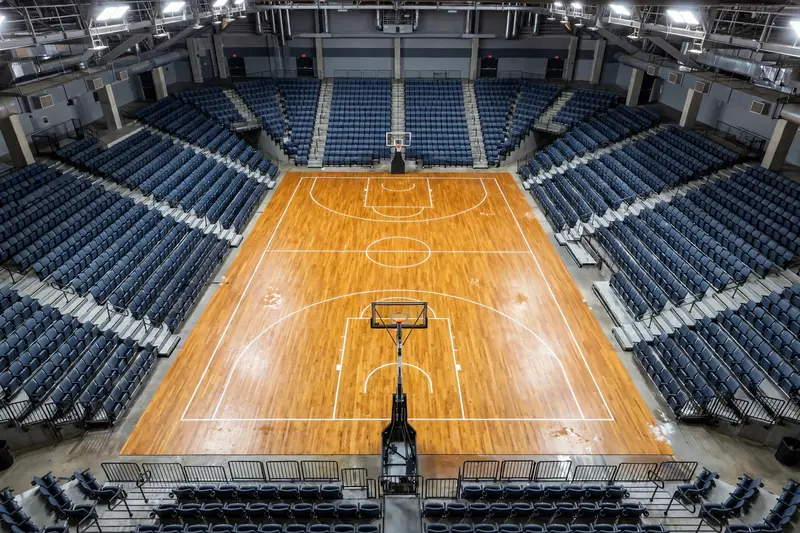
Basketball Court Dimensions: The Complete Guide to Court Size, Lines and Hoop Height
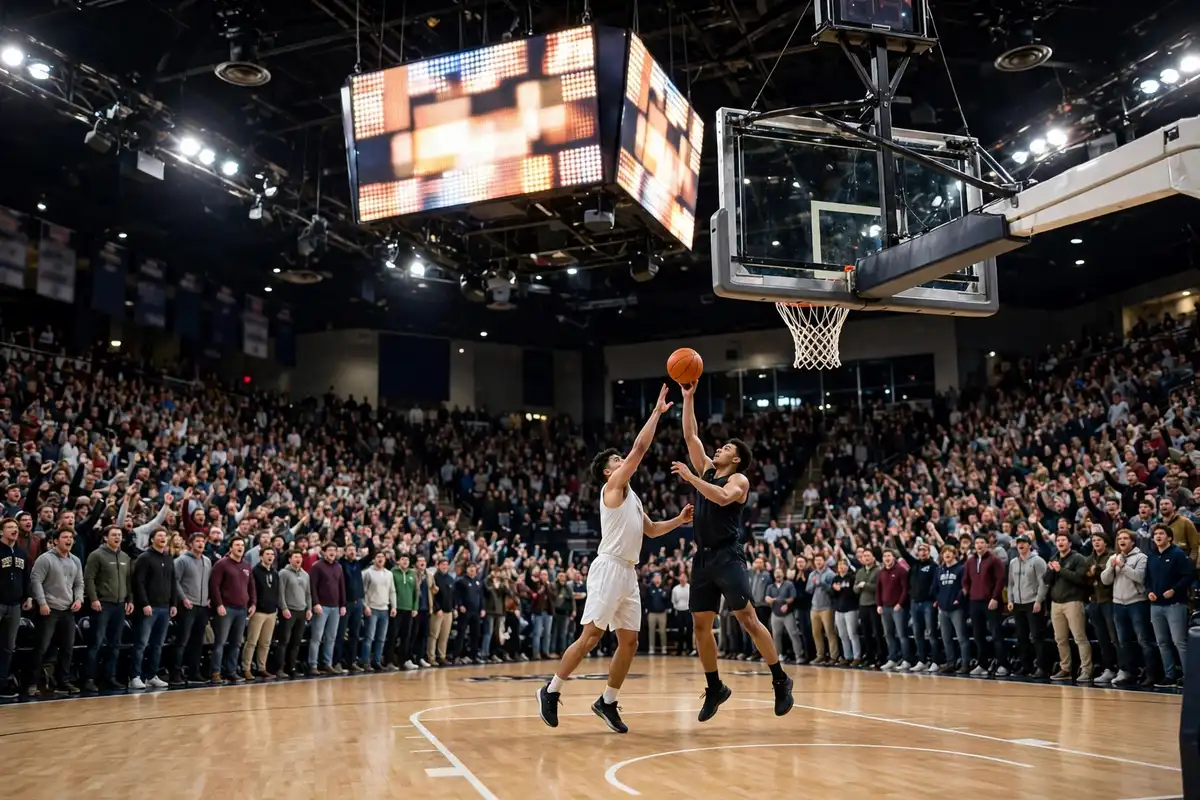
A basketball court looks simple from the stands. It is a flat rectangle, two hoops, and a set of white lines. Step onto the floor, though, and every line has a job. The sidelines set the playing area, the three-point line sets the value of a shot, and the lane shapes what happens near the basket.
Knowing those measurements helps players space the floor, helps coaches plan drills, and helps parents set up a safe court at home. This guide covers the standard sizes used at the top level and in high school, explains each line in plain language, and shows how courts change for younger players and smaller spaces.
How Big Is a Basketball Court?
There is no single size for every game. The game uses the same basic shape at every level, but the length changes with the age and level of the players. The width stays the same in the two most widely used American standards, which makes the court feel familiar even when it gets shorter.
An NBA court measures 94 feet from baseline to baseline and 50 feet from sideline to sideline. That is the largest court used in the major American game, and it is the size most fans see on television. A high school court under the National Federation of State High School Associations, known as NFHS, measures 84 feet long and 50 feet wide.
The ten-foot difference is easy to miss on screen, but it changes how much room players have in transition and how quickly a team can move from defence to attack. College courts in the United States use the same 94-foot length as the NBA. That shared length means a college player who moves to the professional game does not have to relearn the size of the floor.
Youth courts are different again. Many youth leagues use shorter courts, narrower lanes, and lower hoops so that younger players can shoot, pass, and run without the floor feeling too big for them. The goal at that age is learning, not copying the professional game line for line. The women’s game, followed on the WNBA scores page, uses the same basic floor at its own level.
Length and Width in Plain Terms
Length runs from one baseline to the other, along the direction of play. Width runs from one sideline to the other, across the court. On a 94-foot court, a player who sprints from one basket to the other covers a long distance in a few seconds.
The 50-foot width gives room for five players on each side to spread out, for a wing player to stand in the corner, and for a centre to work near the basket without stepping out of bounds. A court that is too narrow crowds the corners and turns every drive into traffic. If you measure a court for the first time, start with length, then width, and check that the corners form right angles.
Why the Court Is That Size
The size of the court grew with the game. Early basketball was played in smaller halls, often with low ceilings and little room around the edges. As players got taller, faster, and stronger, the court grew to give them room to run, jump, and shoot without constant collisions.
The size also shapes tactics. A long court rewards teams that run, because there is more ground to cover before the defence can set up. A wide court rewards teams that pass well, because the ball can move from one side to the other faster than a defender can. Watching the NBA scores over a week shows how different teams use that same space in different ways.
The Lines and Markings on a Court
Every line on a basketball court marks a boundary or a rule. Some lines tell you where the ball is in or out. Others tell you where a player can stand, where a shot is worth two points or three, and where a foul sends a player to the free-throw line.
The outer edge is formed by two sidelines and two baselines, also called end lines. The sidelines run the length of the court. The baselines run the width of the court, behind each basket. Together they form the rectangle that contains play. If a player steps on or over one of those lines while holding the ball, the ball is out of bounds.
Inside that rectangle, the court is split in half by the centre line, also called the half-court line. At the middle of that line sits the centre circle, where the game starts with a jump ball. From each basket, a set of lines radiates outward: the lane, the free-throw line, the three-point line, and the restricted area arc.
Sidelines and Baselines
Sidelines and baselines are the simplest lines on the court, and they are also the ones players touch most often. A sideline is the long edge. A baseline is the short edge behind the basket. Both are usually about two inches wide, though the exact width can vary a little by level and by facility.
Players learn to use the sideline as a guide. A wing player catches the ball with a foot near the line and knows at once how much room is left. A defender uses the sideline as an extra defender, pushing an attacker toward the edge where there is less space to move. Coaches warn young players to keep their feet in bounds on a catch, because a toe on the line is enough to lose the ball.
The Centre Line and Centre Circle
The centre line divides the court into a frontcourt and a backcourt. A team brings the ball up from its own basket, crosses the centre line into the frontcourt, and then tries to score. Once the ball has crossed into the frontcourt, it cannot go back across the centre line without a violation in most rule sets.
The centre circle sits at the midpoint of the court, on the centre line. In the NBA, the circle has a diameter of 12 feet. It is the spot for the opening jump ball, where two players jump for the ball tossed by the referee. After the opening tip, the circle is mostly a visual marker that players cross on every trip up the floor.
For a grounding in the rules that sit behind these lines, the basketball rules for beginners guide explains how the centre line, the shot clock, and the basic violations fit together in a real game.
The Free-Throw Line and the Lane
The free-throw line sits 15 feet from the backboard, in front of each basket. A player who is fouled while shooting stands behind that line and shoots free throws with no defender in the way. Each made free throw is worth one point.
The lane, also called the key or the paint, is the rectangular area between the free-throw line and the baseline, centred on the basket. Its width changes by level. In the NBA, the lane is 16 feet wide. In high school and college play in the United States, it is 12 feet wide. That four-foot difference changes how much room a centre has to work near the basket.
The lane is also tied to a timing rule. An offensive player cannot stand in the lane for too long without the ball. In the NBA, that limit is three seconds. In other rule sets, the limit and the exact wording can differ, but the idea is the same: the lane should not become a camping spot. Players learn to step in, make a move, and step out.
- The free-throw line is 15 feet from the backboard.
- The lane runs from the free-throw line to the baseline.
- The NBA lane is 16 feet wide.
- The high school and college lane is 12 feet wide.
- The free-throw circle extends beyond the line, into the court.
- Players line up along the lane for free throws, in set spots.
The Three-Point Line
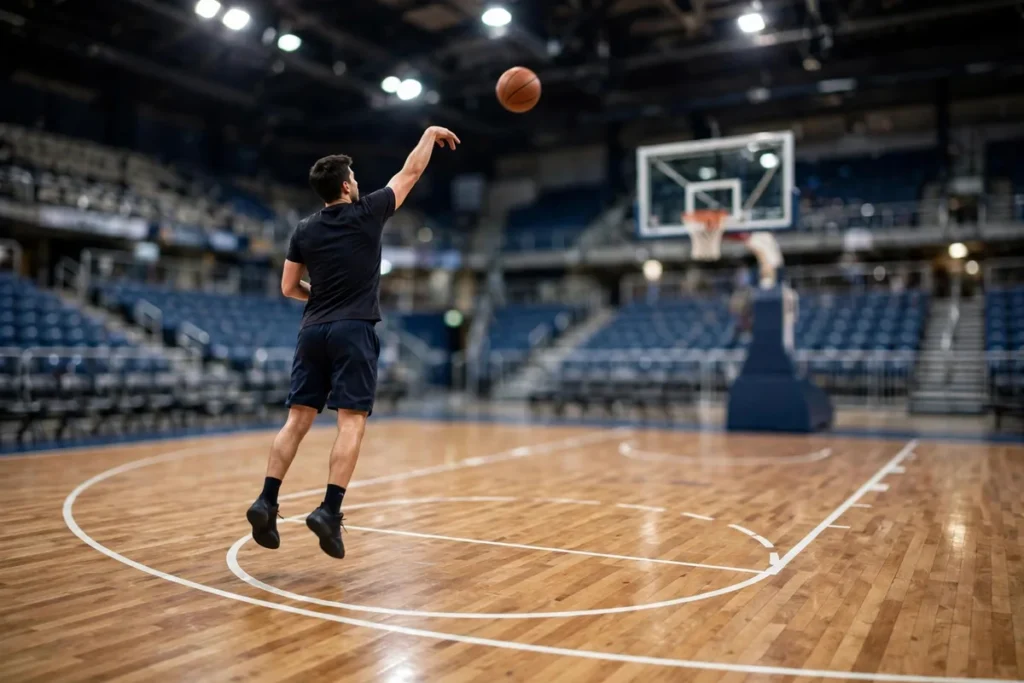
The three-point line is the arc that turns a long shot into three points instead of two. Any shot taken from behind that line, with the shooter’s feet behind it at the moment of release, is worth three points if it goes in. Any shot from inside the line is worth two points. That single difference has changed how the modern game is played, with teams shooting more from distance than ever before. Shooters who can hit from distance are also valued in NBA mock draft talk.
The distance of the three-point line changes by level. In the NBA, the line is 23 feet 9 inches from the basket at the top of the arc, and 22 feet from the basket in the corners, where the line runs straight for a short distance before it curves. In high school and college play, the line is closer to the basket. That shorter distance makes the three-point shot more reachable for younger and less strong players.
When you mark a three-point line at home, do not guess the arc. Measure from the centre of the basket, not from the backboard, and mark several points along the arc before you join them. A simple string, fixed at the centre of the basket and held taut, can trace a clean arc if you move it slowly and mark as you go.
The Restricted Area
Near the basket, a small arc marks the restricted area. In the NBA, that arc sits four feet from the centre of the basket. Inside that arc, a defender cannot draw a charging foul by standing still under the basket. The rule protects an attacking player who drives to the rim and stops a defender from sliding underneath at the last moment to take a charge.
Hoop Height, Backboard and Rim
The hoop is the target of the game, and its height is the same at almost every level of adult play. The rim sits 10 feet above the floor. That height has been standard for a very long time, and it is one of the few measurements that does not change between the NBA, college, and high school.
The backboard sits behind the rim and gives shooters a surface to bank the ball off. In the NBA, the backboard is 72 inches wide and 42 inches tall. That is six feet wide and three and a half feet tall. The rim is attached to the backboard and extends out over the court. The rim itself is 18 inches in diameter, which is just wide enough for two basketballs to pass through side by side.
The Rim and the Net
The rim is a metal ring, 18 inches across, with a net hanging below it. The net does not affect the score, but it slows the ball as it drops through, so the ball does not bounce far away and the shot is easy to see. A net that is tangled, torn, or missing changes the feel of a made basket.
Rims come in two main types. A fixed rim is bolted firmly to the backboard and does not move. A breakaway rim flexes down when a player dunks and then springs back into place. Breakaway rims are standard in most gyms, because they reduce the force on the backboard and on the player’s hands. The net itself is usually made of cord or chain.
For a closer look at the part of the hoop that players see every time they shoot, the guide to a basketball basket net covers net types, sizes, and simple fixes for a net that will not hang straight.
How High Should the Hoop Be for Kids?
The 10-foot hoop is standard for adults, but it is too high for most young children. A child who cannot reach the rim will develop a flat, pushed shot that is hard to unlearn later. Youth leagues therefore lower the hoop for younger age groups. Common youth heights are eight feet for the youngest players and nine feet for older children, though the exact height varies by league.
A portable hoop with an adjustable height is the best choice for a family court. It lets the hoop grow with the child, from eight feet up to ten feet as strength and skill improve. Set the height, check it with a tape measure from the floor to the top of the rim, and lock it in place before play starts. The ball size should change with the hoop height and the age of the player.
A good starting point for families is a junior rubber basketball that suits smaller hands, paired with a hoop set at a height the child can reach with a proper shooting motion.
How Courts Differ by Level of Play
Courts differ by level, but the differences follow a pattern. Higher levels use longer courts, wider lanes, and longer three-point lines. Lower levels use shorter courts, narrower lanes, and shorter three-point lines. Youth levels add lower hoops and smaller balls.
The table below sums up the standard sizes that are most widely used in the United States, so you can compare them at a glance. It is a useful reference to keep beside you when you walk into a new gym and want to know what level of play it was built for.
| Level | Court length | Court width | Hoop height | Lane width |
|---|---|---|---|---|
| NBA | 94 feet | 50 feet | 10 feet | 16 feet |
| College | 94 feet | 50 feet | 10 feet | 12 feet |
| High school (NFHS) | 84 feet | 50 feet | 10 feet | 12 feet |
| Youth | Shorter, varies by league | Often narrower | 8 to 9 feet for younger players | Narrower, varies by league |
High School and College Courts
A high school court is 84 feet long and 50 feet wide, with a 12-foot lane and a 10-foot hoop. That shorter length fits the school gyms that were built long before the professional game settled on 94 feet. It also suits younger players, who have less stamina and less speed than professionals.
A college court is 94 feet long, like the NBA, but with a 12-foot lane and a shorter three-point line. That mix gives college players the full length of the professional floor, while keeping the paint a little narrower and the three-point shot a little more reachable. A college player who moves to the NBA will find the lane wider and the three-point line farther away. A college programme such as Utah Tech basketball plays on a court built to that college standard.
Following the college basketball scores alongside the professional game shows how the same 94-foot length can produce a different style when the players are younger and the three-point line is closer.
How to Mark a Court at Home
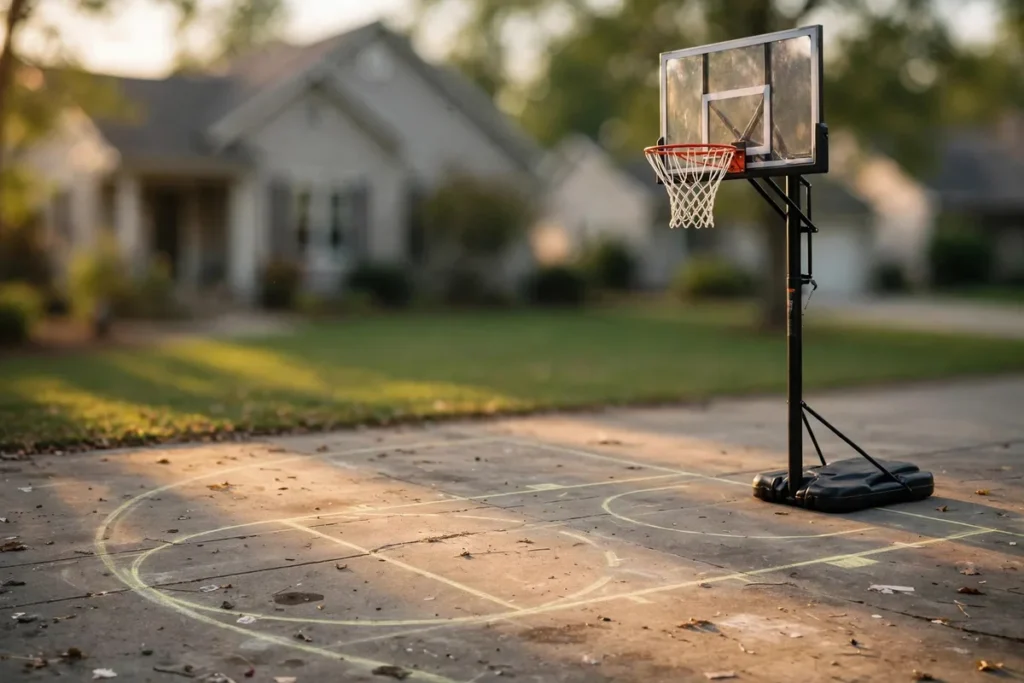
Marking a court at home does not need professional equipment. It needs a flat surface, a long tape measure, chalk or paint, and a little patience. The most common home court is a driveway or a backyard slab with a portable hoop at one end. A half court is enough for shooting practice, one-on-one, and small games. Other indoor games use their space in a similar way, as the positions in volleyball guide shows.
Start by choosing the flattest part of the surface. A driveway that slopes toward the street will make the ball roll, and a backyard slab with cracks will make the bounce uneven. Clear the area of cars, bikes, toys, and loose stones. Measure the space you have, and decide whether you are marking a half court or a smaller practice area.
Measure the free-throw line first. It should be 15 feet from the backboard, measured along the ground from the face of the backboard. Mark it with chalk, then mark the lane. The lane for home use is often 12 feet wide, centred on the basket, running from the free-throw line to the baseline. Mark the three-point arc last, using a string from the centre of the basket to trace the curve.
- Choose a flat, clear surface with room behind the basket.
- Measure the free-throw line 15 feet from the backboard.
- Mark the lane 12 feet wide, centred on the basket.
- Trace the three-point arc with a string from the basket centre.
- Use chalk first, then paint once the lines are right.
- Leave a clear run-off area behind and beside the court.
Frequently Asked Questions
How long is a basketball court?
A standard NBA court is 94 feet long. A standard high school court in the United States is 84 feet long. College courts are 94 feet long, like the NBA. Youth courts are shorter, and the exact length varies by league and by age group.
How wide is a basketball court?
A standard NBA, college, and high school court is 50 feet wide. That width gives room for five players on each side to spread out, for corner shooters, and for post play near the basket. Youth courts are often narrower, to suit younger players and smaller spaces.
How high is a basketball hoop?
A basketball hoop is 10 feet high at the NBA, college, and high school levels. The height is measured from the floor to the top of the rim. Youth leagues use lower hoops, often eight or nine feet, so that younger players can shoot with proper form.
How far is the three-point line?
In the NBA, the three-point line is 23 feet 9 inches from the basket at the top of the arc, and 22 feet from the basket in the corners. In high school and college play, the line is closer to the basket. The exact distance varies by level, so check the rules for the game you are playing before you mark the line.
How wide is the lane in basketball?
In the NBA, the lane is 16 feet wide. In high school and college play in the United States, the lane is 12 feet wide. The lane runs from the free-throw line to the baseline, centred on the basket, and it is the area where the three-second rule applies to offensive players.
Can I mark a basketball court at home?
Yes, you can mark a half court at home on a flat driveway or backyard slab. Measure the free-throw line 15 feet from the backboard, mark a lane 12 feet wide, and trace the three-point arc with a string from the centre of the basket. Use chalk first, then paint once the lines are right, and leave a clear run-off area around the court for safety.
A court is more than a set of numbers. It is the space where the game happens, and knowing its size helps you play it better. Whether you are learning the game, coaching a youth team, or marking a court in your driveway, start with the standard sizes, learn the lines one by one, and check your measurements before you play.
For a final check on the wider basketball calendar, the NBA scores page is a good place to see how teams use the full 94-foot floor night after night.
The college basketball scores page shows the same length in the college game, with its own lane and three-point distances shaping the play.