


Volleyball Bracket Explained: How Tournaments Work
A volleyball bracket is the map of a tournament. It shows who plays whom, when each match happens, and what a team must do to reach the final.
Brackets look crowded at first glance, with lines running in every direction. The logic behind them is simple, though. Teams are placed in a set order, winners move forward, and losers either go home or drop into a second path, depending on the format. Learning that logic turns a confusing chart into a clear story.
If you are new to the sport itself, a quick look at the basic rules helps before you study brackets. Our guide to volleyball rules for beginners covers scoring, rotations, and the rally system that decides every match on the bracket.
Quick Answer: A volleyball bracket is a chart that pairs teams for each round of a tournament. In a single-elimination bracket, the winner of each match advances and the loser is out. Seeding places the strongest teams apart early, pool play can sort teams before the bracket starts, and byes let some teams skip the opening round when the field is not a power of two.
What a Volleyball Bracket Shows
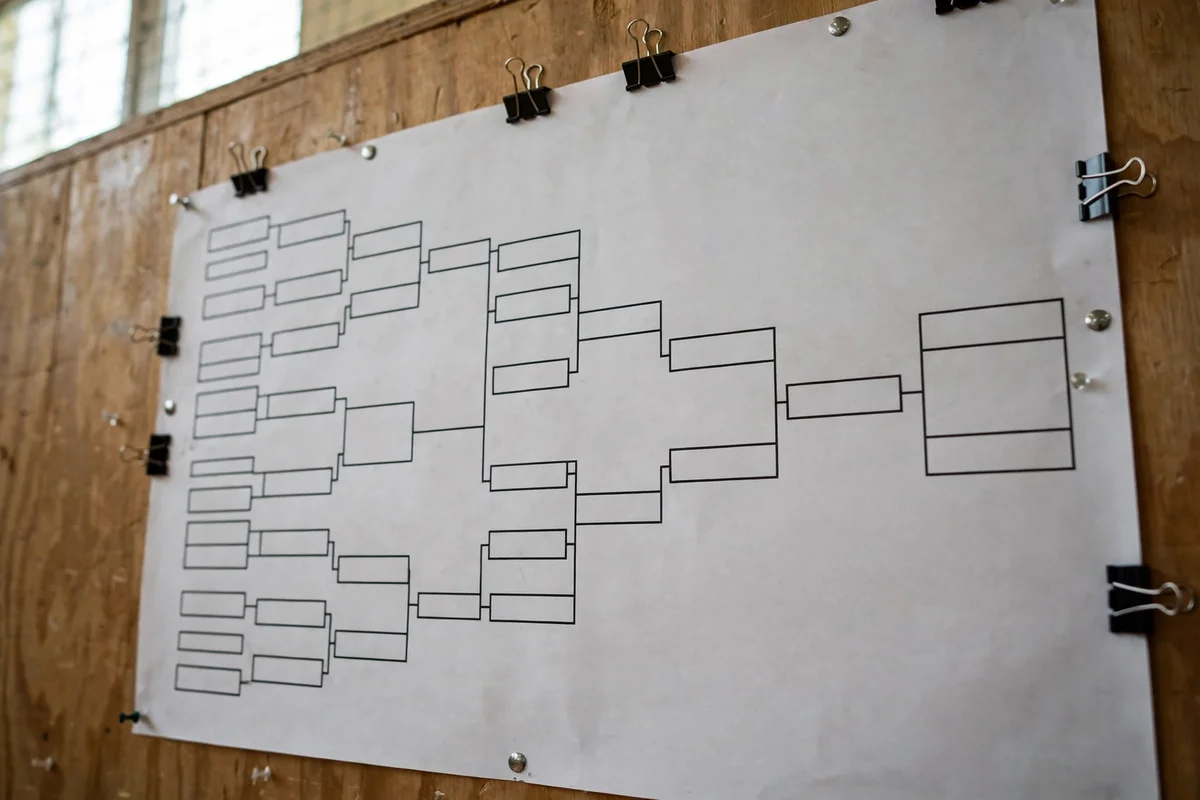
A bracket is a visual schedule. Each box holds a team name, each line connects one match to the next, and the flow runs toward the championship match.
The Parts of a Bracket
Every bracket shares the same basic parts, even when the design changes from one event to another. The opening round sits on one side, later rounds sit closer to the final, and the championship match sits at the far end of the chart.
- Match boxes: Each box, or pair of boxes joined by a line, stands for one match between two teams.
- Round labels: Labels such as first round, quarterfinals, semifinals, and final tell you how far a team has gone.
- Advancement lines: Lines carry the winner of one match into the next box, so you can trace a team’s path.
- Seed numbers: Small numbers beside team names show each team’s rank in the field, with 1 as the top seed.
- Scores and times: Many brackets add the score, the court, and the start time once a match is played or scheduled.
Reading a Bracket From Start to Finish
Start at the opening round and follow one team. Find its first match, check the opponent, then follow the line forward to see who the winner would meet next.
Reading the whole bracket works the same way, round by round. The first round feeds the second, the second feeds the quarterfinals, and so on until two teams remain. A team that keeps winning moves one step closer to the final with each match.
Single Elimination: The Most Common Format
Knockout drama is not unique to volleyball, and fans of the gridiron will recognise the same tension in our NFL scores coverage.
Single elimination is the format most fans meet first. Win and you stay in the tournament. Lose once and your run ends. That simple rule gives every match real weight.
How Single Elimination Works
The field is cut in half each round. Sixteen teams become eight, then four, then two, and a team needs four straight wins to take a sixteen-team bracket.
- Every match is a knockout match, with no second chance after a loss.
- The bracket is drawn before play starts, so teams know their possible path in advance.
- The final is the last match left, between the two teams that have won every match so far.
- A third-place match is sometimes added, so the two semifinal losers play once more for third place.
Strengths of Single Elimination
Single elimination is fast, dramatic, and easy to follow. It fits a weekend event, it keeps the schedule tight, and it gives underdogs a clear shot at a famous upset. One strong performance can change the whole tournament.
The format also suits spectators. Each round matters, the field shrinks quickly, and the final feels earned because both teams survived every test. Fans who follow other knockout sports will find the rhythm familiar, since the same win-or-go-home logic drives the late rounds of many events, including the closing stages covered in our college basketball scores coverage.
Weaknesses of Single Elimination
The main weakness is harshness. A strong team can draw a tough opponent early, have one poor set, and go home without a second match. A single bad day can end a season of good work.
Organizers sometimes soften this with seeding, so the top teams are kept apart in the early rounds. Seeding cannot remove luck entirely, though. An upset in one corner of the bracket can still open a new path for a team nobody expected to reach the final.
Seeding: How Teams Are Placed in the Bracket
Seeding is the ranking that decides where each team starts. The best team is the number one seed, and good seeding spreads the strongest teams across the bracket.
How Seeds Are Decided
Seeding debates happen in every sport, and the same arguments about fair draws appear in our tennis scores pages.
Seeds usually come from results before the tournament, such as a league table, qualifying matches, or a points ranking. The exact method changes by event, but the aim stays the same: rank teams by strength.
- League position is the most common source, with the top team taking the top seed.
- Head-to-head results can break ties between teams with the same record.
- Recent form may count when teams have played different opponents.
- A committee or draw may settle the last few places in invitation events.
The Standard Seeding Pattern
In a standard bracket, the top seed meets the lowest seed in the first round. The second seed meets the second-lowest seed, and the pattern continues through the field. The idea is that the two best teams should only meet in the final if both keep winning.
That pattern also protects the middle seeds. A mid-ranked team faces a beatable opponent first, with a harder test waiting in the next round. The draw rewards a good season with a kinder opening match, which is one reason teams fight for league position right to the end of the regular season.
Pool Play Before the Bracket
Many volleyball tournaments do not start with a bracket. They start with pool play, where teams are split into small groups and play each other before the knockout rounds begin.
How Pool Play Works
Each pool holds three to five teams. Every team plays the others, usually once, and the top teams move into the bracket while the rest go home or drop into a consolation event.
- Pools give every team several matches, even if it loses the first one.
- Pool results decide the seeds for the bracket, so a strong pool run earns a better draw.
- Tiebreakers such as sets won, points difference, or head-to-head results settle teams level on wins.
- Pools can run on several courts at once, which suits large events with many teams.
Why Organizers Use Pools
Pool play also appears in other team sports, and our guide to softball rules for beginners explains a sport with a similar group-stage feel.
Pools solve two problems at once. They guarantee teams a fair number of matches for their entry and travel, and they sort the field so the bracket seeds reflect current form rather than an old ranking.
Pools also help organizers handle big fields. A sixty-team event cannot run a single sixty-team knockout bracket cleanly, but twelve pools of five teams can feed a tidy bracket of the top finishers. The structure scales up without losing its shape.
Byes, Field Size, and Bracket Math
Not every tournament has a neat field of 8, 16, or 32 teams. When the number does not fit, organizers use byes to make the bracket work.
What a Bye Means
Byes reward strong regular seasons in many leagues, and the same idea shapes the weekly picture in our MLB scores coverage.
A bye is a free pass through a round. A team with a bye does not play in the opening round and enters the bracket in the next round instead. Byes go to the highest seeds, as a reward for their ranking.
- A bye saves a team one match, which matters in a long event.
- A bye also gives a team extra rest while its next opponent plays.
- The number of byes depends on how far the field sits below the next power of two.
- A team on a bye still needs to win every match it plays to take the title.
Common Field Sizes
The cleanest brackets use 8, 16, 32, or 64 teams, because each round halves the field exactly. A 16-team bracket needs four rounds to crown a champion, and a 32-team bracket needs five. These sizes are popular because the math is simple and the schedule is easy to plan.
Smaller events use 4-team brackets, which need only a semifinal and a final. Larger events may use 64 teams, though that size needs a lot of courts and a lot of time. The right size depends on the venue, the number of days, and how many matches each team should play.
Double Elimination and Other Formats
Single elimination is not the only option. Some events give teams a second chance, and some use round-robin play instead of a bracket at all.
Double Elimination Explained
Second-chance formats exist across combat and team sports alike, and our boxing schedule shows how fight cards are built around elimination stakes.
In double elimination, a team must lose twice before it goes home. The first loss drops it into a losers’ bracket, and the winner of that bracket faces the winner of the main bracket in the final.
- A team can lose early and still reach the final through the losers’ bracket.
- The format needs more matches and more time than single elimination.
- The final can require two matches if the losers’ bracket winner beats the main bracket winner once.
- Double elimination suits smaller fields, where the extra matches fit the schedule.
Consolation and Placement Brackets
Many events run extra brackets for teams that lose early. A consolation bracket gives those teams more matches and a final placing, such as fifth or ninth, instead of a single loss and a trip home. Placement brackets keep the event useful for every team, not just the title contenders.
These side brackets follow the same logic as the main one, with winners advancing and losers dropping out or moving down a level. A team that loses in the quarterfinals might still finish fifth, which can matter for rankings, qualification, or simply for pride.
How Matches Are Decided Inside a Bracket
A bracket tells you who plays whom, but the matches themselves follow volleyball’s own scoring rules. Knowing how a match is won helps you read the scores that appear on the bracket.
Sets and Match Format
Most volleyball matches are best of five sets, though some events use best of three to save time. The first four sets are usually played to 25 points, and a deciding fifth set to 15. A team must win by two points to take a set.
- A team needs three set wins to take a best-of-five match.
- A team needs two set wins to take a best-of-three match.
- The deciding set is shorter, which raises the pressure on every rally.
- A match can end 3-0, 3-1, or 3-2 in a best-of-five format.
What the Score on a Bracket Means
Reading a scoreline is a skill that transfers well, and our ice hockey rules for beginners guide covers another fast indoor sport.
A bracket score such as 3-1 tells you the match went to four sets, with the winner taking three and the loser taking one. A 3-2 score means the match went the full distance and was decided in the final set. A 3-0 score means a straight-sets win, with no set lost.
Some brackets show set scores too, such as 25-18 or 27-25, which reveal how close each set was. A 27-25 set went beyond 25 points because neither team could build a two-point lead, which usually means a tight, hard-fought battle.

Following a Live Bracket as a Fan
Watching a tournament live is easier when you know what to track, since a bracket changes after every match.
Tracking Your Team
Keeping track of fixtures is a habit worth building, and our WNBA scores pages are a good place to practise it.
Follow your team’s line through the bracket and note the time and court of its next match. After each win, check who the next opponent will be and when that match starts. After a loss in a single-elimination event, the run is over, so the focus shifts to the teams left in the draw.
- Note the court number, because large venues run several matches at once.
- Check the start time of the next round, since delays can push matches back.
- Watch the pool table if the event starts with pools, because goal difference in sets can decide who advances.
- Keep the bracket handy on your phone so you can check results between matches.
Using Bracket Predictions Wisely
Many fans fill in a bracket before the event, guessing every winner through to the final. This is fun, but it is a guess, not a forecast. Form, injuries, travel, and the pressure of a knockout match all affect results in ways a paper bracket cannot capture.
Treat predictions as a way to enjoy the event, not as a guide to what will happen. The best approach is to pick a few teams to watch, follow their paths, and enjoy the surprises when the bracket breaks from the script.
Fans who enjoy this kind of tracking often follow the same habit across sports, checking the daily results in our NBA scores pages.
The same habit works for fixtures too, and our PGA Tour schedule guide shows how a season-long schedule is laid out.
Common Bracket Mistakes to Avoid
Even regular fans misread brackets sometimes, but a few common errors are easy to avoid.
Misreading the Flow
The most common mistake is following a line the wrong way. Lines run from one round to the next, and the winner moves forward, not sideways. If a line seems to jump across the page, check the round labels and follow the line to the next box in order.
- Always check the round label before assuming a match is a semifinal or a final.
- Remember that the two semifinal winners meet in the final, while the losers may meet in a third-place match.
- In a double-elimination bracket, check whether a team is in the winners’ side or the losers’ side before judging its position.
Confusing Seeds With Rankings
A seed is a tournament ranking, not a world ranking. A team seeded first in one event might be seeded fifth in another, depending on who else entered.
A low seed does not mean a weak team. It can mean a team that entered late, a team that had a poor qualifying run, or a team from a region the organizers know less well. Judge teams by how they play, not only by the number beside their name.
Forgetting Byes and Pool Results
A team that has not played yet may hold a bye, not a missing result. A team with no pool wins may still advance if the pool is tight and tiebreakers fall its way. Always check the format notes at the top of the bracket or on the event page before drawing conclusions.
Volleyball Bracket Formats Compared
Different events pick different formats for good reasons. The table below sets out the main choices side by side, so you can see the trade-offs at a glance.
| Format | How it works | Best for | Main drawback |
|---|---|---|---|
| Single elimination | Lose once and you are out | Weekend events, big fields, clear drama | One bad match ends a team’s run |
| Double elimination | Lose twice before going home | Smaller fields, fairer outcomes | Needs more matches and more time |
| Pool play then bracket | Groups first, then knockout rounds | Large events, fair seeding | Long schedule, complex tables |
| Round robin | Everyone plays everyone | Small leagues, ranking events | Too many matches for big fields |
| Consolation bracket | Extra bracket for early losers | Giving every team more matches | Adds matches to an already full day |
What to Ask Before an Event
If you are entering a team or following one, ask the organizers for the format before the event starts. Find out whether pool play comes first, how many teams advance, what the tiebreakers are, and whether a bye applies to your team. Those answers tell you how many matches to expect and what each match is worth.
- How many teams are in the field, and how many advance from each pool?
- What are the tiebreakers if teams finish level on wins?
- Is there a third-place match or a consolation bracket?
- How many sets is each match, and is there a deciding set?
Frequently Asked Questions
How does a volleyball bracket work?
A volleyball bracket pairs teams round by round, with winners advancing toward the final. In single elimination, a loss ends a team’s run. In pool play, teams are grouped first and the top finishers move into the bracket. Seeds decide the pairings, and byes cover gaps when the field is not a power of two.
What does seeding mean in a volleyball bracket?
Seeding is the ranking of teams before the tournament starts. The top seed is ranked first and usually meets the lowest seed in the opening round. Seeds come from league position, qualifying results, or a ranking, and they aim to keep the strongest teams apart until the later rounds.
What is pool play in volleyball?
Pool play splits teams into small groups, and each team plays the others in its group. The results build a table, and the top teams advance into the knockout bracket. Pools give every team several matches and help organizers seed the bracket on current form.
What is a bye in a volleyball bracket?
A bye is a free pass through a round. A team with a bye skips the opening round and enters the bracket later. Byes go to the highest seeds when the field size does not fit a clean bracket, such as 24 teams in a 32-team shape.
How many sets are played in a bracket match?
Most bracket matches are best of five sets, with the first four sets played to 25 points and a deciding fifth set to 15 points. Some events use best of three to fit more matches into a day. A team must win by two points to take a set.
Can a team lose and still win a volleyball tournament?
Yes, in some formats. In double elimination, a team can lose once, drop into the losers’ bracket, and still reach the final. In pool play, a team can lose a pool match and still advance if its overall pool record is strong enough. In single elimination, though, one loss ends the run.
What happens if two teams tie in a pool?
Tiebreakers decide the order, using matches won, sets won, points difference, and head-to-head results.