




Volleyball: Rules, Positions, Leagues and How to Watch
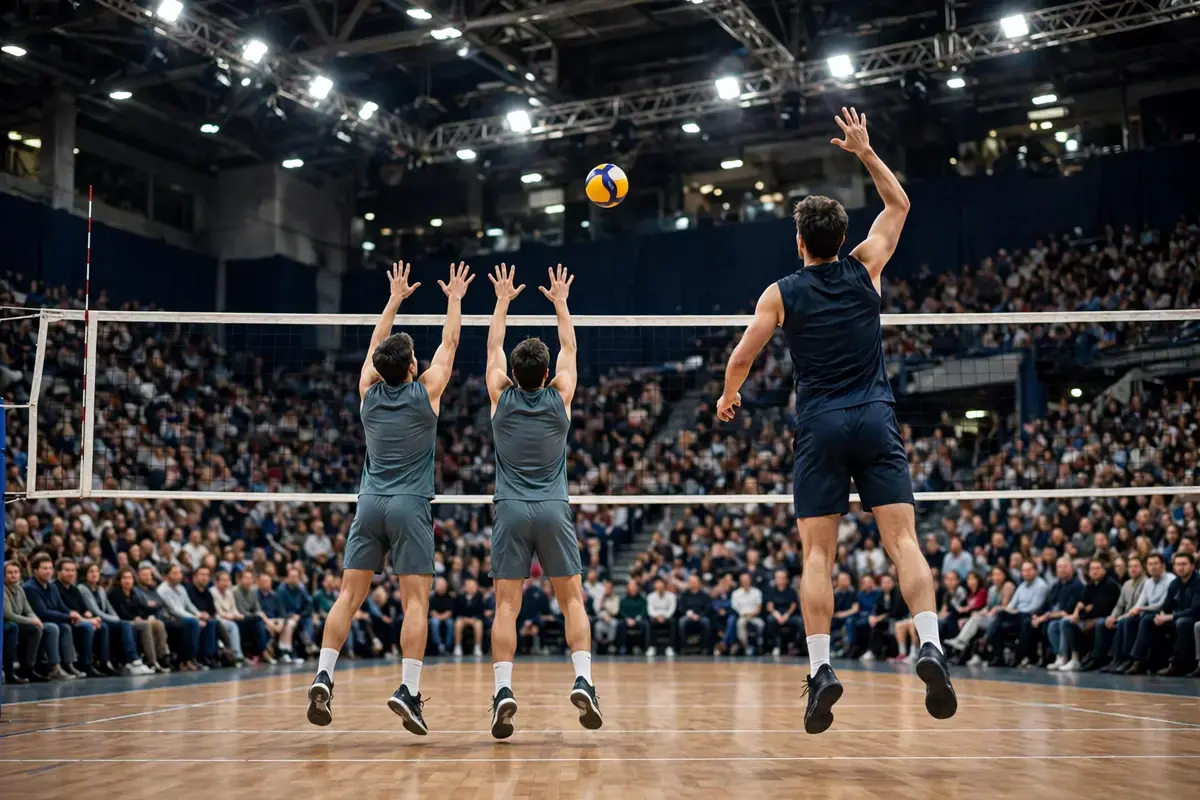
Two teams stand on opposite sides of a net, and a ball must never touch the floor on your side. That single idea explains the whole sport: keep the ball up, send it back with purpose, and make the other team blink first. Everything else — the rotations, the specialist positions, the jump serves, the roaring rallies — grows out of that one rule.
This guide is the hub for the sport on Sports Flash Daily: what the game is, where it came from, how a match works, the rules, the six positions, the five core skills, indoor vs beach, the leagues worth following, and how to watch or start playing. Where a topic needs a full guide of its own, this page points you to it.
Quick Answer
Table of Contents
- What Is Volleyball?
- A Short History of Volleyball
- How a Volleyball Match Works
- The Court, the Net and the Ball
- Volleyball Rules in Plain English
- The Six Positions on the Court
- The Five Core Skills
- Indoor vs Beach Volleyball
- Major Leagues and Tournaments to Follow
- How to Watch Volleyball and Follow a Season
- How to Start Playing Volleyball
- Common Volleyball Terms, Explained
- Frequently Asked Questions About Volleyball
What Is Volleyball?
Two teams of six play on opposite sides of a high net. Each side gets up to three touches to return the ball, and the rally ends when the ball hits the floor, goes out, or a team makes a fault. Points are scored on every rally, so no lead is ever safe.
Every player rotates: when a team wins the serve, all six shift one spot clockwise, so everyone takes a turn at the net and at the back.
A Short History of Volleyball
William G. Morgan invented the sport in 1895 while he was the physical education director at a YMCA in Holyoke, Massachusetts. He wanted a game less physically demanding than basketball, so he blended ideas from basketball, baseball, tennis and handball. He first called it “mintonette”, and the name changed to volleyball a year later, after an observer at an exhibition match noted how much volleying the game involved.
The sport spread quickly through YMCA networks, reaching Canada by 1900. Soldiers carried it to Europe during and after the First World War, and clubs soon appeared in France and across Eastern Europe.
The road to a world sport
The FIVB was founded in 1947 to standardise the rules, and the first World Championships followed: men in 1949, women in 1952. From there the game spread worldwide, growing strong in Brazil, across Europe, in Russia, in Asia and the United States.
The indoor game joined the Summer Games at Tokyo 1964, for both men and women, and the beach game followed at Atlanta 1996. A sitting version of the game is played at the Paralympic Games.
The rules kept changing as the game grew up: the set-and-spike attack arrived in the Philippines in 1916, the three-touch limit followed, and scoring moved to rally scoring, where every rally produces a point.
How a Volleyball Match Works
A match is best of five sets: the first team to win three takes the match. The first four sets are played to 25 points, and a deciding fifth set to 15. Every set must be won by at least two points.
Each set starts with a serve from behind the end line, hit over the net into the other team’s court. The receiving team then has up to three touches to send it back: usually a pass, a set, and an attack. The team that wins the rally scores a point and serves next.
The flow of a rally
A rally is the back-and-forth exchange between the two teams, and it can last one hit or twenty. The serving team tries to make its serve hard to handle. The receiving team tries to control the first touch so the setter can run the attack. The attacking team tries to hit the ball where no defender is standing, and the defending team tries to block at the net or dig it up.
How long a match lasts
There is no clock in the sport. A match can be over in about an hour if one team wins three quick sets, or it can run past two hours when sets go long and a fifth set is needed. Fans used to timed sports should plan around a format, not a clock. Our look at how long a soccer game lasts explains a game that does run on a clock.
The Court, the Net and the Ball
The court is a rectangle 18 metres long and 9 metres wide, about 59 feet by 29.5 feet. A net divides it into two equal halves, and a line 3 metres from the net on each side marks the attack line, separating the front row from the back row. A free zone at least 3 metres wide surrounds the court.
The net sits 2.43 metres high for men and 2.24 metres for women, with lower heights for junior and veterans’ events. Two antennae stick up at the sidelines, marking the sides of the crossing space; a ball must pass between them to count.
The ball is light and built to be hit hard: spherical, made of leather or synthetic leather, 65 to 67 centimetres around and 260 to 280 grams under the international rules. That lightness is why a well-struck spike moves so fast, and why a soft touch can still drop it dead on the other side.
Volleyball Rules in Plain English
A fan only needs a handful of rules to follow a match. The list below covers the ones that decide most points.
- Three touches. A team may touch the ball up to three times before sending it back over the net. A block touch does not count as one of the three.
- No double hit. The same player cannot touch the ball twice in a row, unless the first touch is a block.
- No catch or throw. The ball must be hit cleanly. Catching, holding or throwing it is a fault.
- No net touch. A player cannot touch the net while the ball is in play.
- Serve from behind the line. The server must serve from behind the end line, and the serve must cross the net. A foot fault on the line costs the point.
- Rotation order. Players must hold their rotational order at the moment of the serve. Lining up in the wrong spot is a fault.
- Ball on the line is in. If any part of the ball touches a boundary line, it counts as in.
- Back-row attack. A back-row player must jump from behind the attack line to hit a ball that is above the net.
Those eight rules explain nearly everything you will see in a rally. For the full version with serving faults, substitution rules and the finer points, our volleyball rules for beginners goes through each rule one by one.
The Six Positions on the Court
Six players take the court, and each one has a job. The roles below are the standard set.
Setter: the playmaker
The setter runs the offence, taking the second touch and delivering the ball to an attacker in the best spot to score. A good setter reads the block, picks the right attacker, and hides the plan until the last moment. The role needs soft hands, quick feet and fast decisions.
Outside hitter: the main attacker
The outside hitter attacks from the left front and usually takes the most swings in a match. The role also demands solid passing, because outside hitters help receive serves. It is the most complete job on the court: attack, pass, block and defend.
Opposite hitter: the right-side scorer
The opposite hitter attacks from the right front, opposite the setter in the rotation. The job is built around power hitting and blocking, with less passing duty than the outside role. When a team needs a point in a hurry, the ball goes to the opposite.
Middle blocker: the wall at the net
The middle blocker plays at the centre of the net and leads the blocking. The role needs a fast jump, long arms and quick reads, because the blocker must decide in a split second which attacker to close down. Middle blockers also run quick attacks in the centre, hitting fast, low sets.
Libero: the defensive specialist
The libero is the defensive specialist, and the easiest player to spot: the libero wears a jersey in a different colour from the rest of the team. The role is limited to the back row, and it exists to keep rallies alive with digs and passes others cannot reach.
The libero’s special rules
The libero cannot attack a ball above the net, cannot block, and cannot serve in some competitions. The libero also cannot set with an overhand finger pass from in front of the attack line if the next touch is an attack above the net. Those limits are the trade for swapping in and out without using a substitution.
Defensive specialist: the back-row cover
The defensive specialist is a substitute who comes in for back-row defence and serve receive, close to the libero’s job but using a normal substitution. Coaches use the spot to protect a front-row attacker who is weaker at passing.
For a deeper look at each role, including where each player stands in every rotation, our guide to positions in volleyball walks through the full rotation spot by spot.
The Five Core Skills
Every rally uses the same five skills. Beginners should learn them in the order below, because each one sets up the next.
Serving
The serve starts every rally, and it is the only skill a player performs alone. The server stands behind the end line, tosses the ball, and hits it over the net. Beginners start with the underhand serve, which is steady and easy to control; the overhand serve comes next, and the jump serve is the advanced version, where the server jumps and strikes at full height.
Passing and digging
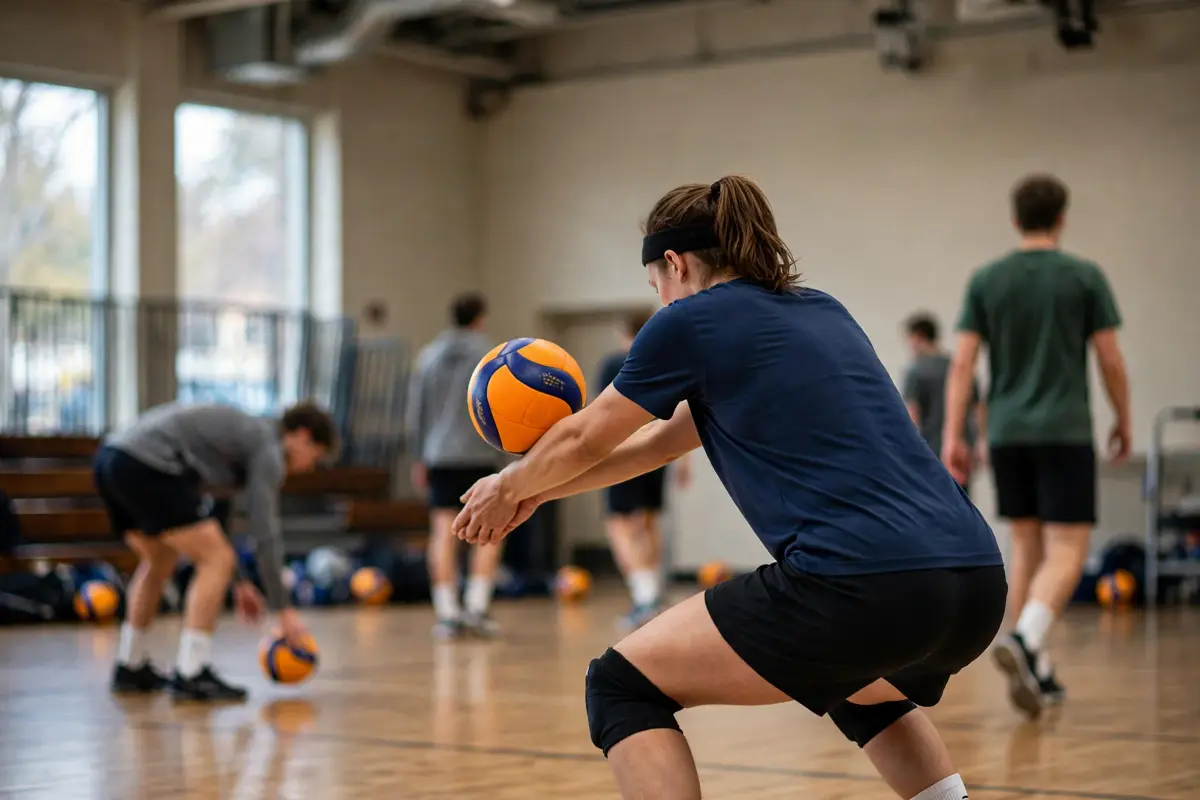
The pass is the first touch after the serve or an attack, and it decides whether the team can run its offence. The most common pass is the forearm pass, where the player joins the forearms and lets the ball rebound off them toward the setter. A dig is the same skill in defence: a low, fast reaction to a spike, often from a crouched position. Good passers keep the ball high and near the net, so the setter has time to choose.
Setting
The set is the second touch, and it is the setter’s main job. The setter uses the fingertips to push the ball up in a high arc toward an attacker. A good set arrives at the right height, the right distance from the net, and the right moment for the hitter’s jump. Setting looks gentle, but it demands the best hands and fastest decisions on the team.
Spiking
The spike is the attack: a player jumps, reaches above the net, and hits the ball down hard into the other team’s court. It is the sport’s most spectacular skill, and it needs timing more than strength. The hitter must watch the set, time the approach, and pick a spot the block cannot cover.
Blocking
The block is the first line of defence. Front-row players jump at the net with their hands high, trying to stop the spike or slow it down so a teammate can dig it. Timing is everything: jump too early and the hitter goes around you, jump too late and the ball is already past. A good block turns hard spikes into soft balls the defence can handle.
Indoor vs Beach Volleyball
The two versions share a net and a ball but play very differently. The table below shows the main differences at a glance.
| Feature | Indoor | Beach |
|---|---|---|
| Players per team | 6 on the court | 2 on the court |
| Court size | 18 m × 9 m | 16 m × 8 m |
| Sets in a match | Best of 5 | Best of 3 |
| Points per set | 25 (5th set 15) | 21 (3rd set 15) |
| Fixed positions | Yes, six specialist roles | No, both players do everything |
| Substitutions | Yes, under the competition rules | No substitutes in most formats |
| Playing surface | Indoor court floor | Sand |
| Weather | None, played indoors | Sun, wind and heat matter |
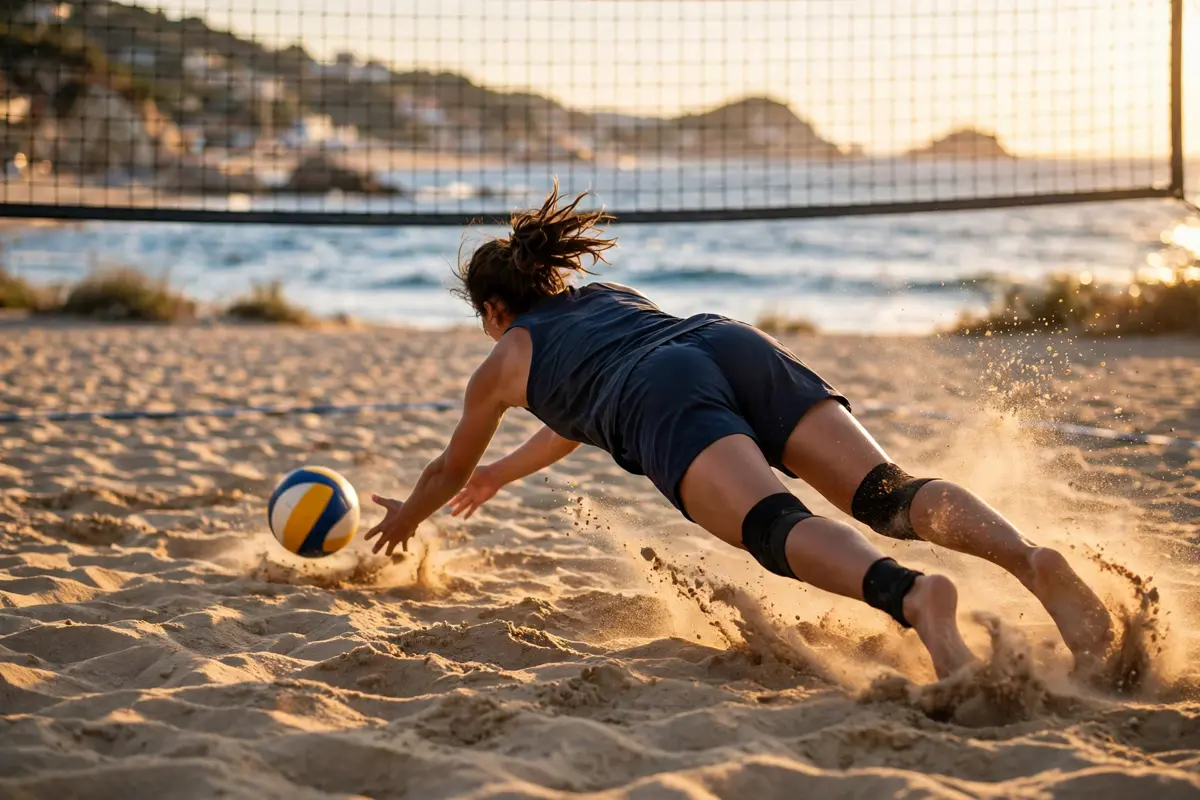
The beach game is slower in one way and harder in another. With only two players, each one covers half the court, so fitness and all-round skill matter more than specialisation. The sand makes jumping and moving harder, and the wind can push a serve off course. The indoor game is faster, with harder spikes and taller blocks.
Major Leagues and Tournaments to Follow
The calendar is built around a few big events.
The Olympics
The Olympic tournament is the sport’s biggest stage. The indoor game has been part of the Summer Games since Tokyo 1964, for both men and women, and the beach game joined at Atlanta 1996. Olympic tournaments run over about two weeks, with group stages followed by knockout rounds.
The World Championship
The FIVB World Championship is the sport’s flagship international tournament. The first men’s event was held in 1949 and the first women’s event in 1952. National teams qualify through continental competitions, and it is the best place to see the international game at its highest level.
The Volleyball Nations League
The Volleyball Nations League is the FIVB’s annual international competition, with men’s and women’s editions running through the summer. National teams play a long round of matches before a final round decides the winner. It is the main yearly event for international teams outside Olympic and World Championship years.
College volleyball in the United States
College volleyball is one of the biggest stages for the sport in the United States, especially on the women’s side. The season builds toward a national championship tournament each year. Fans who want to understand how young players reach the professional level should start here, and our guide to the NCAA tournament schedule explains how a college bracket works.
Professional leagues
Professional club leagues are played around the world, with strong traditions in Brazil, Italy, Poland, Turkey, Russia and Japan. Club seasons run through the winter months, and the best clubs also meet in continental competitions. In the United States, the Pro Volleyball Federation gives American players a home league, and the beach game has its own international circuit, with pairs earning ranking points at events through the season.
For the full tournament picture, including how brackets are built and how teams advance, our guide to volleyball brackets explains every common format.
How to Watch Volleyball and Follow a Season
Watching is easy once you know what to look at. Track the set score, not a clock, because there is no game clock. A team leads two sets to one, for example, and needs one more set to win. The scoreboard shows the current set score and the sets won.
Start by watching the setter, who touches the ball on nearly every rally; the choice of attacker tells you how the team plans to score. Then watch the block: the team that wins the blocking battle usually wins.
To keep up with a season, follow the league’s own schedule and standings pages, which list fixtures, results and tables in one place. Live score pages help on a match night: our NFL scores page works the same way for football fans.
For basketball nights, the NBA scores page covers the action.
The WNBA scores page does the same for the women’s game. Check results the morning after a match day, and the table will tell you which teams are rising and which are slipping.
How to Start Playing Volleyball
Starting is simple: you need a ball, a net and a few people. Most beginners join a recreational league, a school team or a local club, and the first sessions focus on passing and serving.
Finding a team
Look for adult recreational leagues, community centres and school or university teams. Many clubs run beginner sessions with no experience needed, and the sport is one of the cheapest to start: a ball and court shoes are enough. If you are new to team sports, our guide to basketball rules for beginners is a useful first read.
Your first practice
Expect most of the session to be the forearm pass and the underhand serve, with short rallies once the group can control the ball. Wear court shoes, bring water, and do not worry about the jump serve yet. New players often pick up a second sport too, and our guide to baseball rules for beginners covers another team game from the ground up.
The team side of the game is what hooks most new players. Our guide to softball rules for beginners is a good next step for anyone who wants to try a second team sport.
Common Volleyball Terms, Explained
- Ace: a serve that lands in without being touched.
- Dig: a defensive save of a hard-hit ball.
- Kill: an attack that cannot be returned and scores.
- Rally: the exchange of hits between the two teams.
- Rotation: the clockwise shift of players when the serve changes hands.
Frequently Asked Questions About Volleyball
How many players are on a volleyball team?
Six per side indoors, with substitutes; two per side on the beach.
How long does a volleyball match last?
Usually between one and two hours, because matches are best of five sets with no clock.
What is the difference between indoor and beach volleyball?
Indoor is six-a-side on a hard court; beach is two-a-side on sand, with a smaller court and sets to 21.
What does the libero do?
The libero is a back-row defensive specialist in a different-colour jersey who cannot attack above the net or block.
How many touches can a team take?
Three, not counting a block touch: pass, set, attack.
How tall is a volleyball net?
2.43 metres for men and 2.24 metres for women.
When was volleyball invented?
In 1895, by William G. Morgan at a YMCA in Holyoke, Massachusetts. It was first called mintonette.
Is volleyball an Olympic sport?
Yes — the indoor game since Tokyo 1964, and the beach game since Atlanta 1996.
Share this article: X | Facebook | LinkedIn | Email
Written by Jaani | View all articles by Jaani
Facts checked on 13 November 2026. Sources: the FIVB and Wikipedia for the sport’s history and rules, and Sports Flash Daily’s own volleyball guides for the linked articles.



















