





College softball is one of the fastest-growing sports in America, and its season peaks in May and June when the Women’s College World Series takes over the calendar. Hundreds of games are played every week from February onwards, and the only way to keep up is to know where the scores live, how to read them, and how the season fits together.
This guide covers all of it: the best places to find scores, how to read a box score, how softball scoring works, the season calendar, the conferences and rankings, and the road to the Women’s College World Series. Whether you follow one team or the whole sport, you will finish this guide knowing exactly how to stay on top of every game.
Table of Contents
- What Following NCAA Softball Scores Really Means
- Where to Find NCAA Softball Scores
- How to Read a Softball Box Score
- How Softball Scoring Works: Runs, the Run Rule and Extra Innings
- The Season Calendar: February to June
- Conferences and Rankings: RPI Explained
- The Road to the WCWS: Regionals, Super Regionals, Oklahoma City
- Divisions: Division I, II and III
- Stats That Tell the Real Story
- Following Your Team All Season: Alerts, Schedules and Habits
- Frequently Asked Questions
What Following NCAA Softball Scores Really Means
Following scores is about more than the final number. A 5–4 result tells you who won, but it hides the story: who pitched well, which hitter came through late, whether the game went to extra innings, and what the result means for the standings.
NCAA softball plays a huge number of games. Teams often play three or four games in a weekend series, plus midweek games, which means the scoreboard moves constantly from February to June. Fans who check scores once a week will miss most of the season.
The good news is that the tools for following the sport have never been better. Live scores update pitch by pitch, box scores appear within minutes of the final out, and highlights are often available the same evening. You can follow a whole season from your phone if you know where to look.
Start with one team
If you are new to the sport, pick one team and follow it for a month. Learn its pitchers, its best hitters and its schedule. You will soon know the roster, and the rest of the sport will start to make sense around it. If the rules still feel new, a beginner’s guide to softball rules covers the basics in plain terms.
Where to Find NCAA Softball Scores
There is no single home for every score, so the best approach is to use two or three sources together and cross-check them when a game matters.
The NCAA’s official site
The NCAA’s official website is the most reliable place for schedules, scores and standings. It carries the official brackets in the postseason, the selection information for the tournament, and links to live stats for each game. When a score matters for the record books, this is the source that counts.
ESPN’s website and app
ESPN carries the widest coverage of college softball, with live scores, schedules, team pages and player stats on its website and app. Its softball section lets you filter by date, team or conference, and its game pages carry play-by-play, box scores and video highlights. You can also follow specific teams and get personalised notifications.
Team athletics sites
Every school runs its own athletics website, and these are often the fastest source for news about one team. They publish schedules, rosters, live stats links, recaps and interviews. If you follow one school closely, its athletics site should be your first stop each morning.
Score apps
Dedicated sports apps like TheScore and CBS Sports provide instant score updates, game summaries and breaking news. They are useful when you want to track several games at once, since you can follow multiple teams in one feed. Most of them let you set alerts for scores, results and news.
Social media and live blogs
Team accounts, conference accounts and the NCAA’s own softball accounts post live updates, highlights and behind-the-scenes content during games. Sports news outlets also run live blogs and score trackers during the postseason. Social media is best used alongside an official score source, not instead of one, since posts can be delayed or incomplete.
Streaming and television
ESPN+ carries a large amount of live college softball, and many games are also shown on ESPN’s television channels during the season and the postseason. Streaming is worth having if you want to watch games rather than just follow the score, though the best streaming option varies by conference and by season.
How to Read a Softball Box Score
A box score is the game’s story in numbers. It looks dense at first, but it breaks down into a few simple parts.
| Part of the box score | What it tells you |
|---|---|
| Line score | Runs scored by each team in each inning |
| Final score | The result, with the winning team on top |
| Batting lines | Each hitter’s at-bats, runs, hits, RBIs and strikeouts |
| Pitching lines | Each pitcher’s innings, hits, runs, walks and strikeouts |
| Fielding | Errors, double plays and putouts |
| Extra lines | Home runs, stolen bases, hit by pitch and left on base |
The line score is the fastest way to read a game. It shows the runs in each inning, so you can see when the scoring happened: a team that scored four in the first inning controlled the game from the start, while a team that scored three in the seventh staged a comeback.
Batting lines show who delivered. Look for the hitters with multiple hits and RBIs, and check the strikeout column to see who struggled. Pitching lines show who threw, how long they lasted, and how many runs they allowed. A starter who went six innings and allowed one run dominated; a starter pulled in the second inning did not.
Reading a line score in seconds
Start with the final score, then scan the innings for the big one. A single big inning usually decides a softball game, since scoring is harder than in baseball and rallies are less common. Then check the pitching line to see whether one pitcher controlled the game or several were used.
How Softball Scoring Works: Runs, the Run Rule and Extra Innings
Softball scoring follows the same basic idea as baseball: a run scores when a player crosses home plate, and the team with more runs after seven innings wins. The details are what make the sport its own game.
Seven innings, not nine
A regulation college softball game lasts seven innings, not nine like baseball. That shorter game changes everything: pitchers face the order fewer times, a slow start is harder to fix, and a two-run lead in the sixth inning is a serious advantage.
The run rule
Softball uses a run rule, sometimes called the mercy rule. If one team leads by eight runs after five innings, the game ends early. The rule keeps lopsided games from dragging on, and it is a regular part of the sport, especially early in the season when strong teams meet weaker ones.
Extra innings
If the score is tied after seven innings, the game continues into extra innings until one team scores more runs than the other. There is no clock and no shootout: the teams keep playing full innings until someone wins. Postseason games have gone deep into extra innings, and those are the games fans remember for years.
How runs are made
Most runs come from hits, walks and errors, just as in baseball. Home runs matter, but small ball matters more in softball: bunts, stolen bases, hit-and-runs and sacrifice flies are a bigger part of the game, because the smaller field and shorter distances make speed and placement more valuable.
The Season Calendar: February to June
The NCAA softball season typically runs from February to June, and it has a clear shape.
February and March: the early season
The season opens in February with early-season tournaments, where teams play several games in a weekend against opponents from other conferences. These tournaments are where teams test their line-ups, find their pitching rotation and build their record. The weather is warm in the southern states, so most early games are played there.
March and April: conference play
Conference play takes over in March and April. Teams play weekend series against conference rivals, usually three games, and the conference standings start to take shape. This is the long grind of the season, and it is where the best teams separate from the rest.
May: the peak
May is when the sport peaks. Conference tournaments decide automatic bids to the NCAA tournament, the selection show sets the field, and the regionals begin. Scores matter more in May than at any other time, because every result shapes the road to the World Series. Fans who want to plan around the biggest weekends should watch the calendar closely, and Texas tournament listings are a good example of how packed the spring schedule gets.
June: the Women’s College World Series
June belongs to the Women’s College World Series in Oklahoma City. The eight best teams in the country play for the national championship over about a week, and the whole sport watches. For fans, it is the best time to follow the scores, because every game matters and every game is televised.
Conferences and Rankings: RPI Explained
College softball is organised into conferences, and the conferences shape everything about the season.
The major conferences
The Southeastern Conference, known as the SEC, is the strongest softball conference, sending many teams to the postseason each year. The Atlantic Coast Conference, the Big 12 and the Big Ten are also strong, and several mid-major conferences regularly produce teams that reach the regionals and beyond.
Conference play matters because it decides the conference champion and the automatic bid to the NCAA tournament. A team that wins its conference tournament is in, whatever its record. A team that loses must hope its overall record and ranking earn an at-large bid.
What RPI means
RPI stands for Ratings Percentage Index. It is a formula that ranks teams based on their winning percentage, their opponents’ winning percentage, and their opponents’ opponents’ winning percentage. In plain terms, it rewards teams that win and that play a tough schedule.
The selection committee uses RPI as one of its main tools when choosing the tournament field and seeding the regionals. A team with a good record against weak opposition will rank lower than a team with a similar record against strong opposition. That is why early-season tournaments matter: beating a good team in February helps in May.
Polls and rankings
Weekly polls rank the top 25 teams, and they are a useful guide to who is hot and who is fading. Polls are voted on by coaches or writers, so they reflect opinion as well as results. RPI is the more objective measure, and the two together give a good picture of the sport.
The Road to the WCWS: Regionals, Super Regionals, Oklahoma City
The postseason is a three-step climb, and each step cuts the field down.
Regionals
The NCAA tournament begins with 16 regional sites, each hosting four teams in a double-elimination format. A team must lose twice to be eliminated, which means the best team usually survives even if it drops one game. The winner of each regional advances.
Super regionals
The 16 regional winners are paired into eight super regionals, each a best-of-three series between two teams. The super regionals are played on campus, usually at the higher-seeded team’s ground, and the atmosphere is intense. Win two games and you are going to Oklahoma City.
The Women’s College World Series
The eight super regional winners meet in Oklahoma City for the Women’s College World Series, known as the WCWS. It is a double-elimination tournament, so a team must lose twice to be eliminated, and the last two teams play a best-of-three final series for the national championship.
The WCWS is the pinnacle of the sport: a week-long celebration in one city, with the best players in the country, huge crowds and every game on television. For fans, it is the easiest part of the season to follow, because the field is small, the stakes are clear and the schedule is simple.
Why the format matters for scores
Each round changes how you read the scores. In the regionals, a loss is not fatal, so a team can drop its opener and still advance. In the super regionals, every game is a must-win once a team falls behind. In the WCWS, the double-elimination format creates dramatic second chances and late comebacks.
Divisions: Division I, II and III
NCAA softball is played at three levels, and they are easy to confuse.
Division I is the top level, the one on television, with the biggest schools, the most scholarships and the WCWS in Oklahoma City. When people talk about NCAA softball scores, they almost always mean Division I.
Division II and Division III also have national championships, their own tournaments and their own stars. The standard is high, but the coverage is thinner, and scores are harder to find outside the schools’ own athletics sites. If you follow a Division II or III team, the school’s site and the NCAA’s championship pages are your best sources.
Stats That Tell the Real Story
Scores tell you what happened. Stats tell you why it happened, and which teams are likely to keep winning.
Hitting stats
Batting average measures a hitter’s success rate. On-base percentage shows how often a player reaches base, including walks. Slugging percentage measures power. Runs batted in show how many runs a player has driven home. Together they describe a hitter far better than any single number.
Pitching stats
Earned run average, known as ERA, is the key pitching number: it shows how many earned runs a pitcher allows per seven innings. Strikeouts show how often a pitcher misses bats. Walks plus hits per inning pitched, known as WHIP, shows how many baserunners a pitcher allows. A low ERA with a low WHIP is the mark of a dominant pitcher.
Fielding stats
Fielding percentage measures how reliably a player makes the plays she should make. Errors are costly in softball, because the short game means one mistake can lead to several runs. The best teams are usually the best fielding teams as well.
Using stats to read a score
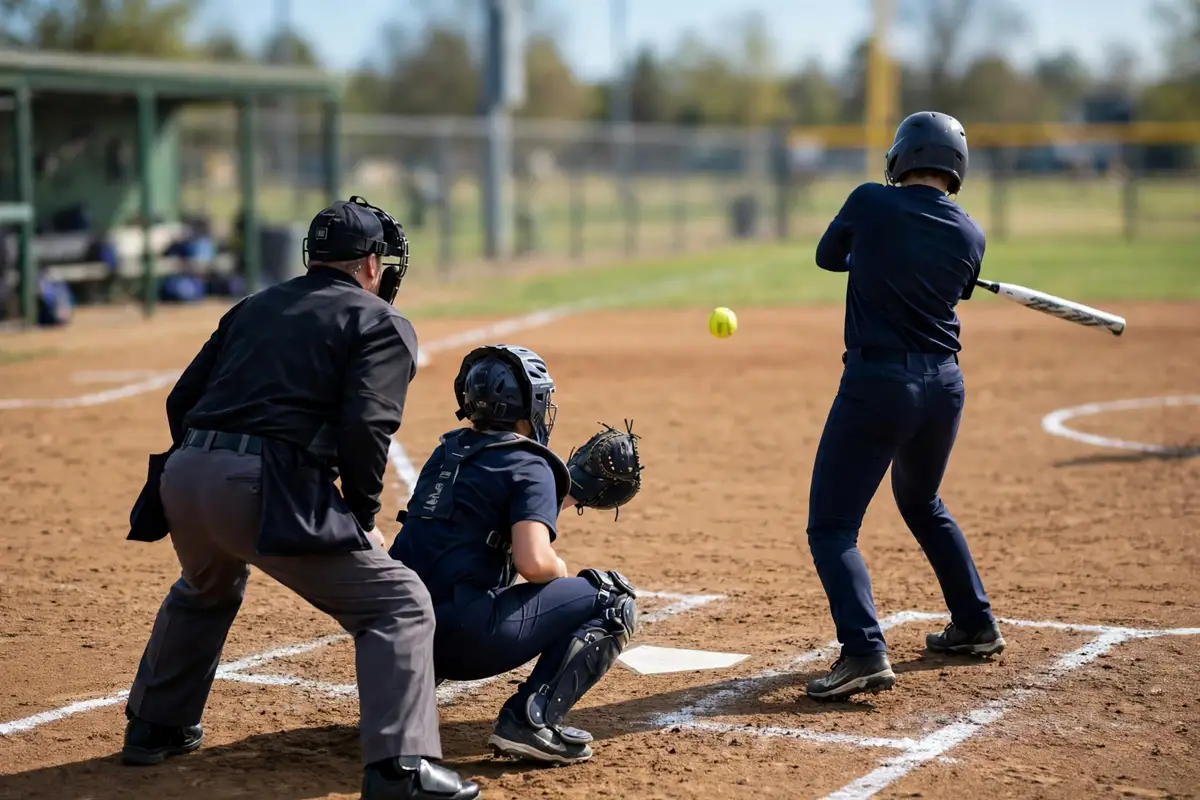
When a favourite loses a game she should have won, check the stats before blaming the score. A team that outhit its opponent but left ten runners on base did not get the big hit. A team that lost on errors did not lose on talent. Stats turn a confusing score into a clear story.
Following Your Team All Season: Alerts, Schedules and Habits
The best fans build a routine. It takes ten minutes a week and it means you never miss a big result.
Set up alerts
Pick your team in a score app and turn on alerts for game starts, scores and results. Add the conference and the NCAA accounts on social media for news. Alerts are the difference between hearing about a result and living through it.
Check the schedule weekly
Look at your team’s schedule every Monday. Note the series, the times and the broadcast details. College softball often plays double-headers and weekend series, so a quick look at the week ahead stops you missing a Friday game you expected on Saturday. For a concrete example of a team schedule page, LSU’s schedule page shows how a full season is laid out.
Keep a simple record
Note the results that matter: series wins, big pitching performances, injuries and ranking changes. A short note each week turns a season of scores into a story you can follow, and it makes the postseason much more enjoyable because you know how each team got there.
Follow other sports the same way
The same habits work across the whole site. College basketball’s scoreboard is the place to check during the winter months.
The men’s bracket schedule is covered through the big bracket schedule each spring.
The basics of basketball rules are explained in our basketball rules guide if you are new to that sport too.
Baseball’s live scoreboard works the same way for following hitters night after night.
The basics of baseball rules are covered in our baseball rules guide for fans who follow both diamond sports.
College football’s scoreboard fills Saturdays the same way softball fills the spring.
Tennis fans can follow every tournament through tennis live scores with the same daily routine.
Football’s live scoreboard fills Sundays the same way softball fills the spring.
Soccer runs on a different clock, and a guide to how long a soccer game lasts helps if you follow both sports.
Frequently Asked Questions
Where can I find NCAA softball scores live?
The NCAA’s official site, ESPN’s website and app, team athletics sites and score apps like TheScore and CBS Sports all carry live scores. ESPN and the NCAA site are the most complete sources, while team sites are best for news about one school.
When does the NCAA softball season start and end?
The season typically runs from February to June. It opens with early-season tournaments in February, moves into conference play in March and April, peaks with the conference tournaments and regionals in May, and ends with the Women’s College World Series in June.
How does the Women’s College World Series work?
Eight teams reach the WCWS in Oklahoma City. It is a double-elimination tournament, so a team must lose twice to be eliminated, and the last two teams play a best-of-three final series for the national championship.
What is the run rule in softball?
If one team leads by eight runs after five innings, the game ends early under the run rule. It keeps lopsided games from dragging on and is a regular part of the college game.
What is RPI in college softball?
RPI stands for Ratings Percentage Index. It ranks teams by their winning percentage, their opponents’ winning percentage and their opponents’ opponents’ winning percentage. The selection committee uses it to choose the tournament field and seed the regionals.
How is NCAA softball different from baseball?
Softball is played on a smaller field with seven innings instead of nine, underhand windmill pitching instead of overhand throwing, and a larger ball. The shorter game and the run rule make scoring patterns different, and speed and small-ball tactics matter more.

By Sports Flash Daily — View All Articles
Facts checked on 13 November 2026. This guide was made by reading the NCAA’s official softball pages and the leading score guides, comparing the season structure and postseason format across several sources, and checking the rules and rankings against published references.



















