





Mixed martial arts, known as MMA, is a combat sport where fighters use skills from several martial arts. A bout can move from striking on the feet to wrestling against the fence, then to grappling on the ground. That mix is what makes MMA different from a single-discipline sport such as boxing or wrestling alone.
The sport is built around control. A fighter needs to strike, defend takedowns, work from the ground, and manage energy across rounds. The best fighters blend skills, rather than relying on one strength.
If you are new to combat sports, MMA can look chaotic at first. Once you know the basic rules, the rounds, and the main disciplines, it becomes much easier to follow. This guide explains those basics in plain terms.
You can also follow major combat-sport cards through the UFC schedule to see how events are organised across a season.
The Basic Idea of MMA
MMA brings together techniques from striking arts, grappling arts, and wrestling. Striking includes punches, kicks, knees, and elbows. Grappling includes holds, joint locks, and chokes. Wrestling includes takedowns, clinch control, and positional work on the ground.
A fight can be won by knockout, technical knockout, submission, or decision. A knockout happens when a fighter cannot continue after a strike. A submission happens when a fighter taps out or a referee stops the bout because of a hold. A decision happens when the fight goes the full distance and judges score the rounds.
That range of outcomes is central to MMA. A fighter who is losing on the feet can change the fight with a takedown, and a fighter on the ground can work to stand up.
Why It Is Called Mixed Martial Arts
The blend of styles is similar to how other sports blend skills. The basketball rules for beginners guide shows how one sport’s rules shape its style of play.
The word mixed points to the blend of disciplines. Early events tested one style against another. Over time, fighters learned that a single style was not enough. They began training in several arts and combining them into a complete game.
Modern MMA training usually covers striking, wrestling, and Brazilian jiu-jitsu, along with conditioning and defence. Fighters still have a base style, such as wrestling or striking, but they train the other areas so they are not exposed in a weak spot.
MMA Versus Other Combat Sports
Boxing focuses on punches. Kickboxing focuses on punches and kicks. Wrestling focuses on takedowns and control. MMA allows all of those tools, within its rules, and adds ground fighting.
That breadth makes MMA harder to learn, because a beginner must study several skills at once. It also makes it interesting to watch, because a fight can change in a single moment. A striker can be taken down, a grappler can be caught with a punch, and a close round can turn on one exchange.
Where MMA Fights Take Place
Most professional MMA bouts take place inside a caged enclosure, often called an octagon because of its eight sides. The cage keeps fighters in the fighting area and allows them to use the fence for control and defence. It is not a ring with ropes, so fighters cannot fall out of the area in the same way.
The cage has padded posts, a mat floor, and a fence that fighters can lean on or push against. The fence is part of the sport. Fighters use it to stay upright, to trap an opponent, or to work for a takedown. Referees watch for illegal use of the fence, such as grabbing it to avoid a takedown.
The Cage, the Mat, and the Referee
A referee stays inside the cage during the bout. The referee starts and stops the action, warns fighters about fouls, and stops a fight when a fighter cannot defend himself or herself. That role is central to safety. A referee can stop a bout even if a fighter wants to continue.
Judges sit outside the cage and score rounds. A doctor may be present at ringside, and officials check gloves, hand wraps, and other equipment before a bout. Those checks are part of the formal structure of a professional event.
Amateur and Professional Levels
Amateur levels exist in many sports, with modified rules for learners. The college basketball scores page shows how a lower level of a sport is followed week by week.
Amateur MMA often uses modified rules, with extra protection and limits on certain techniques. Professional MMA uses the full rule set for that promotion or commission. Beginners usually start with training and amateur rules, learning technique and safety before they think about competition.
Training in a gym is different from competing. Most people who train MMA do so for fitness, self-defence, and skill, without ever fighting in a cage. Classes teach striking, grappling, and conditioning in a controlled setting, with partners and coaches.
Rules Basics: What Is Allowed and What Is Not
MMA rules aim to keep the sport competitive while reducing serious injury. The exact rules can vary by promotion and by local commission, but the core ideas are consistent. Fighters must follow the referee, respect the rules, and avoid dangerous techniques.
Legal techniques include punches, kicks, knees, and elbows to most parts of the body, takedowns, clinch work, and submissions. Fighters can strike on the feet and on the ground, within limits. They can also work for positional control, passing guard, and improving their position.
- Striking: Punches, kicks, knees, and elbows, with limits on strikes to certain areas.
- Takedowns: Wrestling-style takedowns, trips, and throws to bring a fight to the ground.
- Clinch work: Close control against the fence or in open space, with knees and short strikes.
- Grappling: Holds, joint locks, and chokes that can end a fight by submission.
- Ground control: Positional work, including passing guard and holding a dominant position.
Fouls are a key part of the rules. Common fouls include eye pokes, groin strikes, strikes to the back of the head, biting, hair pulling, and grabbing the fence. A referee can warn a fighter, deduct a point, or disqualify a fighter for serious or repeated fouls.
Fouls and Referee Warnings
Referees keep play fair in every sport. The ice hockey rules for beginners guide explains how officials and rules work in a fast team game.
When a foul happens, the referee may pause the action, warn the fighter, and give the other fighter time to recover. A point deduction can change a close fight. A disqualification ends the bout and gives the win to the other fighter.
Fighters are expected to know the rules before they compete. Ignorance is not a defence, and repeated fouls can lead to a loss even if a fighter is ahead on points. That is why coaches teach rules alongside technique.
How a Fight Can End
A fight can end in several ways. A knockout or technical knockout ends the fight when a fighter cannot continue. A submission ends the fight when a fighter taps out or a referee stops the bout due to a hold. A decision ends the fight after the final round, with judges scoring the bout.
A fight can also end by disqualification or by a doctor stoppage. A doctor may stop a fight if a cut or injury makes it unsafe to continue. Those outcomes are less common, but they are part of the sport’s safety structure.
Rounds, Time, and Scoring
MMA bouts are fought in rounds, with rest periods between rounds. The number and length of rounds depend on the level and type of bout. Most non-title professional bouts have three rounds. Title bouts often have five rounds.
Each round usually lasts five minutes, with a one-minute rest between rounds. That structure tests both skill and conditioning. A fighter must manage energy, because a strong first round does not guarantee a strong third round.
| Bout type | Rounds | Round length | Rest between rounds |
|---|---|---|---|
| Most non-title bouts | 3 | 5 minutes | 1 minute |
| Title bouts | 5 | 5 minutes | 1 minute |
| Some amateur bouts | 3 | Shorter, varies by rules | 1 minute |
Scoring uses a ten-point system in most professional events. The winner of a round usually receives ten points, and the loser receives nine or fewer. Judges score based on effective striking, grappling, control, and aggression. A dominant round can be scored ten to eight, though that is less common.
Conditioning Across Rounds
MMA conditioning is demanding because a fight mixes striking, wrestling, and grappling. A fighter may need to strike for a minute, defend a takedown, work on the ground, then stand up and strike again. That changes the energy demands in a way that a single-discipline sport does not.
Training reflects that mix. Fighters train striking rounds, grappling rounds, and wrestling drills, along with running, strength work, and recovery. Beginners should build fitness slowly, rather than trying to match a professional training load at once.
For a comparison with a sport that uses a very different scoring system, the NBA scores page shows how points build across quarters in basketball.
Weight Classes in General Terms
Weight classes are a way of grouping competitors fairly. A similar grouping by level appears in the college football scores coverage of university teams.
Weight classes match fighters of similar size. That reduces the advantage of a much larger fighter and makes bouts fairer. Fighters weigh in before a bout, and they must meet the limit for their class. If a fighter misses weight, the bout may be changed or cancelled, depending on the rules.
The names and limits of weight classes vary by promotion. Common divisions include lighter classes such as flyweight and bantamweight, middle classes such as lightweight and welterweight, and heavier classes such as light heavyweight and heavyweight. Each class covers a range of weights, and fighters usually compete in the class that best fits their natural size.
A fighter may move between classes during a career. That can happen when their body changes, when they want a new challenge, or when a cut to a lower weight becomes too hard. Moving up usually means facing larger opponents. Moving down usually means a harder weight cut, which needs careful planning.
The Main Disciplines in MMA
MMA draws on several martial arts. No single list covers every fighter, but a few disciplines appear in almost every training programme. Understanding them helps you follow a fight and see what each fighter is trying to do.
Striking arts teach punches, kicks, knees, and elbows, along with footwork and defence. Grappling arts teach holds, locks, and chokes. Wrestling teaches takedowns and control. Together, they form the base of modern MMA.
- Boxing: Punches, head movement, footwork, and combinations on the feet.
- Muay Thai: Punches, kicks, knees, elbows, and clinch work, with a strong emphasis on leg kicks.
- Kickboxing: Punches and kicks, with footwork and combinations, often in a faster striking style.
- Wrestling: Takedowns, takedown defence, clinch control, and positional dominance.
- Brazilian jiu-jitsu: Ground control, submissions, escapes, and guard work.
- Judo: Throws, trips, and clinch control, with some groundwork.
- Karate and taekwondo: Kicks, distance control, and timing, used by some fighters as a striking base.
A fighter does not need to master every discipline. They need a strong base, plus enough skill in the other areas to avoid being exposed. A wrestler needs striking defence. A striker needs takedown defence. A grappler needs to close distance safely.
Striking: Punches, Kicks, and Knees
Striking timing takes practice, much like timing in other sports. The tennis scores page shows how timing and form decide points in a very different contest.
Striking is the most visible part of MMA. Fighters use jabs, crosses, hooks, and uppercuts, along with leg kicks, body kicks, and head kicks. Knees and elbows are used in the clinch and at close range.
Good striking is not just about power. It is about timing, distance, and combinations. A fighter who throws one punch at a time is easier to read than a fighter who mixes punches, kicks, and level changes. Footwork matters too, because it creates angles and helps a fighter avoid being hit.
Grappling and Submissions
Grappling takes place on the ground or in the clinch. Fighters work for dominant positions, such as mount or back control, and look for submissions. Common submissions include chokes and joint locks, such as arm locks and leg locks.
A submission does not need to cause injury to win. A fighter taps out when they are caught in a hold they cannot escape. The referee stops the fight at that point. That makes grappling a technical part of the sport, where leverage and position matter more than raw strength.
For a look at how a related striking sport is organised, the boxing schedule page shows fight nights in a sport that focuses on punches alone.
How a Typical MMA Bout Unfolds
A bout starts with both fighters on their feet, at distance. They feel each other out, test with jabs and leg kicks, and look for an opening. The early minutes are often cautious, as fighters learn timing and distance.
As the fight develops, one fighter may press forward, while the other looks to counter. A takedown attempt can change the pace. If it succeeds, the fight moves to the ground, where the takedown fighter looks for control or a submission, and the other fighter looks to escape or stand up.
The Striking Phase
On the feet, fighters use distance to set up strikes. A jab can test range, a leg kick can slow movement, and a combination can create an opening. Defence includes head movement, blocking, and footwork. A fighter who stands still becomes an easy target.
The striking phase can end quickly with a knockout, or it can last for rounds. Fighters must manage energy, because throwing hard strikes for five minutes is tiring. Smart fighters pick their moments, rather than throwing every strike at full power.
The Ground Phase
On the ground, position matters more than wild movement. The fighter on top usually has an advantage, but the fighter on the bottom can work from guard, look for submissions, or try to stand up. Ground striking, known as ground and pound, can end a fight if the bottom fighter cannot defend.
Ground work is often the hardest part for new fans to follow, because the movements are subtle. A small shift in hips or grip can change control. Watching the referee and the fighters’ hands helps, because a submission attempt often starts with a grip change.
Training MMA as a Beginner

Beginner MMA classes focus on basics, safety, and fitness. You do not start by fighting. You start by learning stance, movement, basic strikes, basic takedown defence, and basic ground positions. Classes are usually structured, with a warm-up, technique work, drilling, and light sparring or grappling.
Safety is central. Beginners train with partners, not opponents. They wear gloves, mouthguards, and shin guards where needed. They learn to tap out early in grappling, so they do not get hurt. A good gym teaches respect, control, and patience.
- Start with a beginner class, not an advanced sparring session.
- Learn the basic stance, guard, and footwork before you add power.
- Practise striking on pads and bags before you strike a partner hard.
- Learn to tap out early in grappling, and respect your partner’s tap.
- Build fitness slowly, with regular sessions rather than one hard week.
- Ask your coach about gear, including gloves, wraps, and a mouthguard.
If you are new to combat sports, a good first step is to watch a class, talk to the coach, and try a beginner session. That gives you a feel for the gym, the pace, and the people. You can decide from there whether MMA training suits you.
Gear for Beginners
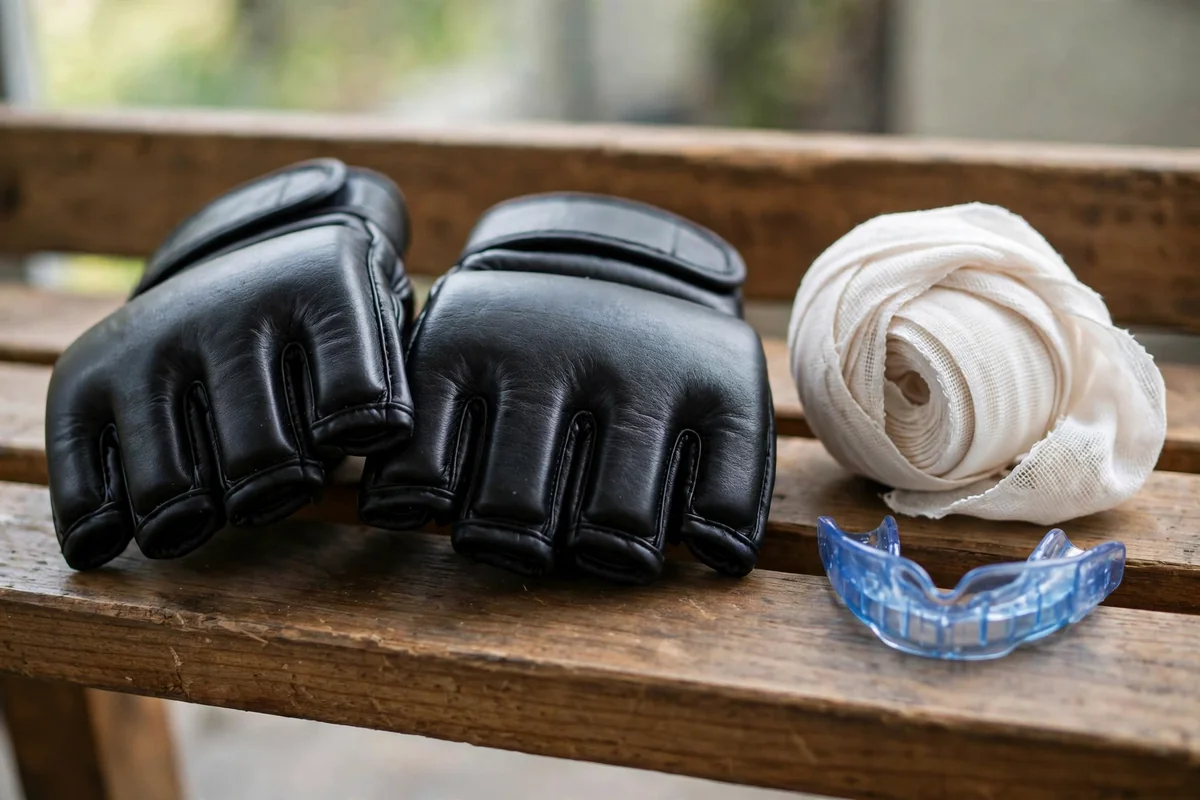
Beginner gear should be simple and practical. The best boxing gloves for beginners training guide covers glove fit and protection in detail.
Beginner gear is simple. MMA gloves are smaller than boxing gloves, with open fingers for grappling. Hand wraps support the wrist and knuckles. A mouthguard protects teeth during sparring. Shin guards protect legs during kick drills. A rash guard or training shirt is common for grappling.
You do not need to buy everything at once. Many gyms lend gear for a first session. Ask what you need for your first class, and add items as you train more often. That keeps costs down and lets you learn what suits you.
Common Misunderstandings About MMA
MMA is sometimes described as a free fight with no rules. That is not accurate. Modern MMA has weight classes, rounds, fouls, referees, and judges. It is a regulated sport, with safety checks and medical oversight at professional events.
Another misunderstanding is that MMA is only about fighting. Many people train MMA for fitness, confidence, and skill, without competing. The training builds coordination, strength, and discipline, and the community in a good gym is supportive.
A third misunderstanding is that a fighter needs to be aggressive to win. In fact, patience, timing, and defence are just as important. A fighter who rushes in without a plan can be caught. A fighter who stays calm, reads the fight, and picks the right moment often does better.
For a different kind of structure, you can see how a team sport season is tracked on the NFL scores page, which shows weekly results in a very different format.
Frequently Asked Questions
What does MMA stand for?
MMA stands for mixed martial arts. It is a combat sport that combines striking, wrestling, and grappling. Fighters use skills from several martial arts, rather than one discipline alone.
Is MMA the same as UFC?
No. MMA is the sport, and UFC is a promotion that organises MMA events. Other promotions also organise MMA bouts. The UFC is one of the best known, but it is not the sport itself.
How long is an MMA fight?
Most non-title professional bouts have three rounds of five minutes, with one minute of rest between rounds. Title bouts often have five rounds of five minutes. Amateur bouts may use shorter rounds, depending on the rules.
What are the main weight classes in MMA?
Weight classes match fighters of similar size, from lighter divisions such as flyweight and bantamweight to heavier divisions such as light heavyweight and heavyweight. The exact names and limits vary by promotion, so a class in one organisation may differ slightly in another.
Is MMA safe for beginners?
Beginner training is structured and controlled, with coaches, partners, and safety gear. Beginners learn technique and defence before they spar hard, and they are taught to tap out early in grappling. As with any contact sport, there is some risk, but a good gym manages it with clear rules and supervision.
Do I need experience in another martial art to start MMA?
No. Many beginners start MMA with no prior experience. A good beginner class teaches the basics from scratch, including stance, striking, takedown defence, and ground positions. Prior experience in boxing, wrestling, or jiu-jitsu can help, but it is not required.
What gear do I need to start MMA training?
Beginner gear usually includes MMA gloves, hand wraps, a mouthguard, and comfortable training clothes. Shin guards are often used for kick drills. Many gyms lend gear for a first session, so ask the coach what you need before you buy.



















