





Starting boxing is exciting, and it is also a little confusing the first time you stand in front of a wall of gloves. Sizes look similar, weights sound alike, and every pair claims to be the right one for a beginner. The truth is simpler than the labels make it seem. A good first pair protects your hands, fits well with wraps, and holds up through regular bag work and pad work while you learn the basics.
This guide covers glove types, weight and fit, materials, and care. There is no single pair for every hand. The goal is to help you pick a sensible, comfortable pair and start training with confidence.
If you are new to the sport, it helps to understand the wider calendar too. You can follow upcoming bouts and fight nights through the boxing schedule before you settle into a regular training routine.
What Beginners Actually Need from Training Gloves
A beginner does not need a specialist glove. You need a pair that does the ordinary jobs well. That means padding that spreads impact, a wrist that stays stable, a thumb that sits in a safe position, and a lining that does not rub your knuckles raw after a few rounds.
Most beginners train on a heavy bag, hit pads with a partner or coach, and learn footwork and basic combinations. A training glove covers all of that. It is not built for hard sparring, and it is not built for competition. It is built for learning, and that is exactly what you need at the start.
Protection Comes First
Boxing rewards steady progress, and following another sport week by week shows the same pattern. You can see how results build across a season on the NFL scores page.
Your hands contain many small bones, and a punch puts force through the knuckles and wrist. Padding absorbs part of that force. A glove with thin or uneven padding leaves your knuckles sore and can make you flinch before you punch, which hurts your technique.
Look for padding that feels even across the knuckles when you press it. It should spring back, not stay dented. The wrist area should feel firm when the glove is closed. If the glove bends easily at the wrist, it will not support you when you hit a bag at full power.
Comfort Matters More Than Looks
Comfort also matters in other sports, where the basic rules shape how equipment is used. The baseball rules for beginners guide explains those basics in plain terms.
A glove can look great and still be wrong for you. Comfort is about the inside shape, the thumb position, and how the glove closes. A pair that pinches your thumb, rubs the back of your hand, or leaves your fingers cramped will distract you in every session.
Try gloves on with hand wraps if you can. Wraps add bulk, and a glove that fits bare hands may feel tight once wraps are on. Walk around, make a fist, and open your hand. The glove should feel snug without cutting off circulation. Your fingertips should not press hard against the end.
Types of Boxing Gloves Explained
If you enjoy learning how different sports are organised, the PGA Tour schedule page is a useful example of a season laid out clearly.
Gloves are made for different jobs, and the names can be confusing. Bag gloves, sparring gloves, training gloves, and competition gloves all look alike at first glance. The differences sit in the padding, weight, and shape.
A beginner should start with a general training glove. It is the most flexible option. It works for bag work and pad work, and it gives you time to learn what you like before you think about a specialist pair.
- Training gloves: All-round gloves for bag work, pad work, and general drills. These are the best starting point for most beginners.
- Bag gloves: Lighter gloves made mainly for heavy-bag work. They often have less padding than training gloves.
- Sparring gloves: Heavier gloves with softer, thicker padding to protect both boxers. They are used when you start sparring under supervision.
- Competition gloves: Lighter gloves made for bouts, with specific rules on weight and padding. Beginners do not need these at first.
- Muay Thai gloves: Similar in shape, often with a slightly different cuff and thumb. Some beginners use them for boxing, but a boxing training glove is the simpler choice.
If you train in a class that mixes bag work and partner drills, a training glove is the safest bet. You can add a sparring pair later, when your coach says you are ready for sparring. That keeps your first purchase simple and useful.
For a sense of how fight nights are structured, many beginners also enjoy following major cards alongside their training. The UFC schedule shows how combat-sport events are organised across a season.

Glove Weight and Size: How to Choose
Glove weight is measured in ounces, written as oz. Common training weights are 10 oz, 12 oz, 14 oz, and 16 oz. Heavier gloves have more padding, not a larger hand compartment. That is a common misunderstanding. A 16 oz glove is not always bigger inside than a 12 oz glove. It has thicker padding.
Your body size, training type, and gym guidance should shape the choice. A smaller person may find 12 oz comfortable for bag work. A larger person may prefer 14 oz or 16 oz. If your gym has a standard weight for beginners, follow that standard first.
| Glove weight | Typical use | Who it often suits |
|---|---|---|
| 10 oz | Light bag and pad work | Smaller hands, lighter beginners, technique drills |
| 12 oz | General training and bag work | Many adult beginners, all-round use |
| 14 oz | Training, bag work, light sparring | Larger beginners, those who want extra padding |
| 16 oz | Sparring and heavy training | Larger adults, sparring under coach guidance |
This table is a general guide, not a rule. Hand size, wrist strength, and coach advice matter as much as body weight. If you are between sizes, try both with wraps on and choose the pair that feels stable and comfortable through a full round of shadowboxing.
Size and Hand Shape
Hand size varies just as court and field sizes vary across sports. For a contrast, the basketball rules for beginners guide shows how rules shape play in a very different game.
Glove sizes are not as standard as shoe sizes. One brand’s medium may feel different from another brand’s medium. Some gloves suit long fingers, others suit wider hands. That is why trying gloves on matters so much.
Pay attention to these points when you try a pair:
- Your fingers should curl naturally into a fist without pressing hard on the end.
- Your thumb should sit in its loop or pocket without stretching.
- The cuff should cover your wrist without digging in.
- The strap should close firmly without needing to pull it to its limit.
If you buy online, check the return policy before you order. A pair that looks right on a screen may feel wrong on your hand, and a clear return option makes that risk much smaller.
Fit: How Gloves Should Feel
Fit is the difference between a glove you love and a glove you avoid. A good fit feels snug, stable, and natural. A poor fit feels loose, pinchy, or wobbly. You will notice fit most when you punch, not when you stand still.
Start by putting on hand wraps. Wraps support the wrist and knuckles, and they fill space inside the glove. A glove fitted without wraps will feel different once wraps are on. If you have not learned to wrap your hands yet, ask your coach to show you. It is a basic skill, and it protects your hands from the start.
The Hand Wrap Test
A good wrap test takes only a minute, and it is worth doing before every session. A similar habit of checking the basics first helps when you follow the NHL scores through a busy week.
Put on wraps, then slide your hand into the glove. Make a fist. Your knuckles should sit under the main padding, not near the edge. Your thumb should rest naturally, not stretched across your fingers.
Open and close your hand a few times. The glove should move with your hand, not slide around it. If your hand slides inside the glove when you punch a bag, the fit is too loose, or the closure is not holding your wrist firmly enough.
Wrist Support and Closure
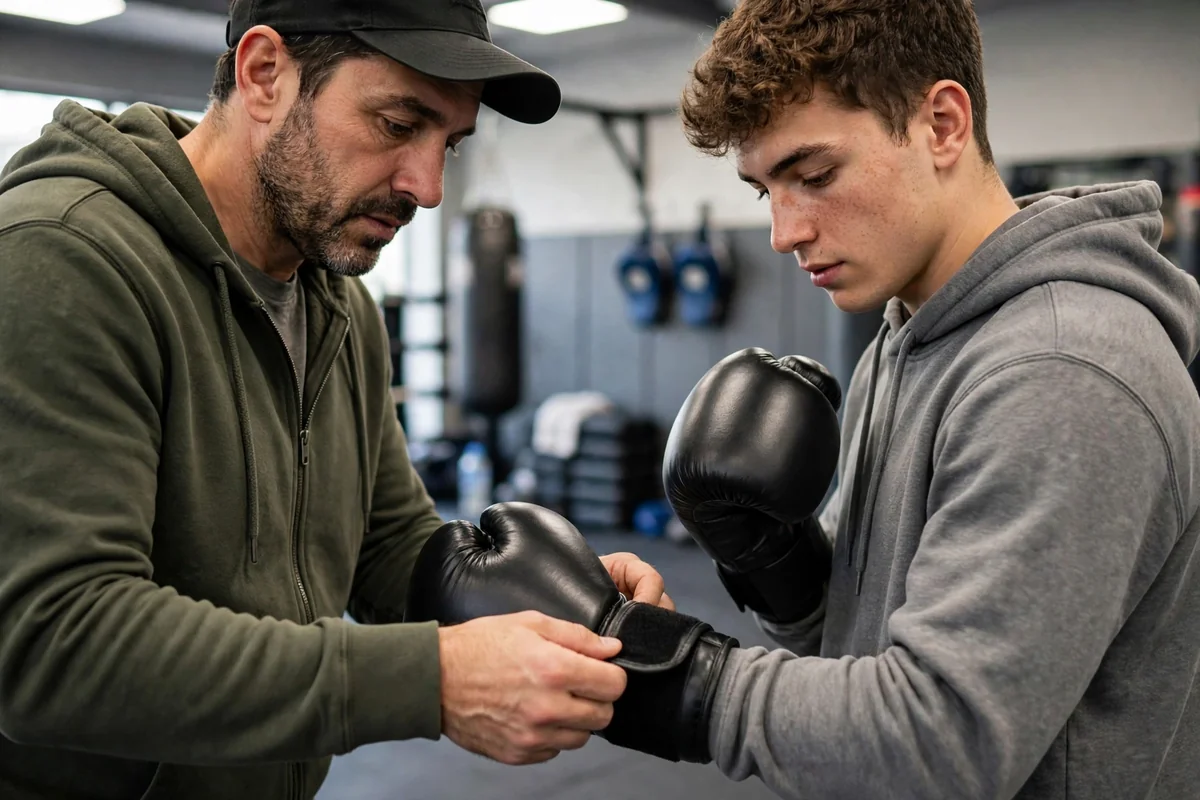
The wrist is the weakest link in a punch. If it bends on impact, you feel pain and you lose power. A good glove supports the wrist with a firm cuff and a closure that holds.
There are two main closure types:
- Velcro strap: Quick to put on and take off, easy to adjust, and common for beginners. It is practical for classes where you put gloves on and off often.
- Lace-up: A snug, custom fit that many experienced boxers prefer. It takes longer to put on and usually needs help from a partner.
For most beginners, Velcro is the better choice. It is fast, it is easy to adjust between rounds, and it gives good wrist support when the strap is wide and firm. Lace-up gloves can come later, if you want that style.
Learning the basics of movement and defence takes time, and the same patience applies to other combat sports. A clear explainer on what is MMA shows how different disciplines fit together in a related sport.
Materials and Construction
Materials affect feel, durability, and care. The two main outer materials are leather and synthetic leather. Both can work well for beginners. The choice is about budget, feel, and how much care you want to give the gloves.
Leather feels soft and moulds to your hand over time. It often lasts longer with good care, and many boxers prefer its feel. Synthetic leather is usually lighter on cost, easier to wipe clean, and a practical choice for a first pair. It may not last as long as leather under heavy use, but it is a sensible start.
Leather Versus Synthetic
Material choice is a practical decision, not a fashion one. The same practical approach helps when you look at the NASCAR schedule and plan which events to follow.
Here is a simple comparison to help you decide:
- Leather: Natural feel, moulds to the hand, often more durable, needs regular cleaning and drying.
- Synthetic leather: Lower cost, easy to clean, good for beginners, may wear sooner under daily use.
- Padding: Foam padding is common in training gloves. It should feel even and springy, not lumpy or flat in places.
- Lining: A smooth lining reduces friction. A rough lining can cause blisters, especially in warm sessions.
- Stitching: Double stitching around high-stress areas is a good sign. Loose threads are a warning sign.
Do not judge a glove by shine alone. A glossy finish does not mean strong stitching or good padding. Press the padding, check the seams, and close the strap. Those simple checks tell you more than the colour or logo.
Care and Maintenance
Good care habits keep kit usable for longer, in boxing and in other sports. You can find the same steady, week-by-week approach in the tennis scores coverage.
Gloves take a lot of sweat and impact. Without care, they smell, the lining wears, and the padding breaks down sooner. With simple care, a first pair can last through months of regular training.
Care starts as soon as you finish a session. Do not leave gloves sealed in a bag. Let them air out. Open the cuff, pull the lining out a little if you can, and leave them in a dry, ventilated place. That simple habit does more than any spray.
- Air gloves out after every session, cuff open, in a ventilated spot.
- Wipe the outer surface with a clean, slightly damp cloth to remove sweat and dust.
- Use hand wraps every time, so wraps absorb sweat before the glove lining does.
- Wash wraps regularly, and let them dry fully before the next session.
- Do not leave gloves in a hot car, near a heater, or in direct sun for long periods.
- Do not soak gloves in water or put them in a washing machine.
If gloves start to smell, airing and wraps help most. Some boxers use glove deodorisers or cedar inserts, but those are extras. The core habit is drying. A dry glove lasts longer and feels better than a damp one.
Common Beginner Mistakes to Avoid
Mistakes are part of learning, and a clear guide can shorten the learning curve. The volleyball rules for beginners guide takes the same plain approach to a different sport.
Beginners make the same few mistakes with gloves, and most are easy to fix. The first is choosing a weight that is too light because it feels fast. Light gloves feel good in the shop, but they offer less protection when you hit a bag hard.
The second mistake is skipping hand wraps. Wraps are not optional extras. They support the wrist and knuckles, and they keep sweat out of the glove. Training without wraps is one of the fastest ways to get sore hands.
The third mistake is buying for looks alone. Colour and brand do not protect your hands. Fit, padding, and wrist support do. A plain pair that fits well will serve you better than a flashy pair that pinches.
- Choosing the lightest weight without thinking about padding and protection.
- Training without hand wraps, or using wraps that are too short or poorly wrapped.
- Picking gloves by colour or logo instead of fit and wrist support.
- Buying sparring or competition gloves before you need them.
- Leaving gloves sealed in a bag after training, so they stay damp and smell.
- Ignoring a poor fit and hoping the glove will stretch enough to fix it.
If you avoid those mistakes, your first pair will do its job while you learn the sport. You can refine your choice later, once you know your hand shape, your training style, and your coach’s preferences.
Training Without Wraps: Why It Hurts
Wraps do three jobs. They hold the small bones of the hand together, they support the wrist, and they absorb sweat. Without them, your hand moves more inside the glove, and your wrist has less support. That can lead to sore knuckles and a sore wrist after a session.
Learning to wrap takes a few tries. Ask your coach to show you once, then practise at home. A good wrap feels snug, not tight. Your fingers should still move, and your wrist should feel supported when you make a fist.
How to Use Your Gloves in Early Training
Your first weeks are about basics: stance, guard, jab, cross, and footwork. Gloves should help you learn those basics, not distract from them. Start with shadowboxing to get used to the weight and feel. Then move to light bag work, focusing on a straight wrist and a clean fist.
A simple early routine might look like this:
- Warm up with skipping, jogging, or light movement for a few minutes.
- Shadowbox for two or three short rounds, focusing on form, not power.
- Hit the heavy bag in short rounds, with rest between rounds.
- Do pad work with a coach or partner, if your class includes it.
- Cool down, stretch, and air out your gloves.
Keep rounds short at first. Your shoulders will tire, and tired shoulders lead to dropped hands and bent wrists. Short, clean rounds build better habits than long, messy ones. Rest between rounds, drink water, and listen to your coach.
A Simple Buying Checklist
Before you buy, run through this checklist. It takes a few minutes and saves you from a poor purchase.
| Checklist item | What to check |
|---|---|
| Type | Training glove, not competition or specialist glove |
| Weight | 12 oz or 14 oz for most adult beginners, or gym standard |
| Fit with wraps | Snug, stable, thumb in place, no pinching |
| Wrist support | Firm cuff, wide strap, wrist does not bend easily |
| Padding | Even, springy, no thin spots over knuckles |
| Closure | Velcro that grips firmly and stays closed |
| Material | Leather or synthetic, with strong stitching |
| Return policy | Clear returns, in case the fit is wrong at home |
If a pair passes those checks, it is a sensible first buy. You do not need to find a perfect pair. You need a pair that protects you, fits well, and lets you train regularly.
Frequently Asked Questions
What size boxing gloves should a beginner get?
Most adult beginners start with 12 oz or 14 oz training gloves. The right size depends on your hand size, body size, and gym guidance. Try gloves with hand wraps on, and choose the pair that feels snug and stable without pinching. If your gym has a standard weight, follow that first.
Do beginners need hand wraps under boxing gloves?
Yes. Hand wraps support the wrist and knuckles, hold the small bones of the hand together, and absorb sweat before it reaches the glove lining. Always wear wraps for bag work, pad work, and sparring. Ask your coach to show you how to wrap your hands correctly.
Are leather or synthetic gloves better for beginners?
Both can work well. Leather often feels softer, moulds to the hand, and lasts longer with care. Synthetic leather is usually lower in cost, easy to clean, and a practical first choice. Choose based on fit, padding, and wrist support first, then consider material.
How long do beginner boxing gloves last?
It depends on how often you train, how hard you hit, and how well you care for them. With regular use two or three times a week and good drying habits, a first pair can last for months of training. Replace gloves when padding flattens, stitching loosens, or wrist support weakens.
Can I use the same gloves for bag work and sparring?
Training gloves work for bag and pad work, but sparring usually needs heavier gloves with softer padding to protect both boxers. Your coach will tell you when sparring starts and what weight your gym uses. Do not use light bag gloves for sparring without coach approval.
How do I clean boxing gloves?
Air them out after every session with the cuff open. Wipe the outside with a clean, slightly damp cloth. Use hand wraps every time, and wash wraps regularly. Do not soak gloves, do not machine wash them, and do not leave them in a hot car or in direct sun for long periods.
Should beginners buy lace-up or Velcro gloves?
Velcro gloves are usually better for beginners. They are quick to put on, easy to adjust, and give good wrist support. Lace-up gloves offer a snug fit but take longer to put on and usually need help. You can try lace-up gloves later, once you know your preferences.



















