





Basketball Basket Net: A Complete Guide to Hoops, Nets, and Care
A basketball hoop looks simple from a distance. A backboard, a round rim, and a net hanging below it. Up close, each part has a job to do, and the net is the part players notice most when they shoot. It slows the ball, shows whether a shot went in cleanly, and gives that soft swish every shooter loves to hear. When the net is worn, tangled, or missing, the whole hoop feels wrong.
This guide explains the setup in plain language. You will learn what the parts are called, how the net works with the rim, which materials suit indoor and outdoor play, how to choose the right size, how to replace a net, how to hang a hoop at home, and how to keep it in good shape. For the rules of the game itself, start with our basketball rules for beginners.
What Is a Basketball Basket Net?
The net is the open mesh that hangs below the rim. It is made from loops of cord or links of chain, joined in a pattern that narrows slightly toward the bottom. The top is wider than the bottom, so the ball enters easily and then meets gentle resistance as it drops through. That shape controls the ball, keeps it from bouncing away too fast, and makes it clear that a shot went through.
A standard net has twelve loops at the top. Each loop fits over a small hook on the underside of the rim. Those twelve points spread the weight evenly, so the net hangs straight. When a ball passes through, the net stretches a little, then settles back into place. A well-made net returns to shape shot after shot, while a worn net stays stretched, twisted, or bunched.
The Basket, the Rim, and the Net
People often use the words basket, hoop, and rim as if they mean the same thing, but they describe different parts. The basket is the whole target: backboard, rim, and net together. The rim is the solid metal ring the ball must pass through. The net hangs from that ring and guides the ball down. A shot counts when the ball goes through the rim from above.
Parts of a Basketball Hoop
The backboard is the flat panel behind the rim. It gives shooters a target for bank shots and stops the ball from flying past the hoop. Backboards come in different sizes and materials, from clear acrylic and tempered glass to moulded plastic and steel. Larger boards give more room for bank shots. Smaller ones suit a driveway or a small gym.
The Backboard and the Rim
Backboard material affects how the ball bounces. Glass and acrylic boards give a true, lively rebound, which is why they are common in gyms. Plastic and steel boards are tougher and cheaper, and they suit outdoor use where weather and rough play are more likely. A board that is cracked, warped, or loose will change how the ball reacts, so check it when you check the net.
A good way to understand rim height and court layout together is to read our guide to basketball court dimensions. It explains how the hoop sits within the court, and why spacing matters for shooting and rebounding.
The Net Hooks
The net hooks are small metal prongs welded under the rim. There are usually twelve of them, spaced evenly around the ring. Each top loop of the net goes over one hook, so the net hangs in a neat circle. Hooks bend over time, especially on outdoor hoops where players pull at the net. A bent hook will not hold its loop well, and the net may slip off during play.
Types of Basketball Nets
Not all nets are the same. The main difference is material, and material changes how the net sounds, how long it lasts, and where it works best. The four common types are nylon, polyester, chain, and heavy-duty all-weather cord. Each has a place, and the right choice depends on where you play and how often you use the hoop.
Chain Nets and Nylon Nets
A chain net is made from small metal links, joined in the same tapered shape as a cord net. It is the toughest type by a wide margin. It does not fray, it does not rot, and it stands up to rain, sun, and heavy use. That is why chain nets are common on public outdoor courts, where a cord net would wear out fast. The downsides are noise, weight, and a rough feel. Chain nets are best kept outdoors.
Polyester, Braided, and Heavy-Duty Nets
Polyester nets look much like nylon nets, but the fibre behaves a little differently. Polyester resists sunlight better than nylon, holds its colour longer, and is less likely to stretch out of shape. Braided nets, whether nylon or polyester, use several strands twisted together for each cord, which makes them thicker and stronger than a single-strand net. For many home courts, a braided polyester net is a good middle ground.
| Net type | Best for | Sound | Weather resistance |
|---|---|---|---|
| Nylon cord | Indoor gyms, light home use | Quiet, soft swish | Low to medium |
| Polyester braided | Home driveways, mixed use | Quiet, soft swish | Medium to high |
| Chain metal | Public outdoor courts | Loud metallic rattle | High |
| Heavy-duty cord | Schools, parks, harsh weather | Medium, firmer swish | High |
Net Materials Explained
Material choice is about trade-offs. No single material is best for every court. Nylon is soft and quiet. Polyester is a little tougher in the sun. Chain is almost indestructible but loud. Heavy-duty cord is a compromise that leans toward toughness. Understanding those trade-offs helps you pick a net that matches your court, not just the cheapest one on the shelf.
What Makes a Net Last
Three things decide how long a net lasts: material, use, and weather. A net used every day on a busy court will wear faster than the same net used twice a week at home. A net in strong sun and rain will age faster than one in a dry gym. A net that is pulled, hung from, or twisted will fail sooner than one that is left alone to do its job.
Indoor and outdoor nets are not always labelled clearly, but the difference matters. An indoor net is usually a light nylon cord, made for a dry gym with no sun or rain. Put that same net outdoors, and sun and rain will shorten its life. An outdoor net is built with weather in mind. It may be polyester, heavy-duty cord, or chain. The same habit of checking gear before play helps in other sports too, as shown in our ice hockey rules for beginners.
How to Choose the Right Net
Choosing a net is simpler than choosing a hoop. Start with size, then think about where you play, how often you play, and who plays.
Size, Fit, and Playing Location
A standard net is made to fit a standard rim. The top loops are spaced to match the twelve hooks, and the length is set so the bottom hangs clear of the pole and backboard. For a junior hoop, the rim is smaller, and the net is shorter. A standard net on a junior rim will hang too long and look baggy. A junior net on a full-size rim will be stretched tight and may pull off the hooks.
If you play with a smaller ball for younger players, a junior rubber basketball pairs with a junior hoop and a junior net, and the whole setup feels right for smaller hands. Where you play decides the material. For an indoor gym, a nylon net is the usual choice. For an outdoor driveway or park court, choose polyester, heavy-duty cord, or chain.
Frequency, Style, and Weather
How often you play matters as much as where you play. A hoop used once a week for casual shooting can use a light nylon net, even outdoors, because wear is slow. A hoop used every day by a family, a team, or a school will need a tougher net. Playing style matters too. If players shoot long shots or dunk, the net takes harder hits and more pulling. A chain or heavy-duty net will cope better than a thin nylon net.
How to Replace a Basketball Net
Replacing a net is a short job, and most people can do it without tools. You will need a new net, a stable step ladder if the rim is high, and a few minutes. Do not climb on a wobbly chair or stand on the base of a portable hoop. Use a ladder on flat ground, and ask someone to hold it steady if you can.
Step-by-Step Fitting
Fitting the new net is the reverse of removing the old one, with one key detail: fit the loops in order around the rim, so the net does not twist. Hold the net with the wide top facing up and the narrow bottom facing down. The top loops are larger and more open. If you hold it upside down, the net will hang wrong and the ball will catch.
- Place the ladder on flat ground, with a helper holding it steady if possible.
- Hold the new net with the wide end at the top and the narrow end at the bottom.
- Start at one hook and loop the first top loop over it, pulling it snug but not tight.
- Move to the next hook clockwise and fit the next loop, keeping the net untwisted.
- Work around the rim until all twelve loops are on their own hooks.
- Step down, stand back, and check that the net hangs straight and even.
- Drop a ball through by hand to test that it passes cleanly and the net settles back.

When to Replace the Net
Replace the net when it no longer hangs straight, when the cord is frayed, or when the knots are coming loose. A net that sags to one side, stays bunched after a shot, or lets the ball catch and twist is past its best. A chain net needs replacing when links are rusted through, bent open, or missing. Do not wait until the net falls off. Keep a spare net in a dry place, so you can swap it in a few minutes.
Watching top-level play can help you see what a good net should look like in action. The NBA scores page is a good place to follow the league, and when you watch a game, notice how the ball drops through the net and settles near the hoop.
How to Hang a Basketball Hoop at Home
Hanging a hoop at home is a bigger job than replacing a net, and it needs planning. The main choices are portable, wall-mounted, and in-ground. Each suits a different space and level of permanence. Before you buy, measure your space, check the ground, and think about who will use the hoop and how often.
Choosing the Right Spot
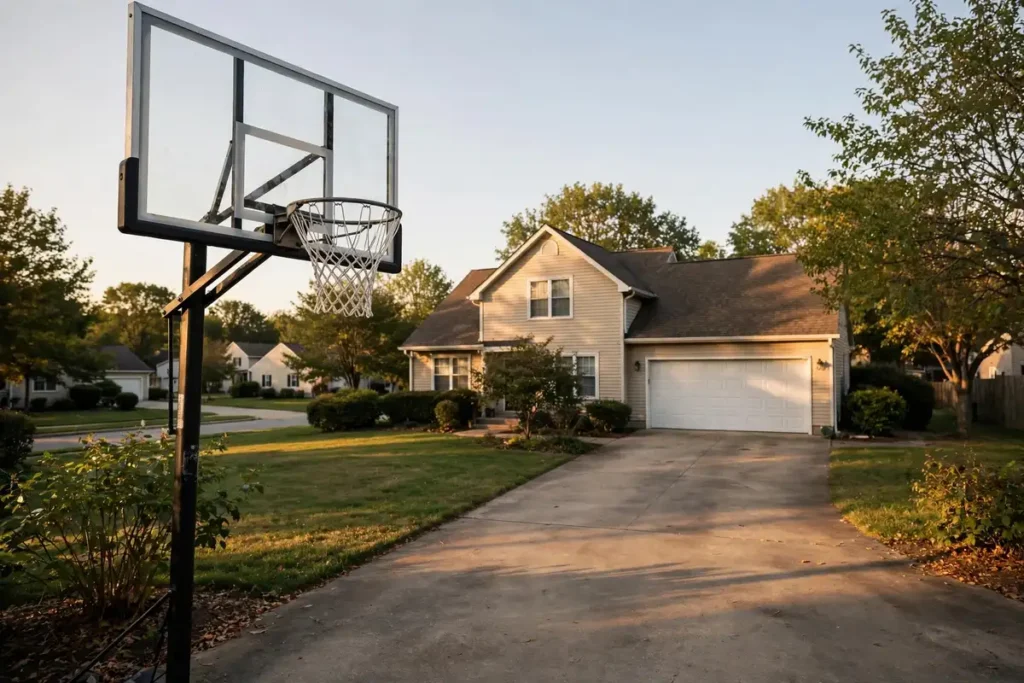
Pick a spot with flat ground, good light, and clear space in front of the hoop. Players need room to shoot, rebound, and move without hitting a wall or a parked car. A driveway with a garage wall behind the hoop can work well, as long as the wall is not too close to the playing area. A spot at the end of a driveway often gives the best balance of space and shelter.
Portable and In-Ground Hoops
A portable hoop is the easiest to set up. It has a base on wheels, a pole, and a backboard that can be moved into place. Fill the base with water or sand as directed, and check that it is full before play. A base that is only half full can tip, especially if the backboard catches the wind. Portable hoops are a good choice if you rent or want to move the hoop for parking.
An in-ground hoop is the most stable and the most permanent. The pole is set in concrete, and it does not move or tip. It is the best choice if you own your home and plan to keep the hoop for years. For planning the space around a home court, our guide to basketball court dimensions gives a sense of spacing, but a home driveway rarely matches a full court, so adapt it to the space you have.
Height and Safety
Standard rim height for adult play is set by the rules of the game, and most home hoops are built to match it. Many portable and in-ground hoops let you adjust the height, which is useful for younger players. A lower rim helps children learn to shoot with good form, rather than straining to reach a full-height rim. Raise the rim as they grow and their strength improves.
Care and Maintenance
A basketball hoop needs little care, but a little regular care goes a long way. The net, the rim, the backboard, and the base all benefit from a quick check every few weeks, especially outdoors. A five-minute check can catch a loose bolt, a bent hook, or a frayed net before it becomes a bigger problem.
Cleaning and Checking the Hoop
Clean the net by taking it off the rim and washing it in warm water with a mild soap. Rinse it well and let it dry fully before refitting it. Do not use bleach or harsh chemicals on a cord net, as they can weaken the fibres. For a chain net, rinse it with water, scrub off any dirt or rust spots with a brush, and let it dry. Clean the rim with a damp cloth, and dry it after.
Seasonal Care
In spring, give the hoop a full check after winter. Wash the net, clean the backboard, check the rim and hooks, and tighten any bolts that have loosened. In summer, check for sun damage on cord nets, and consider a polyester net if the sun is strong. If you go away for a long break, you can take the net off and store it indoors to extend its life. The WNBA scores page follows a league that plays through a season with regular care for its courts and gear.
Common Problems and Fixes
Even a good hoop will develop small problems over time. Most are easy to fix, and knowing the fix saves an early replacement. If a problem involves a cracked backboard, a bent pole, or a loose wall fixing, get help rather than trying to force a fix.
A tangled net is the most common problem. It happens when the cords twist around each other after a shot, or when wind blows a light net into a knot. The fix is usually simple: take the net off, lay it flat, untangle the cords by hand, and refit it in order. If the net tangles again quickly, it may be stretched out or worn, and a new net will solve it.
Fraying, Rust, and Noise
Fraying is the cord breaking down strand by strand. You will see thin spots, loose fibres, or a fuzzy look on the cord. Fraying is a sign to replace the net, because a frayed net can snap during play. Do not try to repair a frayed cord net with tape or glue, as the repair will not hold and the net will still be weak.
Other sports have similar gear-care habits. A look at the volleyball rules for beginners shows how net height and tension matter in another sport, and the same idea of checking tension and fit applies to a basketball net.
Nets for Different Players
Different players need different setups. A young child, a casual home player, and a school team do not need the same net, the same rim height, or the same hoop. Matching the gear to the player makes the game more fun and helps skills develop in the right way.
Home, School, and Community Play
Home driveway play is usually casual, with family and friends of mixed ages and skill. A portable hoop with an adjustable height suits this well, because it can be lowered for children and raised for adults. A polyester braided net is a good choice for a driveway, as it handles outdoor weather and mixed use without needing frequent replacement. Set clear house rules: no hanging from the rim, and no climbing on the pole.
For younger players learning the game, the Utah Tech basketball page is one place to follow college-level play, and watching how college players use the hoop can help young players see good shooting form.
For a wider view of college play, following college basketball scores shows how teams move between gyms and arenas through a season.
Frequently Asked Questions
How long should a basketball basket net last?
A net lasts as long as its material, its use, and its weather allow. An indoor nylon net in a gym can last a long season or more with light use. An outdoor net on a home driveway may last a season, while a chain net on a public court can last much longer. Heavy daily use, strong sun, and frequent rain all shorten life. Check the net every few weeks, and replace it when it frays, sags, or tangles often.
What size net do I need for my hoop?
Most full-size rims take a standard net with twelve loops. Count the hooks under your rim before you buy. If there are twelve hooks, a standard net should fit. If your hoop is a junior model with a smaller rim, you will need a smaller net made for that rim. A standard net on a junior rim will hang too long, and a junior net on a full-size rim will be stretched tight. When in doubt, measure the rim and check the net label.
How do I stop my net from tangling?
Start by fitting the net correctly, with each loop on its own hook and no twists in the cord. A net fitted in order hangs straight and tangles less. Keep the net clean and dry, as dirt and damp can make cords stick. If wind is the cause, a heavier braided or heavy-duty net will hold its shape better than a light nylon net. If the net tangles again and again, it may be stretched or worn, and a new net is the simplest fix.
Is a chain net better than a nylon net?
Neither is better in every case. A chain net is tougher, lasts longer outdoors, and resists weather and heavy use. A nylon net is quieter, softer, and gives the classic swish that most players prefer indoors. The right choice depends on where you play. For a public outdoor court, chain is often the practical choice. For a gym or a quiet home driveway, nylon or polyester is usually the better fit.
Do I need tools to replace a basketball net?
In most cases, no tools are needed to replace the net itself. You lift each loop off its hook by hand, and you fit the new loops by hand in the same way. You may need a step ladder to reach the rim safely, and a helper to hold the ladder steady. Tools may be needed if a hook is bent and needs easing back into place, or if a bolt on the rim is loose. For the net swap alone, hands and a ladder are usually enough.
A basketball basket net may look like a small part of the game, but it shapes how every shot feels. A good net slows the ball, gives a clear swish, and drops the ball close to the hoop. Choose the right material, fit it in order around the twelve hooks, check it often, and replace it when it frays.



















