



Positions in Volleyball: What Each Role Does on Court
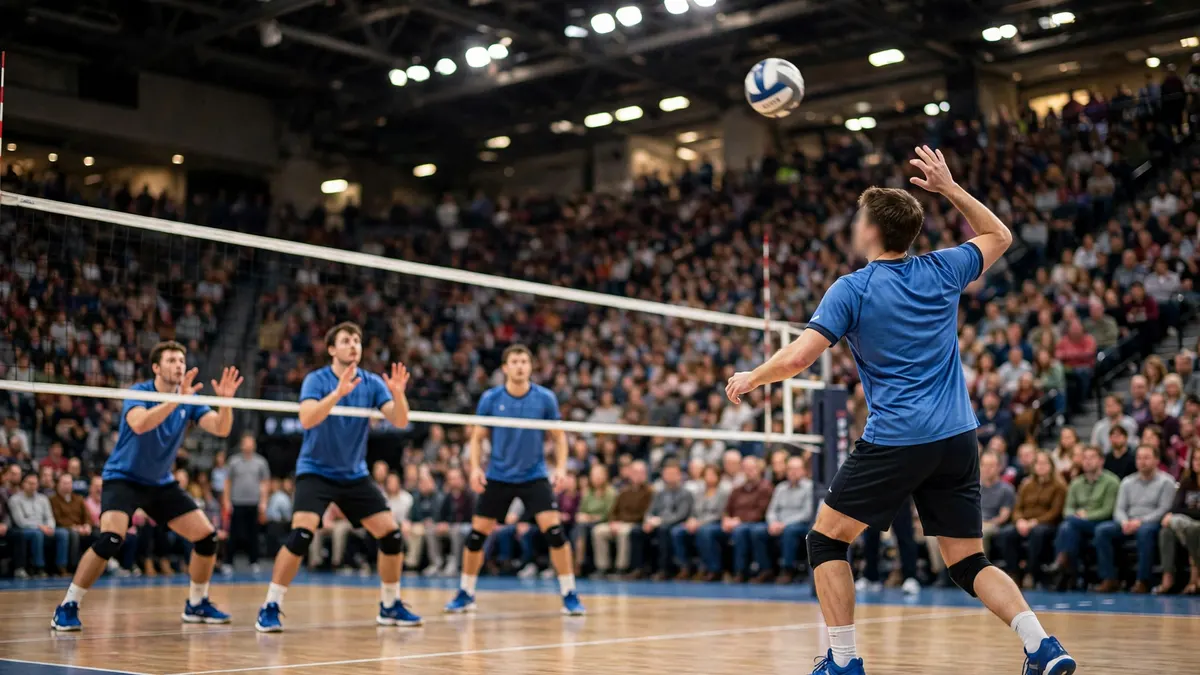
Watch a volleyball match and you will see six players moving with purpose, each doing a different job. One runs the attack on almost every rally, another digs balls in the back row that look impossible to save, and a tall player jumps to block at the net. None of this is random. Every player has a defined role, and the team works only when those roles fit together.
If you are new to the sport, the roles can look confusing, because players rotate and swap places between rallies. Once you learn what each role does, the movement starts to make sense. This guide covers every role in the indoor six-player game and helps you work out which role might suit you.
What Are the Positions in Volleyball?
In indoor volleyball, six players are on court for each team. Each player has a home spot in the rotation and a playing role, such as setter or outside hitter. The rotation spot tells you where a player stands when the ball is served. The role tells you what that player does during the rally.
The six rotation spots are numbered one to six: position one is the serving spot at the back right, two is front right, three is front middle, four is front left, five is back left, and six is back middle. When a team wins the serve back, its players rotate one spot clockwise. That shift happens after every side-out, so the team is always moving.
Front Row and Back Row
The net divides the court into a front row and a back row. Three players stand in the front row, close to the net, and three stand in the back row, further from it. Front-row players can attack and block at the net. Back-row players can attack only from behind the attack line, and they cannot block. That single rule shapes almost every decision a coach makes about who plays where.
Front-row play is about height, reach, and timing at the net. Back-row play is about reading the game, moving early, and keeping the ball alive. Most players spend time in both rows during a match, except for the libero, who plays only in the back row. If you are still learning the basic rules, our beginner’s guide to volleyball rules covers serving, scoring, and faults in plain language.
The Six Main Roles at a Glance
The table below sums up the six main roles, where they usually play, and what they are mainly asked to do.
| Role | Usual spot | Main job |
|---|---|---|
| Setter | Right side, front or back row | Runs the attack and sets the ball to hitters |
| Outside hitter | Left side at the net | Scores with high attacks and passes in serve receive |
| Middle blocker | Centre at the net | Blocks the other team’s hitters and hits quick attacks |
| Opposite hitter | Right side at the net | Attacks from the right, blocks, and backs up the setter |
| Libero | Back row only | Digs, passes, and organises the back-row defence |
| Defensive specialist | Back row, as a substitute | Passes and digs after coming in for a front-row player |
Setter: The Player Who Runs the Attack
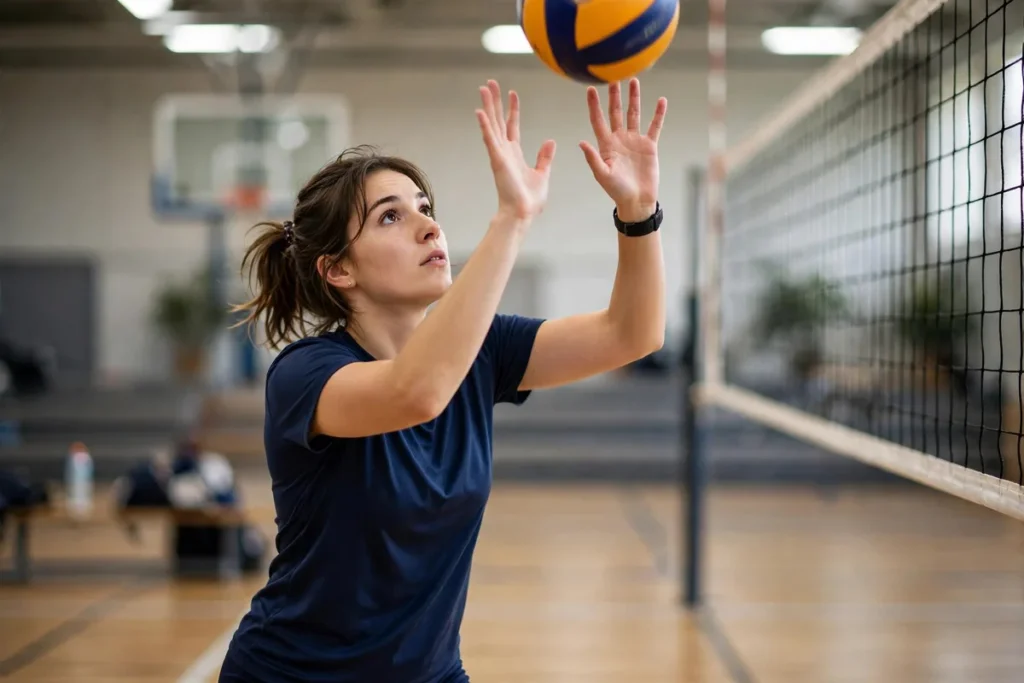
The setter is the playmaker of the team. On most rallies, the second ball goes to the setter, who chooses which hitter gets the attack and places the ball where that hitter can swing well. A good setter makes the whole team look better, keeping the attack varied enough that the defence cannot guess what is coming next.
Setters need soft, accurate hands and quick feet. They have to move to the ball, square up to the target, and deliver a clean set in a split second. They also need a sharp game sense, reading the block and picking the option that gives the team the best chance on that rally.
Setters run an offence the way a point guard does in basketball. The NBA scores page shows how often one playmaker shapes a whole game, and the setter does the same job on a volleyball court.
Setter Systems: One Setter or Two
Teams usually run one of two systems. In a 5-1, one setter stays on court the whole time and sets in every rotation. In a 6-2, two setters take turns, and each setter hits from the front row when the other one is setting. The 5-1 gives one steady playmaker; the 6-2 keeps three hitters at the net in every rotation.
- Moves early to the ball after the pass, aiming for a spot near the net on the right side.
- Chooses which hitter gets the ball based on the pass, the block, and the match situation.
- Delivers sets at different heights and speeds to suit each hitter.
- Keeps the attack varied so the other team’s block cannot settle on one hitter.
Outside Hitter: The Left-Side Scorer
The outside hitter, often called the left-side hitter, is the player most fans notice first. This hitter attacks from the left side of the net, takes a big share of the sets, and is usually the player the team turns to when a rally gets messy. The outside hitter gets high balls set near the antenna, takes a four-step approach, jumps, and swings hard.
What sets the outside hitter apart is the range of jobs. The middle blocker mostly hits and blocks. The opposite mostly hits and blocks. The outside hitter hits, blocks, passes, serves, and digs. When the team is receiving serve, the outside hitter is usually one of the main passers, and on defence the hitter drops back to dig. That workload is why coaches often put their most complete all-round player on the left side.
The outside attack starts with the approach. The hitter times the steps so the jump meets the ball at its peak, then swings while the other arm points at the ball. The hitter can aim down the line, hit cross-court, tip over the block, or tool the ball off the blocker’s hands.
- Attacks from the left side with high sets near the antenna, using line, cross-court, tip, and tool shots.
- Passes in serve receive as one of the team’s main first-touch players.
- Digs and covers in the back row, then moves fast into an attacking approach.
If you want a sense of how all-round roles work in other team sports, our beginner’s guide to basketball rules shows how one player can carry several jobs within a single team shape.
Middle Blocker: The Net Defender and Quick Hitter
The middle blocker plays in the centre of the net and has two linked jobs: block the other team’s hitters and hit quick attacks before the block can form. This is the tallest role on most teams, and it is the one where reach and timing matter most. A middle blocker who reads the setter well can shut down an attack before it starts.
Blocking is the main defensive job. The blocker jumps at the net with hands reaching over into the other team’s side, trying to stop the ball or slow it down so the defence can dig it. Good blocking is not just about jumping high. It is about reading the setter, moving early, and pressing the hands over the net. The middle blocker also slides across to form a double block when the set goes wide.
On offence, the middle blocker hits quick sets, often called ones or quicks, where the ball is set low and fast just above the net and the hitter is already in the air as it arrives. Even when the middle blocker does not get the set, the threat of a quick attack pulls the other team’s middle blocker into the centre, opening space for the outside and opposite hitters.
Blocking timing matters in every net sport. A look at the tennis scores page shows how quickly rallies turn at the net in another sport built around short, sharp exchanges.
Opposite Hitter: The Right-Side Attacker
The opposite hitter, also called the right-side hitter, plays on the right side of the net, opposite the setter in the rotation. The opposite is usually a strong attacker and blocker who does not have to pass in serve receive. That freedom lets the opposite focus on hitting and blocking, and on many teams the opposite is the most powerful hitter on court.
The opposite attacks from the right side, hitting high sets and back-row attacks from behind the attack line. Because the opposite is opposite the setter, the two players are never in the front row at the same time in a standard setup, which means the team always has a setter and a right-side hitter available in each rotation. The opposite also blocks against the other team’s outside hitter, often the strongest hitter on the other side.
Right-side attacks look a little different from left-side attacks. The hitter approaches from the right and swings across the body, so the angle is tighter and the hitter often aims down the line or sharp cross-court. The opposite also backs up the setter, setting the second ball when the setter takes the first touch or cannot reach the pass.
- Attacks from the right side, including high sets and back-row attacks from behind the attack line.
- Blocks against the other team’s outside hitter, often the strongest scorer on that side.
- Sets the second ball when the setter takes the first touch or cannot reach the pass.
For a comparison with another sport where a primary scorer carries a similar load, the WNBA scores page shows how teams lean on a main scorer, and the opposite fills a similar role in volleyball.
Libero: The Back-Row Defensive Specialist
The libero is the player in the different coloured jersey, which is there so officials and fans can spot this player easily. The libero plays only in the back row, never attacks at the net, never blocks, and never serves in most standard rules. What the libero does instead is defend, pass, and keep rallies alive.
The libero is a specialist in first touches. In serve receive, the libero takes a large share of the passes, freeing the hitters to focus on attacking. On defence, the libero reads the hitter, moves early, and digs balls that are hit hard and low. The libero also organises the back row, calling out hitters and warning teammates about tips.
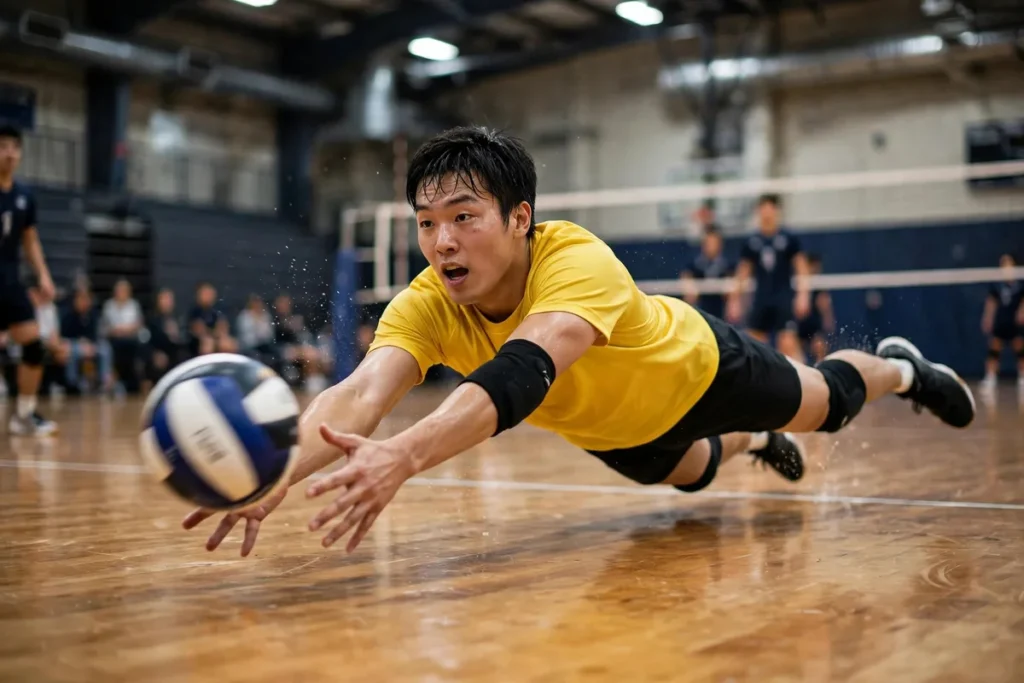
Digging is the libero’s signature skill. A dig is a controlled pass made from a hard-driven attack, usually with the forearms, that keeps the ball in play and gives the setter a chance to run the attack. Good digging is about reading the hitter, moving before the ball is hit, and staying low and balanced.
- Plays only in the back row, in a different coloured jersey from the rest of the team.
- Digs hard-driven attacks, keeping rallies alive and giving the setter a playable ball.
- Passes serves as one of the team’s most reliable first-touch players.
Our guide to softball rules for beginners shows another sport where defensive roles are just as specialised, even though the field and the ball are very different.
Defensive Specialist: The Back-Row Substitute
The defensive specialist is a back-row player who usually enters the match as a substitute, often replacing a front-row player who has rotated to the back row. The job is to pass and dig at a high level for a few rallies, then leave when the rotation turns again. It suits strong defenders and passers who may not be the team’s best hitters or blockers.
The defensive specialist is different from the libero in one key way. The libero can swap in and out freely and plays in a different jersey. The defensive specialist is a normal substitution, counts against the team’s substitution limit, and wears the same jersey as everyone else. The defensive specialist can also serve, which the libero usually cannot.
The role is like a penalty killer in hockey: unglamorous, vital, and noticed most when it goes wrong. Our beginner’s guide to ice hockey rules explains how defensive specialists work in that sport, and the mindset carries over to volleyball.
Coaches bring in a defensive specialist when they want stronger passing or digging for a stretch of the match, often when a strong hitter rotates to the back row. The role rewards readiness, because the player has to be warm, focused, and ready to perform with no time to settle in. Many liberos start as defensive specialists before moving into the full-time libero job.
How Rotations Work in General Terms
Rotations are the part of the game that new fans find hardest, so it helps to think of them as a simple cycle. At the start of a set, each team lines up in a set order. When a team wins the serve back, its six players each move one spot clockwise. That is the whole rule. Everything else is a result of that one move.
The tricky part is that players do not stay in their rotation spots during a rally. Once the ball is served, players move to their playing spots: the setter runs to the net and the hitters move to attack. They must be in the right rotation order at the moment of the serve, but after that they are free to move.
Rotation exists to make the game fair and varied. Without it, a team could keep its best hitter at the net forever. Rotation forces every player to take a turn in each spot, so teams have to be good in the front row and the back row.
- Players rotate one spot clockwise each time their team wins the serve back.
- Rotation order must be correct at the moment of the serve, then players move freely.
- Every player takes a turn in the front row and the back row, except the libero.
If you enjoy following how a lineup changes through a match, the volleyball bracket page is a useful companion, because it shows how teams move through a tournament while their rotations keep turning inside each match.
How to Choose a Position
Choosing a role is a mix of body type, skills, and what you enjoy. Height helps at the net, so tall players are often steered toward middle blocker or opposite. Quick feet and soft hands help at setter. Strong passing and a low, quick stance suit the libero and defensive specialist roles, while a good all-round game suits the outside hitter.
The best way to choose is to try each role in practice and see which one feels natural. Coaches often move young players around before settling them in one spot. A player who tries setting for a few weeks learns to read the game better, even if the player ends up as a hitter. Early variety builds a better all-round player, and it helps the player make a more informed choice later.
Players building role-specific fitness can borrow ideas from other sports. The types of martial arts guide shows how different disciplines build different strengths, and the same idea applies here: train the skills your role needs most.
- Tall with good reach and timing: try middle blocker or opposite first.
- Soft hands, quick feet, and a feel for the game: try setter first.
- Strong all-round game with hitting, passing, and defence: try outside hitter first.
- Quick, low, and a strong reader of hitters: try libero or defensive specialist first.
For a wider look at how athletes pick a role that fits their body and skills, our guide to basketball court dimensions shows how court shape influences where each player works, and volleyball roles follow a similar link between space and job.
Players who want to improve their all-round game can also learn from other sports. The basketball basket and net guide shows how equipment shapes shooting, and in volleyball the net height and the ball shape the roles in a similar way.
Frequently Asked Questions
What are the six positions in volleyball?
The six main roles are setter, outside hitter, middle blocker, opposite hitter, libero, and defensive specialist. Each role has a different job, from running the attack to digging in the back row. The six rotation spots are numbered one to six, and players move through them as the team rotates, but the role stays with the player.
Which volleyball position is the hardest to play?
Setter is often called the hardest role because the setter touches the ball on most rallies and must make a fast choice every time. Outside hitter is also demanding, asking for hitting, passing, blocking, and digging in one role. Each role is hard in its own way, and the hardest is usually the one you have practised least.
What position should a tall player choose in volleyball?
Tall players often suit middle blocker or opposite, because both roles reward reach and blocking at the net. Height also helps with hitting over the block. That said, tall players can play any role, and some tall setters and outside hitters are very effective. Timing, reading, and skill matter just as much. Try a net role first, then decide based on how it feels.
Can a libero attack or block in volleyball?
No, the libero cannot block or attack at the net in the usual sense, and the libero plays only in the back row. The role is built around digging and passing, not scoring. Those limits are why the libero wears a different jersey and swaps freely in the back row, and they are part of what makes the libero so valuable to a team.
What is the difference between a libero and a defensive specialist?
The libero plays only in the back row, wears a different coloured jersey, and swaps freely without counting as a normal substitution. The defensive specialist wears the same jersey, counts as a normal substitution, and can serve. Both focus on passing and digging, but the libero is a full-time back-row player while the defensive specialist is a short-spell substitute.
How do I pick the right volleyball position for me?
Start with your strengths and what you enjoy. Soft hands and a love of decisions point to setter. Height and good timing point to middle blocker or opposite. A strong all-round game points to outside hitter, and quick, low, alert defence points to libero or defensive specialist. Try each role in practice before settling.
The roles in volleyball give the game its shape. The setter runs the attack, the hitters score at the net, the middle blocker guards the centre, the opposite brings power from the right, and the libero and defensive specialist keep the ball alive in the back row. Learn those six jobs, watch how they move through the rotation, and the game will start to make sense rally by rally.
For one more cross-sport look at how roles shape a team, the college basketball scores page shows how different players carry different loads through a season, and volleyball works the same way: six roles, one team, and a shared job to keep the ball alive and score the point.