



Football Offside Law: The Offside Rule Explained
Offside is the law every football fan argues about and almost nobody has read. It decides goals, ends cup runs, and fills phone-ins for days. It also fits in a few lines, once you hold two ideas apart: being in an offside position is not an offence, and being in an offside position and getting involved is.
This guide explains Law 11 of the IFAB Laws of the Game in plain English: what counts as an offside position, when it becomes an offence, the three cases where it never applies, how VAR checks it, and the offside trap.
Quick Answer
Table of Contents
- Why the Offside Law Exists
- What Counts as an Offside Position
- Position Is Not an Offence
- When It Becomes an Offence: Interfering With Play
- Interfering With an Opponent
- Gaining an Advantage
- When Offside Never Applies
- The Deliberate Play Rule
- The Punishment: Indirect Free Kick
- VAR and Semi-Automated Offside
- The Offside Trap
- Offside in Youth Soccer
- Common Offside Myths
- How to Spot Offside as a Fan
- Frequently Asked Questions
Why the Offside Law Exists
Football without an offside law would be a different game. Attackers could stand next to the goalkeeper all match, waiting for a long ball. The law exists to stop goal-hanging and to keep the game stretched across the full pitch.
The rule is old. Early versions had far stricter offside laws, closer to rugby’s. The law was relaxed step by step: first to three opponents between the attacker and the goal, then to two, which is the version we still use. Our guide to how long a soccer game lasts covers the other laws that shape a match.
What Counts as an Offside Position
Law 11 defines the position in one sentence. A player is in an offside position if any part of their head, body or feet is in the opponents’ half and nearer to the opponents’ goal line than both the ball and the second-last opponent.
Three parts of that sentence do the work. First, the player must be in the opponents’ half. Second, the player must be nearer to the goal line than both the ball and the second-last opponent. Third, only the head, body and feet count. Hands and arms do not count for any player, including the goalkeeper. You can be offside by a knee, a shoulder or a toe, but not by a fingertip.
The second-last opponent is usually the last outfield defender plus the goalkeeper. But the goalkeeper is not special in the law. If the goalkeeper comes out and two outfield defenders are behind the attacker, the attacker is onside. If the goalkeeper is the only opponent behind the attacker, the attacker is offside. Level is onside: if the attacker is level with the second-last opponent, or level with the ball, there is no offside position at all.
Position Is Not an Offence
This is the sentence that unlocks the whole law: it is not an offence to be in an offside position. A striker can stand five yards beyond the last defender all afternoon, and as long as the ball never comes to them and they never interfere, the referee does nothing.
The position is judged at one moment only: when the ball is played or touched by a teammate. Not when the attacker receives it, and not when they shoot. The assistant referee watches the passer, not the receiver.
This timing rule is why so many offside calls look wrong on first viewing. Fans watch the moment the attacker receives the ball, when the attacker is clearly beyond the defence. The official watches the moment the ball was played, when the attacker may have been level. The two moments are often a second apart, and a second is enough for a fast striker to gain five yards.
When It Becomes an Offence: Interfering With Play
A player in an offside position is only penalised when they become involved in active play. Law 11 gives three ways that happens, and this section covers the first: interfering with play.
Interfering with play means playing or touching a ball passed or touched by a teammate. The attacker was offside when the pass was made, the ball reaches them, and they touch it. The flag goes up. It does not matter whether the touch is a shot, a pass, or a clumsy first touch. Touching the ball is enough.
It also does not matter whether the attacker meant to be offside. Offside is not about intent. A striker who drifts a yard beyond the line while watching the ball is offside just as surely as one who plans it. The law judges position, not motive. Our MLS scores page shows the results of the league where many fans first learn this rule in detail.
The one thing that saves an attacker here is the source of the ball. If the ball comes from an opponent rather than a teammate, the rules change, and that is covered in the deliberate play section below.
Interfering With an Opponent
The second way to commit an offside offence is interfering with an opponent. This is the one that causes the most confusion, because the attacker does not need to touch the ball.
A player interferes with an opponent by preventing them from playing the ball, by obstructing their line of vision, or by challenging them for the ball. The classic case is a striker standing in front of the goalkeeper, blocking their view of a shot from distance. The striker never touches the ball, the shot goes in, and the goal is disallowed.
Another common case is the decoy run. An attacker in an offside position sprints toward the ball, and a defender follows them, leaving space for a teammate who was onside. If the offside player clearly challenges for the ball, the offence is given. The World Cup simulator shows how these calls can shape a tournament.
Gaining an Advantage
The third way is gaining an advantage by being in an offside position. If a shot hits the post, bounces off the goalkeeper, or is blocked by a defender, and the ball falls to an attacker who was in an offside position when the shot was taken, that attacker has gained an advantage from the position. The goal is disallowed. The logic is simple: the attacker was only in that spot because they were offside, and the rebound is their reward for it.
There is one important exception. If the ball reaches the attacker from an opponent who deliberately played it, the attacker has not gained an advantage, and play goes on. A save is not a deliberate play: if the goalkeeper parries a shot and it falls to an offside attacker, the offence stands, because the save was forced, not chosen.
When Offside Never Applies
Law 11 lists three restarts where there is no offside offence at all: a goal kick, a throw-in, or a corner kick. Directly is the key word: the exemption applies to the first touch after the restart, not to the next pass.
The goal kick exemption surprises new fans most. A goalkeeper can launch the ball upfield, and a striker standing beyond the whole defence can collect it and score. The same applies to throw-ins and corners.
The definition itself rules out two more cases. A player cannot be offside in their own half, and cannot be offside if they are level with or behind the ball when it is played. A winger who receives the ball level with the passer is onside, however far up the pitch they both are.
The Deliberate Play Rule
This is the subtlest part of the law. A player in an offside position who receives the ball from an opponent who deliberately played it is not considered to have gained an advantage, unless it was a deliberate save.
Deliberate play means the defender chose to play the ball: a pass, a clearance, or an attempted interception they had time and control to make. If the ball ricochets to an attacker who was offside, the attacker is onside, because the defender’s touch reset the phase.
A deliberate save is different. If the goalkeeper or a defender blocks a shot on the line, that is a save, not a deliberate play, and an offside attacker who collects the rebound is still penalised. A deflection is different again: if the ball merely bounces off a defender who had no chance to control it, that is not a deliberate play either.
The Punishment: Indirect Free Kick
If an offside offence occurs, the referee awards an indirect free kick to the defending team. Indirect means the ball must touch another player before a goal can be scored from it.
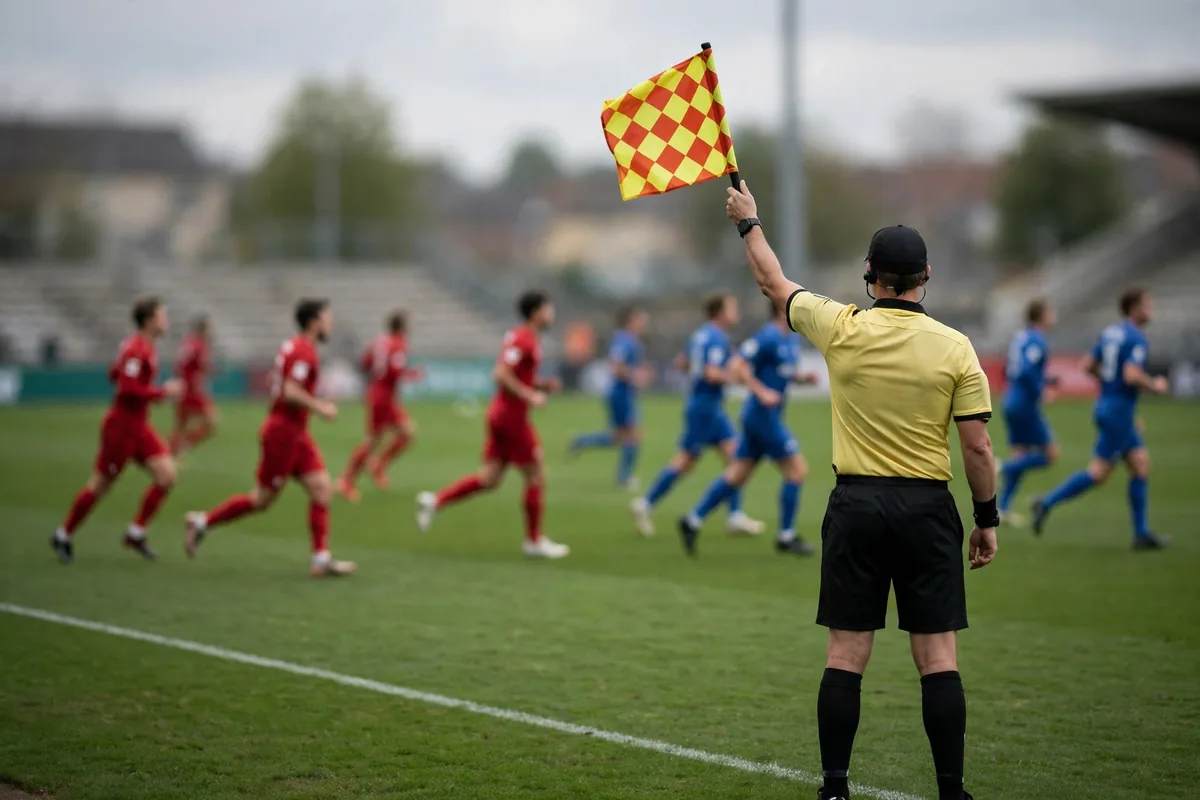
Offside is not a foul and not misconduct. A player cannot be booked for being offside, and there is no penalty kick for an offside offence. The assistant referee raises the flag when an offside offence has occurred, not when a player strays into an offside position.

VAR and Semi-Automated Offside
VAR checks offside in a narrow set of situations: goals, penalty decisions, direct red cards, and mistaken identity. For offside, the check that matters is goals.
The check has two steps. First, find the exact moment the ball was played by the teammate. Second, draw the lines: one through the second-last opponent, one through the attacker. If any part of the attacker’s head, body or feet is beyond the defender’s line, the attacker is offside.
Semi-automated offside technology now does this faster in several major competitions. Cameras and sensors track the players and the ball, detect the moment of the pass, and produce the offside line within seconds. The referee still makes the final decision. Hockey reviews goals too, and our ice hockey rules for beginners guide explains how that sport handles disputed goals.
The FIFA brackets page shows how a single VAR call can change a knockout tie.
The Offside Trap
The offside trap is the defensive answer to the law. The back line steps up in unison, just as the opponent plays the ball forward, leaving the attackers beyond the second-last opponent. If the timing is right, the flag goes up. If it is wrong by a fraction, the striker is through on goal.
The trap needs four defenders who move as one, and a goalkeeper who sweeps behind them. It is high risk, because one defender who steps up late plays everyone onside. The trap is also why the law matters tactically. Without it, defences would have to sit deep, and the game would lose its most exciting moment: the through ball that splits a high line. With it, the game becomes a contest of timing, and the best strikers are the ones who time their runs to the passer’s foot, not to the ball’s flight. Fans who want to understand how a match is structured should read our guide to how long a soccer game lasts, which covers the shape of the game the trap is played in.
Offside in Youth Soccer
Small-sided youth soccer treats offside differently, and this is where most parents’ confusion starts. In the United States, under U.S. Soccer’s small-sided standards, there is no offside at all in 4v4 games for under-8s and younger, and there is no goalkeeper either.
From 7v7, for under-9s and under-10s, offside applies, but only between the build-out line and the goal line. The build-out line is drawn across the pitch partway between the halfway line and the penalty area. Full offside under Law 11 applies from 9v9 onwards, usually from under-11s. Other sports teach their rules to young players the same way, and our volleyball rules for beginners guide covers another net sport from the ground up.
Other countries use similar stepped versions, and the exact ages vary by association. The principle is the same everywhere: introduce the law gradually. Starting a new sport is easiest young, and our how can I play cricket guide is a good first read for a second sport.
Common Offside Myths
Myth one: you cannot be offside if the ball is passed backwards. Wrong. The law does not care about the direction of the pass. It cares about the attacker’s position when the ball is played. A backward pass to a player beyond the second-last opponent is still offside.
Myth two: you cannot be offside from a free kick. Wrong. Free kicks are not on the exempt list. Only goal kicks, throw-ins and corners are exempt.
Myth three: the goalkeeper always counts as one of the two opponents. Wrong. The law counts the second-last opponent, whoever that is. If the goalkeeper is up for a corner and two outfield players are behind the attacker, the attacker is onside.
Myth four: being in an offside position is a foul. Wrong. Offside is not a foul and not misconduct. No card can be shown for it, and the restart is an indirect free kick, not a penalty.
Myth five: VAR checks every offside. Wrong. VAR checks offside only when it matters to a goal, a penalty, or another reviewable incident. An offside in the middle of the pitch that leads nowhere is never reviewed. The tennis scores page shows a sport where line calls are checked far more often.
How to Spot Offside as a Fan
Watch the passer, not the receiver. That is the whole trick. When the ball is played, freeze the picture in your mind: where was the attacker, where was the second-last defender, and where was the ball? If the attacker was beyond both, and then got involved, it is offside.
Watch the assistant referee’s position too. The assistant stays level with the second-last opponent, or with the ball when the ball is further forward. If they are sprinting to keep up with a run, the line is moving, and the call is close.
Finally, accept the close ones. The law is drawn to the centimetre now, and a striker’s toe can be the difference between a goal and a free kick.
Other sports have the same problem with their own lines. Our guide to basketball rules for beginners shows how basketball draws its boundaries.
Our guide to baseball rules for beginners does the same for baseball.
Frequently Asked Questions
What is the offside rule in simple terms?
A player is offside if they are in the opponents’ half, ahead of the ball and the second-last opponent when a teammate plays the ball, and then they get involved. Being ahead alone is not an offence.
Can you be offside in your own half?
No. A player cannot be in an offside position in their own half, no matter how far forward they are when the ball is played.
Can you be offside from a corner?
No. There is no offside offence when a player receives the ball directly from a corner kick, a goal kick, or a throw-in.
Does the goalkeeper count for offside?
The law counts the second-last opponent, and the goalkeeper is usually one of the two. If the goalkeeper is out of position, two outfield defenders can be the two.
What is the punishment for offside?
An indirect free kick to the defending team, taken where the offence occurred. Offside is not a foul, so no card can be shown for it.
How does VAR check offside?
VAR finds the exact frame the ball was played and draws a line through the second-last opponent and the attacker.
What is the offside trap?
A defensive tactic where the back line steps up together as the ball is played, leaving the attackers offside.
Can you be offside if the pass goes backwards?
Yes. The direction of the pass does not matter; the attacker’s position when the ball is played does.
Share this article: X | Facebook | LinkedIn | Email
Written by Hafs | View all articles by Hafs
Facts checked on 14 November 2026. Sources: IFAB Laws of the Game 2026-27 (Law 11), the FA’s Law 11 guide, Wikipedia’s Offside page, and Sports Flash Daily’s own soccer guides for the linked articles.