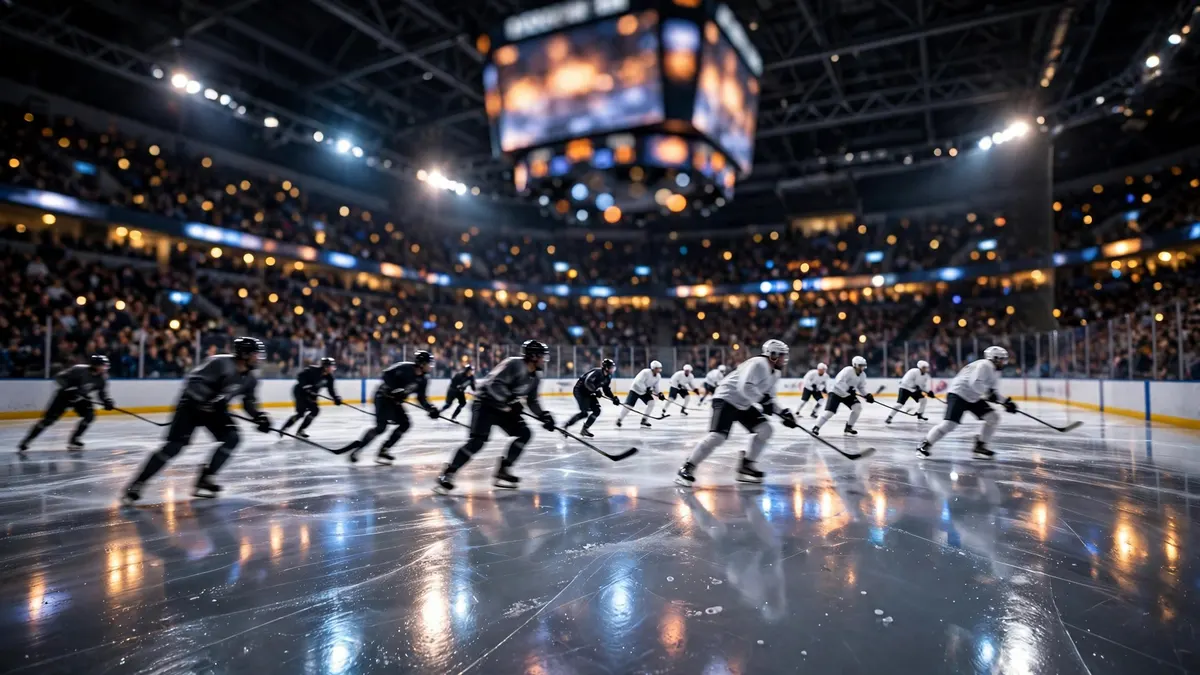



A hockey game lasts 60 minutes on the clock and about two and a half hours in real life. That gap confuses every new fan. The clock says one thing, the evening says another, and the difference is made up of intermissions, stoppages, television breaks and, sometimes, overtime.
This guide explains every minute. It covers the three periods, the two intermissions, why a 20-minute period takes 35 to 40 minutes to play, how overtime and shootouts work, and how long a game takes at every level from the NHL to youth hockey.
Quick Answer
How long is a hockey game? A hockey game has 60 minutes of regulation play, split into three 20-minute periods, with two 18-minute intermissions between them. The game clock stops on every whistle, so a period takes 35 to 40 minutes in real time. Across 1,312 NHL games in the 2025-26 regular season, the average game ran 2 hours and 32 minutes from puck drop to final horn. Regulation games averaged 2 hours and 30 minutes. If the score is tied, regular-season games go to a five-minute sudden-death overtime and then a shootout, while playoff games play full 20-minute overtime periods until someone scores, with no time limit.
Table of Contents
- Regulation Time: Three 20-Minute Periods
- Intermissions: The Breaks Between Periods
- Why a 20-Minute Period Takes 35 to 40 Minutes
- How Long Is Overtime in Hockey?
- The Shootout Explained
- Playoff Hockey: When Games Have No Time Limit
- How Long Is a Hockey Game on TV?
- How Long Is a Hockey Game at Other Levels?
- Planning Your Night: How Much Time to Block Off
- Frequently Asked Questions
Regulation Time: Three 20-Minute Periods
A hockey game is played in three periods of 20 minutes each, for 60 minutes of regulation play. The NHL rulebook states it plainly: three twenty-minute periods of actual play, with a rest intermission between periods. The clock counts down from 20:00 to 0:00 in each period, and the team with more goals at the end of the third period wins.
The key word is “actual play.” The clock runs only while the puck is live. Every time the whistle blows, for an icing, an offside, a penalty, a goal, or a puck frozen by the goalie, the clock stops. There is no running clock and no stoppage time like soccer. If the puck is not live, the clock is not moving, and that is why a 60-minute game takes two and a half hours.
Teams switch ends after each period, and they defend the goal closest to their own bench in the second period in most leagues. The switch is a small detail, and it matters for strategy. Coaches want the long change in the second period, when their players have further to skate to the bench, and it shapes how they use their lines.
If you are new to the sport, our ice hockey rules for beginners explain the offside rule, icing, and penalties in plain English. The rules are the reason the clock stops so often, and understanding them makes the length of a game make sense.
Intermissions: The Breaks Between Periods
There are two intermissions in a hockey game, one after the first period and one after the second. In the NHL, each intermission lasts 18 minutes. The intermission clock does not start until the last official has left the ice, so the real gap between periods runs a little longer than 18 minutes.
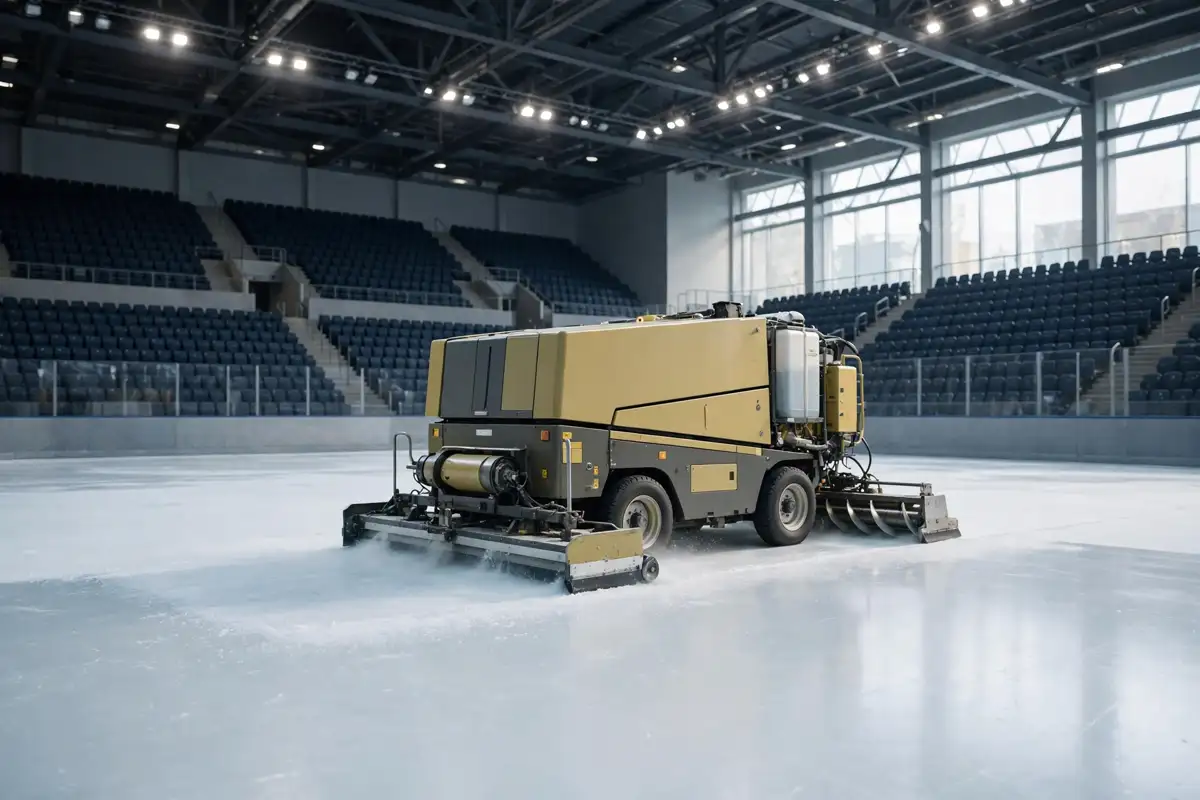
Intermissions exist for three reasons. The ice needs resurfacing, and the Zamboni needs time to make a full pass. The players need rest, fluids and coaching adjustments. And the broadcast needs time for analysis, replays and advertising. Eighteen minutes is long enough for all three, and short enough to keep the crowd in the building.
Two intermissions add 36 minutes to the night before a single whistle blows. Add that to the 60 minutes of regulation play and you reach 96 minutes, or one hour and 36 minutes. The remaining hour of a typical game comes from stoppages, television breaks and everything else that fills a period.
Fans use intermissions differently depending on where they watch. At the arena, it is time for food, the bathroom and the concourse. At home, it is time to check the other games and the highlights.
Why a 20-Minute Period Takes 35 to 40 Minutes
A 20-minute period takes 35 to 40 minutes of real time, and the gap comes from everything that stops the game. Faceoffs, penalties, goals, video reviews, injuries and pucks leaving the rink all stop the clock, and each stoppage adds a minute or two of real time while the game clock stays still.
Television timeouts are the biggest single addition. NHL games get three commercial breaks per period, taken at the first eligible whistle after the 14:00, 10:00 and 6:00 marks. Each break runs about two minutes, which adds about 18 minutes across a full game. The rules block a commercial break right after a goal and right after an icing, so a team that iced the puck cannot use the ad break to rest tired legs.
Goals add time, but less than fans expect. In the 2025-26 season, regulation games with three goals or fewer averaged 2 hours and 27 minutes, while games with eight or more goals averaged 2 hours and 32 minutes. That is five minutes for all the celebrations, replays and centre-ice faceoffs. On October 1, 2026, Edmonton beat the Canucks 9-7 in Vancouver, sixteen goals in total, and the whole game took 2 hours and 37 minutes.
Penalties add time too, because a power play changes the shape of the game and the officials need time to sort out coincidental minors and misconducts. Video reviews for goals can add several minutes, and they happen most often in close games where the stakes are highest.
Each team also gets one 30-second timeout per game, and coaches usually save it for the final minutes of a close game. It is a small number, and it rarely decides the length of a night. The real time comes from the whistles, and hockey has more of them than any other major sport.
How Long Is Overtime in Hockey?
Overtime only happens if the score is tied after 60 minutes of regulation, and the rules change completely depending on whether it is the regular season or the playoffs.
Regular-season overtime
In the NHL regular season, a tied game goes to one five-minute sudden-death overtime period, played three-on-three. The next goal wins. There is no intermission before overtime. The crew shovels the ice, the teams stay at their benches, and the rulebook says overtime should start about two minutes after regulation ends.
Three-on-three overtime is fast and open, because the extra space creates breakaways and odd-man rushes. Most overtime games end quickly. In the 2025-26 season, the average overtime winner came 2 minutes and 26 seconds into the extra period, and about two-thirds of overtime goals came in the first three minutes. Games that went to overtime averaged 2 hours and 35 minutes, only five minutes longer than games decided in regulation.
If nobody scores in the five minutes, the game goes to a shootout. The shootout is covered in the next section, and it is the part of the night that adds the most time to a regular-season game.
Playoff overtime
Playoff hockey throws out the shootout entirely. If a game is tied after 60 minutes, the teams take a 15-minute intermission and play a full 20-minute sudden-death period at five-on-five. If that ends tied, they do it again. And again. The first goal wins, whenever it comes.
That changes the math completely. In the 2026 Stanley Cup Playoffs, games settled in regulation averaged 2 hours and 37 minutes, and the 22 games that went to overtime averaged 3 hours and 15 minutes. Four went to double overtime, and every one of them ran about four hours. Playoff overtime has no time limit, and that is what makes it the most dramatic format in the sport.

The Shootout Explained
The shootout decides regular-season games that are still tied after overtime. Each team picks three shooters, and they take turns skating in alone on the goalie. The team with more goals after three rounds wins. If the score is still tied, the shootout continues one round at a time until one team scores and the other does not.
Shootouts add real time to a game. A shootout game in the 2025-26 season averaged 2 hours and 44 minutes, fourteen minutes longer than a regulation game. The extra time comes from the full overtime period, a second round of ice shovelling, and the shootout itself, with its pauses between shooters and its celebrations after a winner.
The shootout is also one of the most debated parts of the sport. Fans love the drama of a one-on-one duel, and purists dislike deciding a team game with an individual skills contest. The NHL keeps it because it guarantees a winner on the night, and because it avoids the endless overtime periods that would make the regular-season schedule impossible.
For the players, the shootout is a specialist skill. Some scorers are famous for their shootout moves, and some goalies are famous for stopping them. Coaches pick their three shooters carefully, usually mixing a sniper, a deker and a player with a hot hand.
Playoff Hockey: When Games Have No Time Limit
Playoff overtime is where hockey becomes legend. The games have no time limit, the stakes are the highest in the sport, and the players keep going until someone scores. The longest games in NHL history are all playoff games, and the list reads like a museum of the sport.
| Rank | Game | Date | Overtimes | Total game time |
|---|---|---|---|---|
| 1 | Red Wings 1, Maroons 0 | March 24, 1936 | 6 | 176:30 |
| 2 | Maple Leafs 1, Bruins 0 | April 3, 1933 | 6 | 164:46 |
| 3 | Flyers 2, Penguins 1 | May 4, 2000 | 5 | 152:01 |
| 4 | Lightning 3, Blue Jackets 2 | August 11, 2020 | 5 | 150:27 |
| 5 | Ducks 4, Stars 3 | April 24, 2003 | 5 | 140:48 |
| 6 | Panthers 3, Hurricanes 2 | May 18, 2023 | 4 | 139:47 |
The longest game ever played was on March 24, 1936, when the Detroit Red Wings beat the Montreal Maroons 1-0. Mud Bruneteau, a rookie who had scored two goals all season, ended it at 16:30 of the sixth overtime, after 176 minutes and 30 seconds of play. The game ended at 2:25 in the morning. Detroit goalie Normie Smith reportedly made 92 saves.
The modern entries on the list are just as remarkable. In 2000, Keith Primeau ended a five-overtime game between Philadelphia and Pittsburgh after 152 minutes. In 2020, Brayden Point ended a five-overtime game between Tampa Bay and Columbus after 150 minutes. In 2023, Matthew Tkachuk ended a four-overtime game between Florida and Carolina after nearly 140 minutes.
These games are rare, and that is part of their power. In the 2026 playoffs, only four games went to double overtime, and each ran about four hours. Most playoff games end in regulation or in the first overtime. The marathon games are the exception, and they are remembered for decades because they break every rule about how long a game should last.
If you follow the NHL closely, our NHL scores page tracks the results as they happen, including the playoff games that run long into the night.
Our Pittsburgh Penguins rumors page follows one of the league’s most storied franchises through the season. The Penguins appear on the longest-games list from 2000, and their history is tied to the playoff marathon as much as any team’s.
How Long Is a Hockey Game on TV?
Watching on television adds time around the game itself. The broadcast usually starts 30 minutes before puck drop with a pre-game show, and it runs 15 to 30 minutes after the final horn. A game that takes 2 hours and 32 minutes on the ice takes about three hours and 15 minutes of your evening if you watch the full broadcast.
The listed start time is not always the puck drop. Ceremonies, banner raisings and pre-game events can push the first faceoff back. On the opening night of the 2026-27 season, the Carolina Hurricanes raised their Stanley Cup banner before the game, and the puck did not drop until 5:20 p.m. for a game listed at 5 p.m.
Commercial breaks are the main reason a televised game feels longer than the same game in the arena. The three breaks per period add about 18 minutes, and the intermission shows add analysis and advertising around the 36 minutes of breaks.
If you record a game, plan for the overrun. A recording set for two and a half hours will cut off an overtime game, and a recording set for three hours will cut off a long playoff game. Set the recording for four hours in the playoffs, and you will catch almost everything. The same advice applies to a DVR and to a streaming replay, since both stop when the scheduled window ends.
Football broadcasts run longer than hockey, and our NFL scores page follows the league whose games stretch past three hours on television.
How Long Is a Hockey Game at Other Levels?
The NHL is not the only version of the sport, and the length changes at every level. The table below compares the main levels, using the standard formats for each.
| Level | Regulation | Intermissions | If tied (regular season) | If tied (playoffs) |
|---|---|---|---|---|
| NHL | 3 x 20 minutes | 2 x 18 minutes | 5-minute 3-on-3 OT, then shootout | 20-minute 5-on-5 OT periods until a goal |
| NCAA | 3 x 20 minutes | 2 x 15 minutes | 5-minute 3-on-3 OT, then shootout if the conference uses one | 20-minute sudden-victory OT periods |
| AHL | 3 x 20 minutes | 2 x 18 minutes | 5-minute 3-on-3 OT, then shootout | 20-minute OT periods until a goal |
| International (IIHF) | 3 x 20 minutes | 2 x 15 minutes | 5-minute 3-on-3 OT, then shootout | 20-minute OT periods until a goal |
| Youth / high school | Shorter periods | Shorter breaks | Varies by league | Varies by league |
College hockey uses the same three 20-minute periods as the NHL, with 15-minute intermissions. The overtime rules differ in one important way. The NCAA made five-minute three-on-three overtime mandatory starting in 2020-21, and a shootout can settle a regular-season game if the host school’s conference uses one. Otherwise the game can end in a tie, which is something the NHL never allows. In conference tournaments and the national tournament, college hockey uses full 20-minute overtime periods.
The American Hockey League, the NHL’s top minor league, follows the same format as the NHL. Games run about two and a half hours, with the same overtime and shootout rules. If you want a cheaper night at the rink, our American Hockey League tickets page explains how the minor league works.
International hockey under the IIHF also uses three 20-minute periods, with 15-minute intermissions and a five-minute overtime followed by a shootout in most tournament games. The main difference is the rink, which is wider in international play, and the style, which tends to be faster and less physical. The length of the game stays about the same.
Youth, high school and adult recreational leagues play shorter games. Periods are often 12 to 15 minutes, and the whole game can finish in 60 to 90 minutes including breaks. The exact length is up to the league and how much ice time it books. If your child has a game on Saturday, the league’s own rules are the place to check.
Planning Your Night: How Much Time to Block Off
For a regular-season NHL game, plan on two and a half hours from puck drop. Add 30 minutes before the game for travel, parking and finding your seat, and 30 minutes after for getting out of the arena. A night at the rink is a four-hour commitment door to door, and that is before overtime.
For a playoff game, plan on three hours from puck drop and do not make plans for after. Overtime in May does not care about your babysitter, and a game that looks like a regulation win at 9 p.m. can still be going at midnight. The four double-overtime games in the 2026 playoffs each ran about four hours.
If you watch from home, the math is simpler. Block off three hours for a regular-season game, including the pre-game show, and three and a half hours for a playoff game. If the game goes to overtime, you will be glad of the buffer. If it does not, you get an early night.
The season itself is longer than it used to be. The NHL went to 84 games per team in 2026-27, up from 82. At last season’s average of 2 hours and 32 minutes, watching every game of your team takes about 212 hours across the season. That is a serious commitment, and it is why most fans pick their nights.
Money matters too, and the business of the sport shapes the experience. Our NHL salary cap page explains how teams build their rosters under the cap.
Our Boston Bruins lines page follows one of the league’s most famous teams. The Bruins are a useful example of how a franchise manages its roster and its ice time across a long season.
Other sports run on different clocks, and the comparison helps. Soccer games run about two hours including half-time, and our guide to how long a soccer game lasts explains why the clock works differently there.
Baseball has no clock at all, and our baseball rules for beginners explain why innings, not minutes, decide the length of a game.
Basketball runs on a different clock too, with four quarters and a shot clock, and our basketball rules for beginners explain how its timing works.
Baseball fans planning a summer night can check the MLB scores page for the evening’s games.
College fans can follow the college football scores page for the Saturday action in the fall.
Frequently Asked Questions
How long is a hockey game?
A hockey game has 60 minutes of regulation play, three 20-minute periods, but takes about two and a half hours in real time. Across 1,312 NHL games in the 2025-26 regular season, the average game ran 2 hours and 32 minutes.
How many periods are in hockey?
Hockey has three periods. In the NHL and NCAA, each period is 20 minutes of game clock, for 60 minutes of regulation. The clock stops on every whistle, so each period takes much longer than 20 minutes in real time.
How long is an intermission in hockey?
NHL intermissions are 18 minutes, and there are two of them, after the first and second periods. The intermission clock starts once the last official leaves the ice. In the playoffs, teams take a 15-minute intermission before each 20-minute overtime period.
How long is overtime in the NHL?
In the regular season, NHL overtime is one five-minute, three-on-three, sudden-death period, followed by a shootout if no one scores. In the Stanley Cup Playoffs there is no shootout. Teams play full 20-minute, five-on-five overtime periods until someone scores.
How long is a playoff hockey game?
In the 2026 Stanley Cup Playoffs, games decided in regulation averaged 2 hours and 37 minutes, and the 22 games that went to overtime averaged 3 hours and 15 minutes. The four double-overtime games each ran about four hours.
What is the longest NHL game ever played?
The longest NHL game was played on March 24, 1936, when the Detroit Red Wings beat the Montreal Maroons 1-0. Mud Bruneteau scored at 16:30 of the sixth overtime, ending the game after 176 minutes and 30 seconds of play.
How long is a hockey game on TV?
A televised game takes about three hours and 15 minutes including the pre-game show and post-game coverage. Recordings should be set for four hours in the playoffs to catch overtime.
How long is a youth hockey game?
Youth, high school and adult recreational games are shorter. Periods are often 12 to 15 minutes, and the whole game usually finishes in 60 to 90 minutes including breaks. The exact format varies by league, so check the league’s own rules.
Share this article: Share on X · Share on Facebook · Share on LinkedIn · Share by Email
Written by Saadi for Sports Flash Daily. View all articles by Saadi.
Facts checked on 13 November 2026. This guide was made by checking the NHL’s 2026-27 rulebook for the period and intermission lengths, and by using the official game summaries for all 1,312 games of the 2025-26 NHL regular season and all 82 playoff games for the average lengths.