




Volleyball Court: Dimensions, Lines and Net Height
A volleyball court looks simple from the stands: a rectangle, a net, and a few white lines. Those lines decide almost every point, though. A ball on a line is in, a foot over a line can cost a serve, and a back-row player who jumps from the wrong side of the attack line gives the point away. Fans who can read the court can follow the game.
This guide covers the whole court in plain English: the size in metres and feet, every line and what it does, net heights for men, women and juniors, the zones where players stand, the free zone around the court, and the differences between indoor, beach, grass and sitting volleyball. It also shows how to set up a court at home, at school, or in a gym, and how to avoid the mistakes that make a court play badly.
Quick Answer
Table of Contents
- The Court at a Glance
- Indoor Court Dimensions in Metres and Feet
- Every Line on the Court, Explained
- The Attack Line and the Front and Back Rows
- Net Height: Men, Women and Juniors
- The Net, Posts and Antennas
- The Six Zones: Where Players Stand
- The Free Zone and Ceiling Height
- Beach Volleyball Court
- Grass, Sitting and Junior Courts
- How to Set Up a Volleyball Court
- Common Court Mistakes and How to Fix Them
- Frequently Asked Questions About the Volleyball Court
The Court at a Glance
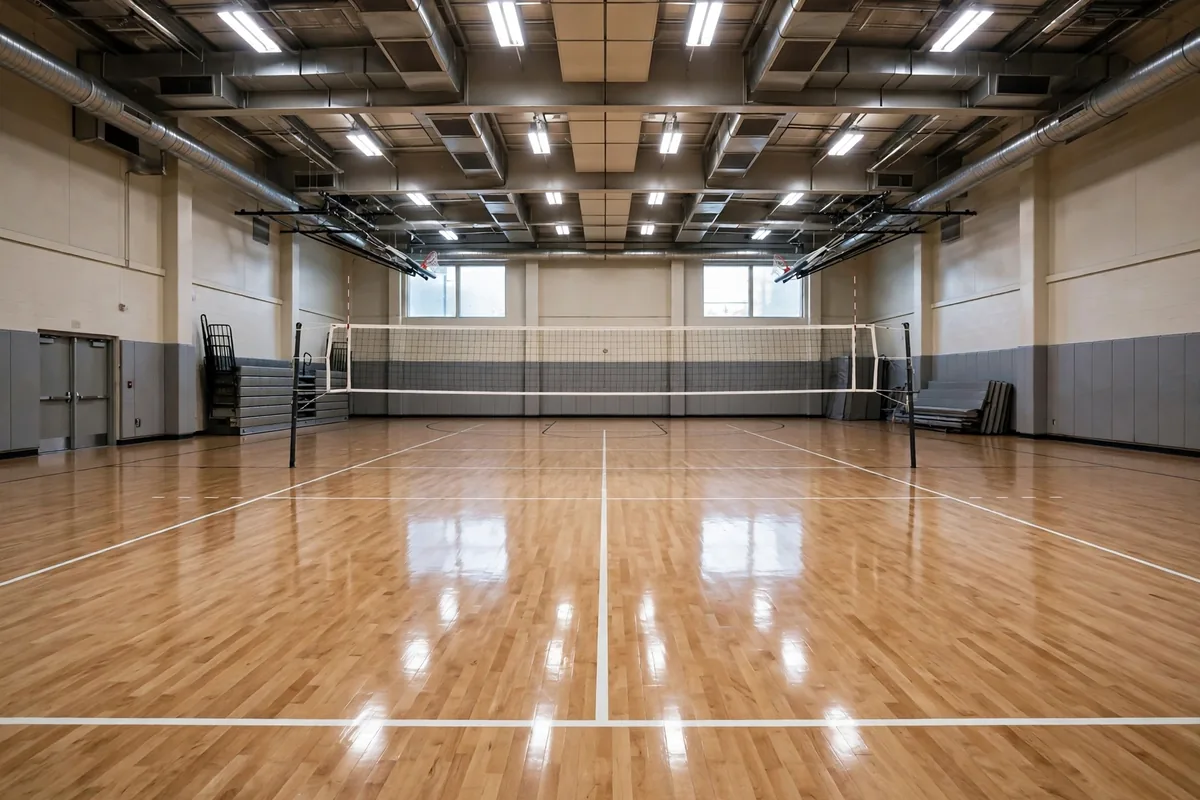
A volleyball court is a rectangle 18 metres long and 9 metres wide. A net divides it into two equal halves, each 9 metres by 9 metres. The playing surface must be flat, even and free of obstacles, and the lines must contrast with the floor so players and officials can see them clearly.
Our main guide to the sport, volleyball, explains how a match works, and this guide is the companion piece that explains the ground it is played on.
Indoor Court Dimensions in Metres and Feet
The official indoor size under the FIVB rules is 18 metres by 9 metres, a fixed rectangle, and the same measuring habit applies in our tennis scores guide to reading a court. In feet, that is 59 feet by 29 feet 6 inches. The area of the court is 162 square metres, or about 1,744 square feet.
The table below gives the key measurements in one place, so you can check a court against the standard without hunting through a rulebook.
| Measurement | Metres | Feet and inches |
|---|---|---|
| Court length | 18 m | 59 ft |
| Court width | 9 m | 29 ft 6 in |
| Each half | 9 m × 9 m | 29 ft 6 in square |
| Attack line from centre line | 3 m | 9 ft 10 in |
| Line width | 5 cm | 2 in |
| Free zone, FIVB minimum | 3 m all sides | 9 ft 10 in |
| Ceiling height, FIVB minimum | 7 m | 23 ft |
| Net height, men | 2.43 m | 7 ft 11⅝ in |
| Net height, women | 2.24 m | 7 ft 4⅛ in |
Every Line on the Court, Explained
Every line on a volleyball court has a job. The boundary lines decide whether a ball is in or out. The centre line divides the two halves. The attack line divides the front row from the back row. Together they form the map that players, referees and fans all read.
- Sidelines. The two long lines down the sides of the court. A ball landing outside a sideline is out.
- End lines. The two short lines at the back of each half. The server stands behind the end line to serve.
- Centre line. The line under the net, running across the full width of the court. It divides the two halves, and players must not cross it completely during a rally.
- Attack lines. The lines 3 metres from the centre line on each side. They mark the boundary between the front row and the back row.
- Line width. All lines are 5 cm wide, about 2 inches. Lines are part of the court, so a ball that touches any part of a line is in.
How line calls work
A ball is in if any part of it touches a boundary line. A ball is out if it lands completely outside the lines, hits an object outside the court, or crosses the net outside the antennas. The first referee judges most line calls, with line judges helping at higher levels.
The Attack Line and the Front and Back Rows
The attack line is the most tactical marking on the court. It sits 3 metres from the centre line on each side, and it divides each half into a front zone and a back zone. Three players stand in the front row, near the net, and three stand in the back row, near the end line.
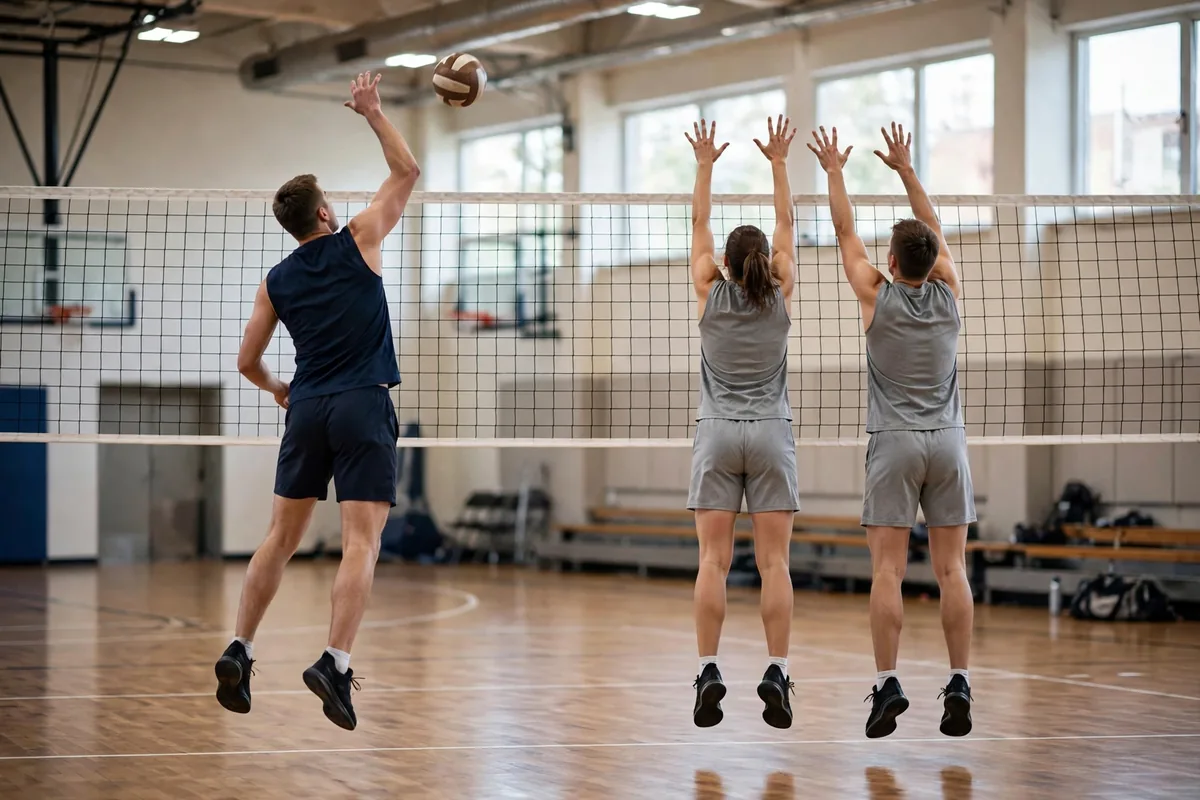
Front-row players can attack a ball that is above the net from anywhere in the front zone. Back-row players can only attack a ball above the net if they jump from behind the attack line. If a back-row player jumps from in front of the line and hits a ball above the net, it is a fault and the point goes to the other team.
Our guide to positions in volleyball walks through each role and where it stands in every rotation, and it is the best next read after this section.
Net Height: Men, Women and Juniors
The net sits 2.43 metres high for men and 2.24 metres for women, and our basketball rules for beginners guide shows how other indoor sports set their heights. In feet, that is 7 feet 11⅝ inches for men and 7 feet 4⅛ inches for women. The height is measured from the centre of the court, at the middle of the net, and the net must not be more than 2 cm higher at the sidelines.
The table below lists the standard heights at a glance.
| Players | Net height |
|---|---|
| Men | 2.43 m (7 ft 11⅝ in) |
| Women | 2.24 m (7 ft 4⅛ in) |
| Co-ed | 2.43 m (7 ft 11⅝ in) |
| Reverse co-ed | 2.24 m (7 ft 4⅛ in) |
| Juniors and veterans | Lower, by age group |
A net set too high kills a casual game, because nobody can attack over it. A net set too low makes the game too easy and teaches bad habits. Measure the height at the centre of the net with a tape measure, not by eye, and adjust the posts until it is right.
The Net, Posts and Antennas
The net itself is 1 metre tall from top to bottom and 9.5 to 10 metres long, with 10 cm square mesh. It hangs across the centre line, with its top edge at the official height and its bottom edge about a metre lower. The top of the net has a white band, and the bottom has a similar band.
The posts hold the net up. They stand outside the sidelines, 0.5 to 1 metre beyond the court, so players can play the ball in the free zone without hitting a post. At higher levels the posts are padded for safety. The posts must be stable enough that the net stays taut through a match.
Two antennas stick up from the net at the sidelines. They are thin, flexible rods, 1.8 metres long, and they mark the sides of the crossing space. A ball must pass between the antennas to count. A ball that crosses outside an antenna, or hits an antenna, is out.
The Six Zones: Where Players Stand
Each half of the court is divided into six zones, numbered 1 to 6. The zones describe where players stand at the moment of the serve, and they are the basis for the rotation order.
- Zone 1: back right, where the server stands.
- Zone 2: front right, where the setter often plays.
- Zone 3: front middle, where the middle blocker plays.
- Zone 4: front left, where the outside hitter plays.
- Zone 5: back left, a defensive spot.
- Zone 6: back middle, where the libero often plays.
For the full rotation picture, including where each role stands in every rotation, our guide to volleyball rules for beginners goes through each rule one by one.
The Free Zone and Ceiling Height
The free zone is the clear area around the court where players can still play the ball, and the same idea of safe space around the field appears in our how long is a soccer game explainer. It is part of the playing area, even though it is outside the lines. A player can run into the free zone to save a ball, and the rally continues as long as the ball is returned legally.
Under FIVB rules, the free zone must be at least 3 metres wide on all sides. At World and Official events it is wider: 5 metres on the sides and 6.5 metres behind the end lines. USA Volleyball sets a minimum of 2 metres, and high school rules ask for 6 feet, with 10 feet preferred.
The ceiling matters too. The FIVB asks for at least 7 metres of clear space above the court, and 12.5 metres at World and Official events. USA Volleyball wants 7 metres for national events. A low ceiling changes the game, because high sets and serves hit the roof and the rally ends.
Beach Volleyball Court
The beach court is smaller than the indoor court: 16 metres long and 8 metres wide, or 52 feet 6 inches by 26 feet 3 inches. With only two players per side, each player covers half the court, so the smaller size keeps rallies playable.
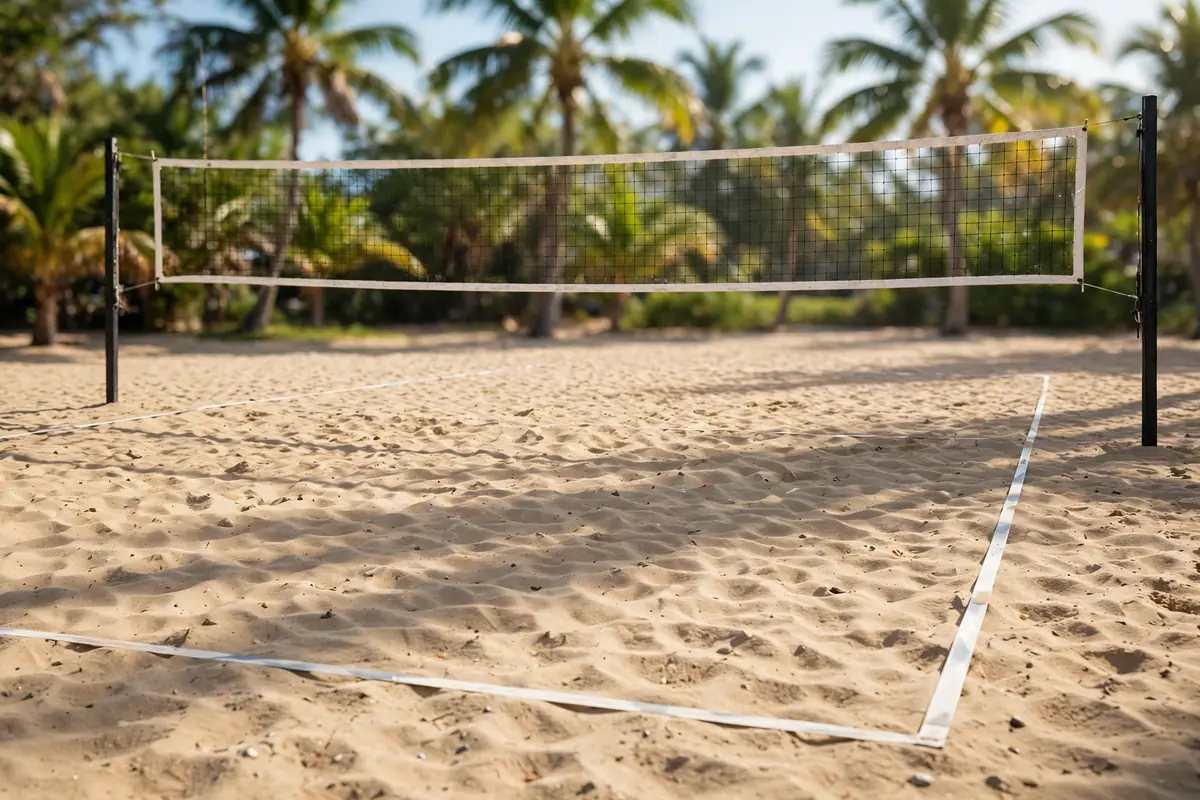
There is no centre line and no attack line on a beach court. The lines are made of flexible material laid on the sand, 5 cm wide, and they form a rectangle with no markings inside it. The net is the same height as indoors, 2.43 metres for men and 2.24 metres for women, but the net itself is shorter at 8.5 metres long.
The free zone around a beach court is at least 3 metres on all sides, and 5 to 6 metres at World events. The sand makes jumping and moving harder, and the wind can push a serve off course, so the beach game rewards fitness and all-round skill more than specialisation.
The table below compares the two courts side by side.
| Feature | Indoor | Beach |
|---|---|---|
| Court size | 18 m × 9 m | 16 m × 8 m |
| Players per team | 6 | 2 |
| Attack line | Yes, 3 m from centre | No |
| Centre line | Yes | No |
| Net length | 9.5–10 m | 8.5 m |
| Surface | Wood or synthetic floor | Sand |
| Sets in a match | Best of 5 | Best of 3 |
Fans who want the full comparison, including how the rules change on sand, can read the indoor versus beach section in our main volleyball guide.
Grass, Sitting and Junior Courts
Grass volleyball uses the same court size as beach volleyball: 16 metres by 8 metres, and beginners can compare it with our softball rules for beginners guide to another outdoor team game. The lines are laid on the grass, and the ground must be free of holes, puddles and uneven patches. Grass games are usually casual, but organised grass tournaments use the same net heights as the beach game.
Sitting volleyball is played on a smaller court: 10 metres long and 6 metres wide, with an attack line 2 metres from the centre line. The net is lower, and players sit on the floor throughout the rally. It is played at the Paralympic Games, and it is one of the fastest versions of the sport to watch.
Junior courts are smaller for younger players. For players under 10, the court shortens to 16 metres long while keeping the 9-metre width. For players aged 9 and under, it reduces further to 14 metres long by 9 metres wide. The idea is to keep the court in proportion to the players, so rallies last longer and skills develop faster.
How to Set Up a Volleyball Court
Setting up a court takes a tape measure, a net, two posts, and some line markers, and new players should also read our baseball rules for beginners guide for a second team sport. The steps below work in a gym, on grass, or on sand.
- Measure the court. Mark 18 metres by 9 metres for indoor play, or 16 by 8 metres for beach and grass. Use a long tape and check both diagonals.
- Mark the lines. Lay tape, chalk or flexible line material for the sidelines, end lines and centre line. Make every line 5 cm wide.
- Mark the attack lines. Measure 3 metres from the centre line on each side and mark the attack line across the full width.
- Set the posts. Place the posts 0.5 to 1 metre outside the sidelines, on the centre line. Check that they are stable and upright.
- Hang the net. Attach the net to the posts and tighten it until the top edge is straight. Measure the height at the centre: 2.43 metres for men, 2.24 metres for women.
- Fit the antennas. Attach the antennas at the sidelines, on the outer edge of the side lines, and check that they stand straight up.
- Check the free zone. Clear at least 2 to 3 metres around the court, and check the ceiling height if you are indoors.
Common Court Mistakes and How to Fix Them
Most court problems come from measurement, not from the players. The list below covers the mistakes that turn up most often, and the fix for each one.
- Wrong attack line. The attack line is 3 metres from the centre line, not 3 metres from the net post or 10 feet from the end line. Measure from the centre line every time.
- Lines too narrow or too wide. All lines are 5 cm wide. Lines that are too wide eat into the court, and lines that are too narrow are hard to see.
- Net too high or too low. Measure at the centre of the net, not at the posts. A net that sags in the middle is lower than it looks from the side.
- Posts too close to the court. Posts must stand outside the sidelines, or players will hit them when they chase a ball into the free zone.
- No free zone. A court jammed against a wall gives defenders nowhere to run. Clear the space before you play, not after the first injury.
- Wrong court for the age group. Junior players on an adult court get short rallies and bad habits. Measure the court for the age group.
- Beach lines that move. Sand lines shift during play. Check them between sets and reset them if they have moved.
The same care applies to other court sports. Our guide to basketball court dimensions shows how a basketball court is measured, and the habit of measuring before you play is the same in both games.
Frequently Asked Questions About the Volleyball Court
How big is a volleyball court?
An indoor court is 18 metres long and 9 metres wide (59 feet by 29 feet 6 inches). A beach court is 16 by 8 metres (52 feet 6 inches by 26 feet 3 inches).
How high is a volleyball net?
2.43 metres for men and 2.24 metres for women. The height is measured at the centre of the net.
Where is the attack line?
The attack line is 3 metres (9 feet 10 inches) from the centre line on each side of the court. It divides the front row from the back row.
How wide are the lines on a volleyball court?
All lines are 5 cm wide, about 2 inches, and they count as part of the court. A ball on a line is in.
What is the free zone in volleyball?
It is the clear area around the court where players can still play the ball. The FIVB minimum is 3 metres on all sides.
How many zones are there on a volleyball court?
Six zones, numbered 1 to 6, describe where players stand at the moment of the serve. They are the basis for the rotation order.
Is a beach volleyball court smaller than an indoor court?
Yes. A beach court is 16 by 8 metres, against 18 by 9 metres indoors, and it has no attack line and no centre line.
How do I set up a volleyball court at home?
Measure the court, mark the lines, set the posts outside the sidelines, hang the net at the right height, fit the antennas, and clear the free zone around it.
Share this article: X | Facebook | LinkedIn | Email
Written by Jaani | View all articles by Jaani
Facts checked on 14 November 2026. Sources: the FIVB 2025-2028 rules and USA Volleyball for court, line and net measurements, and Sports Flash Daily’s own volleyball guides for the linked articles.



















