





Army vs Kansas State: History, Preview and How to Watch
Two programmes from different worlds meet on a football field, and the result is always worth watching. One is a service academy where players are cadets first and footballers second. The other is a Big 12 programme from the Kansas plains that turned itself from the worst team in the country into a conference champion. When they play, the game is slow, physical, and decided by discipline rather than speed.
This guide covers the whole matchup: the short series history, the famous 2025 upset in Manhattan, how each programme is built, the triple option against a Big 12 defence, the stadiums, the Fort Riley connection, and how to watch the next meeting. It is written for fans who want the context behind the score, not just the score itself.
Quick Answer
Table of Contents
- What This Matchup Is
- The Series History in Full
- The 2025 Game: How Army Won in Manhattan
- Army: The Black Knights, Explained
- Kansas State: The Wildcats, Explained
- The Triple Option Against a Big 12 Defence
- Key Matchups When These Teams Meet
- Stadiums and Game-Day Atmosphere
- The Fort Riley Connection
- How to Watch and Follow the Next Meeting
- What the Series Means for Each Programme
- Frequently Asked Questions About Army vs Kansas State
What This Matchup Is
College football is full of games between teams that look alike. This one is the opposite. Army is the United States Military Academy at West Point, New York. Its players are cadets who will become Army officers after graduation. They train, study, and live under military discipline, and football fits around that life rather than the other way round.
Kansas State is a land-grant university in Manhattan, Kansas, a town locals call the Little Apple. The Wildcats play in the Big 12, recruit like a normal Power conference programme, and have a modern football operation built over three decades. The two schools could hardly be more different in size, mission, or resources.
The game itself is a clash of styles. Army wants a slow game with long drives, few possessions, and a running clock. Kansas State wants to use its athletes in space and score quickly. The team that imposes its tempo usually wins. Fans who follow the weekly picture should start with our guide to college football scores, which explains how results, standings, and the playoff race fit together.
The Series History in Full
The two programmes have met only three times in nearly sixty years. That scarcity is part of the appeal. Each meeting has been separated from the last by decades, so every game feels like a fresh chapter rather than a routine fixture.
The first meeting came in 1966 at West Point. Army won 21-6. College football looked very different then: Army was still a national power in living memory, and Kansas State was a long way from the programme it would become under Bill Snyder. The game left little trace in the record books beyond the score.
The second meeting came in 1987, again after a gap of 21 years, this time at Manhattan. Army won convincingly on the road. Kansas State was then in the dark years before Snyder arrived, a programme widely described as the worst in major college football. Army’s win drew little attention at the time, and the two schools did not meet again for 38 years.
The third meeting came on 6 September 2025 at Bill Snyder Family Stadium in Manhattan. Army won 24-21. That result is the reason this matchup now has a real story, and it is covered in full in the next section. The table below sets out the series at a glance.
| Meeting | Venue | Result |
|---|---|---|
| 1966 | West Point, New York | Army won 21-6 |
| 1987 | Manhattan, Kansas | Army won |
| 6 September 2025 | Manhattan, Kansas | Army won 24-21 |
| All-time series | — | Army leads 3-0 |
One honest note about the record: some low-quality pages on the web give a different score for 1987, and at least one invents a 2008 meeting that never happened. The official game notes for the 2025 game state plainly that it was the third meeting, with the first two in 1966 and 1987. This guide follows that record. Where sources disagree on a detail, the detail is left out rather than guessed.
The 2025 Game: How Army Won in Manhattan
Army walked into Manhattan as an underdog of around 17 points. Kansas State was at home in front of more than 52,000 fans. The Wildcats had opened the season with a close loss to Iowa State in Dublin, Ireland, then survived a scare against FCS side North Dakota, needing a late touchdown to win 38-35. Army had just lost a double-overtime game at home to Tarleton State. On paper, the game looked like a comfortable home win.
The game played out the other way. Army held the ball for more than 40 minutes. The Black Knights ran 82 plays to Kansas State’s 43. In the second half, the Wildcats’ offence held the ball for barely three minutes. Army converted six of seven fourth-down attempts, refusing to give the ball back and refusing to let Kansas State’s offence find any rhythm.
Kansas State actually gained more yards per play. That is the trap of playing Army: efficiency means little when you only get the ball a handful of times. The Wildcats could not build a lead because they could not stay on the field, and they could not stop Army’s drives because the Black Knights kept converting on fourth down.
The win mattered beyond one Saturday. It was Army’s first win over a Big 12 team since beating Baylor in 2006, and its first road win over a Power conference team since beating Wake Forest in 2016. For Kansas State, it was a first-ever loss to Army and a reminder that a disciplined running game can still beat a more talented roster. Our look at the Kansas State vs Arizona prediction explains how to read a Wildcats matchup line by line.
Army: The Black Knights, Explained
Army football is one of the oldest programmes in the sport. The United States Military Academy fielded teams that won national titles in the 1940s, when players like Doc Blanchard and Glenn Davis became household names. The modern game moved on, and the academy could not keep up with programmes that recruit without academic and military limits. The programme spent long stretches losing, then rebuilt itself under Jeff Monken.
Monken took over in 2014 and is now in his 13th season as head coach. He rebuilt Army around the triple option, discipline, and physical conditioning. The results followed: a 10-3 season in 2017 with the Commander-in-Chief’s Trophy, an 11-2 season in 2018, and the programme’s best modern run in 2024, when Army started 9-0, finished 12-2, went unbeaten in the American Athletic Conference, and won the Independence Bowl.
Army joined the American Athletic Conference for football only, giving up the independence it had held for years. The move gave the Black Knights a path to a conference title and a clearer route toward the expanded College Football Playoff, explained in our college football playoff predictions guide.
The 2025 season was a step back at 7-6, but the win at Kansas State showed the programme’s identity had not changed. Army still wins by running the ball, controlling the clock, and playing with a discipline that comes from the academy itself.
The Army-Navy game
No guide to Army is complete without the Army-Navy game. It is the programme’s biggest fixture every year, played in December after the regular season. The two service academies also compete with Air Force for the Commander-in-Chief’s Trophy, awarded to the academy with the best record in the round-robin series. Army won the trophy in 2017 for the first time since 1996. The rivalry shapes the whole season: a year is judged first by the Navy result, then by everything else.
Life as a cadet-athlete
Army players are cadets before they are footballers. They follow a military daily schedule, take a full academic load, and accept a service commitment after graduation. They do not receive the name, image, and likeness deals that shape rosters elsewhere, and they cannot transfer freely. That is why Army’s style is built on development and system rather than recruiting stars: the programme keeps players for four years and teaches them one offence better than anyone else in the country.
Kansas State: The Wildcats, Explained
Kansas State football is one of the great rebuilding stories in the sport. Before Bill Snyder arrived in 1989, the programme was widely called the worst in major college football, with decades of losing and little hope. Snyder built it into a Big 12 champion through junior-college recruiting, discipline, and special teams, and the stadium now carries his name.
The modern Wildcats are a steady Big 12 programme. They won the Big 12 title in 2022 with a 10-4 season and a Sugar Bowl trip. Chris Klieman, the head coach since 2019, has kept the programme competitive with a physical, disciplined style of his own: strong defence, sound special teams, and a running game that wears opponents down. The current CFP rankings show where the Big 12 sits in the national picture each week.
Kansas State’s identity is built on doing the small things well. The Wildcats rarely beat themselves with penalties or turnovers. Their fans are known for loyalty through the bad years, and Manhattan on a Saturday night is a loud, purple place. That is what made the 2025 loss to Army sting: the Wildcats were beaten at their own game, by a team that was even more disciplined than they were.
The Triple Option Against a Big 12 Defence
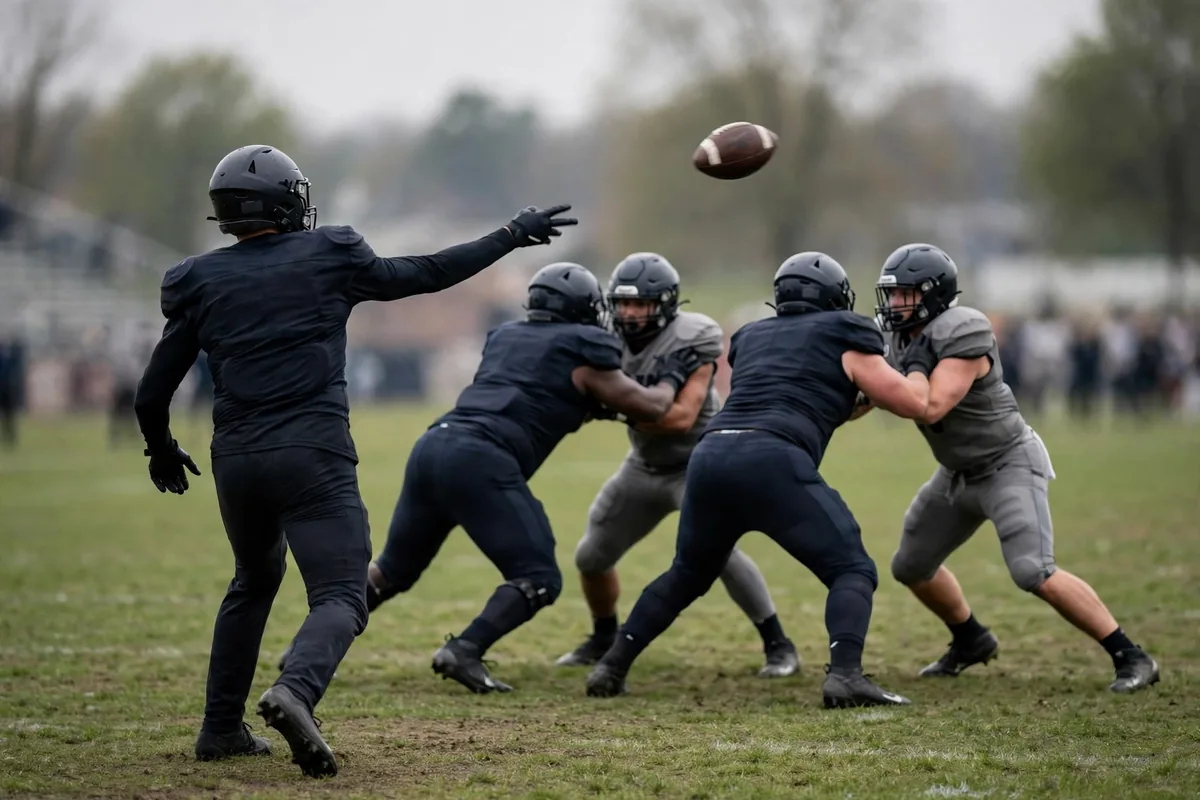
The triple option is the heart of this matchup. It is an offence built on reads rather than passes: on each play the quarterback can hand the ball to the fullback, keep it himself, or pitch it to a trailing back. The defence must account for all three choices on every snap, and one wrong step creates a big gain.
Army’s version has changed in recent years. After rule changes limited cut blocking, Monken moved the attack to a shotgun-based system in 2023. The principles stayed the same, but the quarterback could see the field better and the offence gained new ways to attack the perimeter. The 2024 season, when Army averaged huge rushing totals and started 9-0 behind quarterback Bryson Daily, showed the new version could work at a high level.
Facing the option is a problem for a Big 12 defence because nobody else runs it. Kansas State’s defenders spend all season preparing for spread passing attacks, then get one week to learn assignment football against the option. Each defender has one job on each play: take the dive, take the quarterback, or take the pitch. If one player guesses wrong, the play breaks open.
The counter is discipline and tackling. A defence that stays in its lanes, tackles well in space, and forces Army into third-and-long can get off the field. The risk is that Army converts fourth downs anyway, as it did six times in seven tries in 2025.
Key Matchups When These Teams Meet
Every game between these teams turns on a small set of battles. The list below covers the ones that decide the result.
- Army’s offensive line vs Kansas State’s front seven. The option lives or dies on the line of scrimmage. If Army’s linemen reach the second level, the backs run free. If Kansas State’s linemen hold their ground, the plays start behind the chains.
- Fourth-down conversions. Army goes for it on fourth down more than almost any team in the country. Each conversion extends a drive and steals a possession from the other side. Kansas State must win at least half of these stands.
- Kansas State’s running game vs Army’s front. The Wildcats like to run the ball too. If they can match Army’s physicality, they control the tempo instead of chasing it.
- Turnovers. Army’s offence rarely turns the ball over because it rarely throws. Kansas State must protect the ball, because a short field is one of the few ways to score quickly against a team that eats the clock.
- Special teams. Both programmes value the kicking game. A long return or a blocked kick can swing a low-possession game in one play.
- Red-zone finishing. Army drives often stall inside the 20 without points if the defence holds. Kansas State must turn those stops into points on the other end.
The pattern is clear: this is a game of few possessions, so each one carries more weight than in a normal game. A single turnover or a single fourth-down stop can be the difference between winning and losing.
Stadiums and Game-Day Atmosphere
Michie Stadium, Army’s home at West Point, is one of the most striking venues in college football. It sits on the Hudson River, with the academy’s stone buildings rising behind the stands. Cadets fill sections in uniform, and the atmosphere is orderly and loud at the same time. Visiting teams find the setting as intimidating as the team.
Bill Snyder Family Stadium in Manhattan holds more than 50,000 fans and is the heart of Kansas State’s campus. The crowd wears purple, the student section stands all game, and the stadium is at its best under the lights. The 2025 game drew more than 52,000 fans, and the noise could not save the Wildcats from an offence that would not give the ball back.
Both stadiums reward fans who arrive early. At West Point, the pre-game includes the cadet march-on. At Manhattan, the tailgate scene fills the lots around the stadium hours before kickoff. Our guide to the NFL coverage map works the same way for pro fans trying to find which game airs in their area.
The Fort Riley Connection
There is a real bond between Kansas State and the Army that has nothing to do with football. Fort Riley, one of the largest Army posts in the country, sits a short drive from the Kansas State campus. The post traces its roots to the early 1850s, when it was built to protect settlers along the Oregon and Santa Fe trails. It later housed the famed Buffalo Soldiers and remains the home of the 1st Infantry Division.
Soldiers from Fort Riley take classes at Kansas State, and the university’s alumni serve in the military in large numbers. The school holds a Fort Riley Day each season, and officials chose the 2025 game against the Black Knights for that honour. The pre-game carried a military flavour that both sets of fans understood: this was a game between two institutions that respect the same uniform.
That connection is why the matchup feels different from a normal non-conference game. The fans are not enemies. Kansas State supporters know what the underdog life feels like, having lived through decades in the cellar before the 1990s. Army supporters know what it means to be underestimated every single week.

How to Watch and Follow the Next Meeting
The two schools meet rarely, so the next game is an event rather than a routine date. The 2025 meeting was a Saturday night game on national television, and any future meeting is likely to get the same treatment. Check the official schedules of both schools when the fixture is announced, because the date, kickoff time, and network are set closer to the season.
To follow the build-up, read the official game notes each school publishes in the week of the game. Kansas State’s notes for the 2025 game ran to a full media guide with series history, statistical leaders, and coaching records. Army’s notes do the same. Those documents are the most reliable source for kickoff time, broadcast details, and injury news.
On game day, live score pages and the conference scoreboard are the fastest way to track the game if you cannot watch. The NFL scores page shows the same format for pro football, and the college version works the same way. After the game, the box score tells the story: look first at time of possession, then at fourth-down conversions, then at total plays.
For fans who want to follow the wider season, the college basketball scores page covers the winter sport once football ends. The habit is the same in every sport: check the standings first, then the schedule, then the results.
A viewing tip for this matchup
Watch the line of scrimmage, not the ball. The option is decided in the first two seconds after the snap, when each defender commits to one of the three choices. If you watch the quarterback’s read and the pitch man’s lane, you will see the play develop before the television angle catches up.
What the Series Means for Each Programme
For Army, the series is proof that the programme’s model works against Power conference opposition. The Black Knights cannot recruit like Kansas State, cannot pay players like Kansas State, and cannot offer the same path to the NFL. What they can do is play a style nobody else plays, execute it with military discipline, and win games they are supposed to lose. The 3-0 record against the Wildcats is a small sample, but it is a real one. Readers who want to see how odds are set for a game like this can start with our guide to NFL lines, which explains the same numbers in the pro game.
The series also matters to the sport as a whole. College football is richer when different styles survive. The option, the service academies, and the programmes that refuse to play like everyone else give the sport its texture. A game between Army and Kansas State is a reminder that there is more than one way to win, and that the team with the better plan can beat the team with the better roster.
Fans who enjoy this kind of tactical contrast will find the same pleasure in our guide to rating a fantasy team, which is about judging a roster by its construction rather than its star names.
The NBA scores page covers a sport where the same debate plays out every night.
Frequently Asked Questions About Army vs Kansas State
Who leads the Army vs Kansas State series?
Army leads 3-0. The Black Knights won 21-6 at West Point in 1966, won at Manhattan in 1987, and won 24-21 at Manhattan on 6 September 2025.
When was the last Army vs Kansas State game?
The last meeting was on 6 September 2025 at Bill Snyder Family Stadium in Manhattan, Kansas. Army won 24-21 as an underdog of around 17 points.
What is Army’s offensive style?
Army runs a triple-option rushing attack, now from a shotgun-based system introduced in 2023. The quarterback reads the defence and chooses between a fullback dive, a keeper, or a pitch, which keeps the ball on the ground and the clock running.
Who is Army’s head coach?
Jeff Monken, in his 13th season in 2026. He took over in 2014 and rebuilt the programme around the triple option, winning a conference title in 2024 with a 12-2 season.
Where do Army and Kansas State play their home games?
Army plays at Michie Stadium in West Point, New York, on the Hudson River. Kansas State plays at Bill Snyder Family Stadium in Manhattan, Kansas.
Why is Kansas State linked to the Army?
Fort Riley, a major Army post and home of the 1st Infantry Division, sits near the Kansas State campus. Soldiers take classes at the university, and the school holds a Fort Riley Day each football season.
How can I watch the next Army vs Kansas State game?
The schools meet rarely, so check the official schedules of both programmes when a fixture is announced. Recent meetings have been Saturday night games on national television, with live scores and box scores available online.
What was Army’s record in 2024?
Army finished 12-2 in 2024, went unbeaten in the American Athletic Conference, won the conference title, and won the Independence Bowl after starting the season 9-0.
Share this article: X | Facebook | LinkedIn | Email
Written by MSUD | View all articles by MSUD
Facts checked on 14 November 2026. Sources: Kansas State’s official 2025 game notes, Military.com’s pre-game report, and Wikipedia for programme records, used alongside Sports Flash Daily’s own college football guides for the linked articles.



















