




Basketball Hoop Height: Regulation, Youth and Home Guide
Ten feet. That is the answer most people are looking for, and it has not changed since the game was invented. A regulation basketball hoop sits 10 feet above the floor, measured from the playing surface to the top edge of the rim. The NBA, the WNBA, college basketball, high school basketball and the international game all use the same height.
Young players do not shoot at 10 feet, because they cannot shoot properly at a rim built for adults. Home hoops are adjustable, and the right setting depends on age, strength and the size of the ball. A rim that is too high teaches bad habits, while a rim that is too low stops a player from learning the real shot.
Quick Answer
Table of Contents
- The 10-Foot Standard
- Why the Rim Is 10 Feet High
- Hoop Height by Age
- The Full Measurements: Rim, Backboard and Court
- NBA vs WNBA vs College vs FIBA
- How to Measure a Hoop Correctly
- Adjustable Hoops: How to Set the Height
- Choosing a Hoop for Home
- Common Mistakes When Setting Hoop Height
- How Height Affects Shooting
- Safety, Care and Maintenance
- Frequently Asked Questions About Basketball Hoop Height
The 10-Foot Standard
A regulation hoop is 10 feet high, and that figure is the same across the sport. The NBA’s official rules put the rim 10 feet above the floor. FIBA, the international governing body, sets the rim at 3.05 metres, which is 10 feet to within a few millimetres. College basketball and high school basketball use the same height, so a player who moves from school to college to the professional game never has to adjust to a new rim height.
The measurement is taken from the playing surface to the top edge of the rim, not to the bottom of the rim and not to the backboard. A tape held to the underside of the rim will read a little low, and a measurement taken from a sloped driveway will read wrong in a different way.
For readers who are new to the sport, our guide to basketball rules for beginners explains the game around the rim, from scoring to fouls, in plain language.
Why the Rim Is 10 Feet High
The 10-foot rim dates back to the invention of basketball. James Naismith hung the first peach basket 10 feet above the floor of the Springfield YMCA gymnasium in 1891, because that was the height of the running track that circled the gym. The basket was nailed to the track’s railing, and the height stuck.
The game grew up around that height. Players learned to shoot with an arc that clears a 10-foot rim, dunkers learned to reach above it, and coaches built offences around spacing that assumes the rim is where it is. The sport has kept the number because it works, and because every player in the world practises at the same height.
That shared standard is rare in sport. A child shooting in a school gym and a professional shooting in an NBA arena are aiming at a rim at exactly the same height.
Hoop Height by Age
Youth basketball is the exception to the 10-foot rule. The NBA and USA Basketball publish joint youth guidelines that set the rim height by age, and they pair each height with the right ball size. The aim is to let young players shoot with proper form instead of heaving the ball with two hands from the chest.
| Age group | Rim height | Ball size | Free-throw distance |
|---|---|---|---|
| Under 7 | 6–7 feet (informal, no official standard) | Size 3 or 4, small and light | Close to the basket |
| Ages 7–8 | 8 feet | Size 5, 27.5-inch circumference | 14 feet |
| Ages 9–11 | 9 feet | Size 6, 28.5-inch circumference | 14 feet |
| Ages 12–14 | 10 feet | Girls size 6, boys size 7 (29.5 inches) | 15 feet |
| Grades 9–12 | 10 feet | Girls size 6, boys size 7 | 15 feet |
The guidelines start at ages 7–8, because there is no official NBA and USA Basketball height for children under 7. For those youngest players, a rim of 6 to 7 feet is the common informal choice. Youth leagues may adjust the numbers, so a local league’s rules are the final word for organised play.
When to raise the rim
A player should move up to the next height when they can shoot with control at the current one, not simply when they reach a birthday. Coaches look at form: if a player can shoot with one hand, with the elbow in and a clean follow-through, the rim can go up. If the player has to push the ball with both hands, the rim should stay where it is.
The progression mirrors how the game is taught. At 8 feet, a 7-year-old learns the shape of a shot. At 9 feet, a 10-year-old learns to shoot from further out. At 10 feet, a 12-year-old learns the real game, with the real rim, the real ball and the real three-point line.

The Full Measurements: Rim, Backboard and Court
The rim height is only one number in a set of measurements that define the game. The rest of the basket — the rim itself, the backboard and the distances on the court — are standardised too, and they are worth knowing if you are setting up a hoop at home or coaching a team.
The rim is 18 inches (45.7 centimetres) in inside diameter in the NBA, and FIBA allows 45.0 to 45.9 centimetres. That is just wide enough for a basketball, about 9.5 inches across, to pass through with room to spare.
The backboard in the NBA is 72 inches wide and 42 inches high (1.83 by 1.07 metres). FIBA’s board is slightly smaller at 1.80 by 1.05 metres. The board is mounted with its bottom edge 9 feet 6 inches above the floor in the NBA, and the rim is attached so that its top edge sits at 10 feet.
Court distances that relate to the rim
The free-throw line sits 15 feet from the backboard in the NBA and in youth play from age 12, and 14 feet for younger age groups. The three-point line is further out, and its distance changes by level: the NBA line is 22 feet in the corners and 23 feet 9 inches at the top. Youth players aged 7 to 11 do not shoot three-pointers under the official guidelines — baskets beyond the arc still count as two points at those ages.
Our guide to basketball court dimensions covers the full court, from the centre circle to the three-point line, and it pairs naturally with this guide if you are marking out a court at home.
NBA vs WNBA vs College vs FIBA
Every major competition uses the same rim height, which is one of the cleanest facts in the sport. The table below puts the four main levels side by side.
| Specification | NBA | WNBA | NCAA | FIBA |
|---|---|---|---|---|
| Rim height | 10 ft (3.05 m) | 10 ft (3.05 m) | 10 ft (3.05 m) | 3.05 m |
| Rim diameter | 18 in (45.7 cm) | 18 in (45.7 cm) | 18 in (45.7 cm) | 45.0–45.9 cm |
| Backboard | 72 × 42 in | 72 × 42 in | 72 × 42 in | 1.80 × 1.05 m |
| Ball size | Size 7 (29.5 in) | Size 6 (28.5 in) | Men size 7, women size 6 | Men size 7, women size 6 |
| Free-throw line | 15 ft | 15 ft | 15 ft | 5.80 m from end line |
The differences between the levels are in the ball and the court markings, not the rim. The WNBA uses a size 6 ball, one inch smaller in circumference than the NBA’s size 7, and women’s college basketball does the same. The rim stays at 10 feet for everyone.
FIBA’s numbers look different only because they are written in metric. The rim is 3.05 metres, which is 10 feet to within 2 millimetres, and the backboard is a few centimetres smaller than the NBA’s.
For fans who follow the professional game, the NBA scores page tracks live results, standings and schedules.
The college basketball scores page does the same for the college game.
How to Measure a Hoop Correctly
Measuring a hoop sounds simple, and it is — as long as you avoid the three mistakes that make most home measurements wrong. The first is measuring to the wrong point on the rim. The rule is the top edge of the rim, not the bottom and not the middle. Hold the end of the tape on the floor, run it straight up, and read it where it meets the highest point of the metal ring.
The second mistake is measuring on a slope. Driveways often slope toward the street for drainage, and a hoop set on a slope will read high on one side and low on the other. Measure on the flattest part of the surface, and check the reading from two sides of the rim if the ground is uneven.
The third mistake is forgetting the rim’s own thickness. A tape held against the side of the rim will sit a little below the top edge, so the reading will be a fraction low. Hold the tape so it touches the top of the ring, and read it at eye level.
Tools you need
- A tape measure at least 12 feet long, so it reaches the rim without stretching.
- A step ladder, so you can hold the tape at the rim and read it safely.
- A level, to check that the rim is horizontal and the pole is vertical.
- A second person, to hold the bottom of the tape on the floor while you read the top.
Check the height once a season, and after any storm, move or hard dunk. Poles settle, bolts loosen and portable bases shift, and a rim that was 10 feet in spring can be 9 feet 10 inches by autumn.
Adjustable Hoops: How to Set the Height
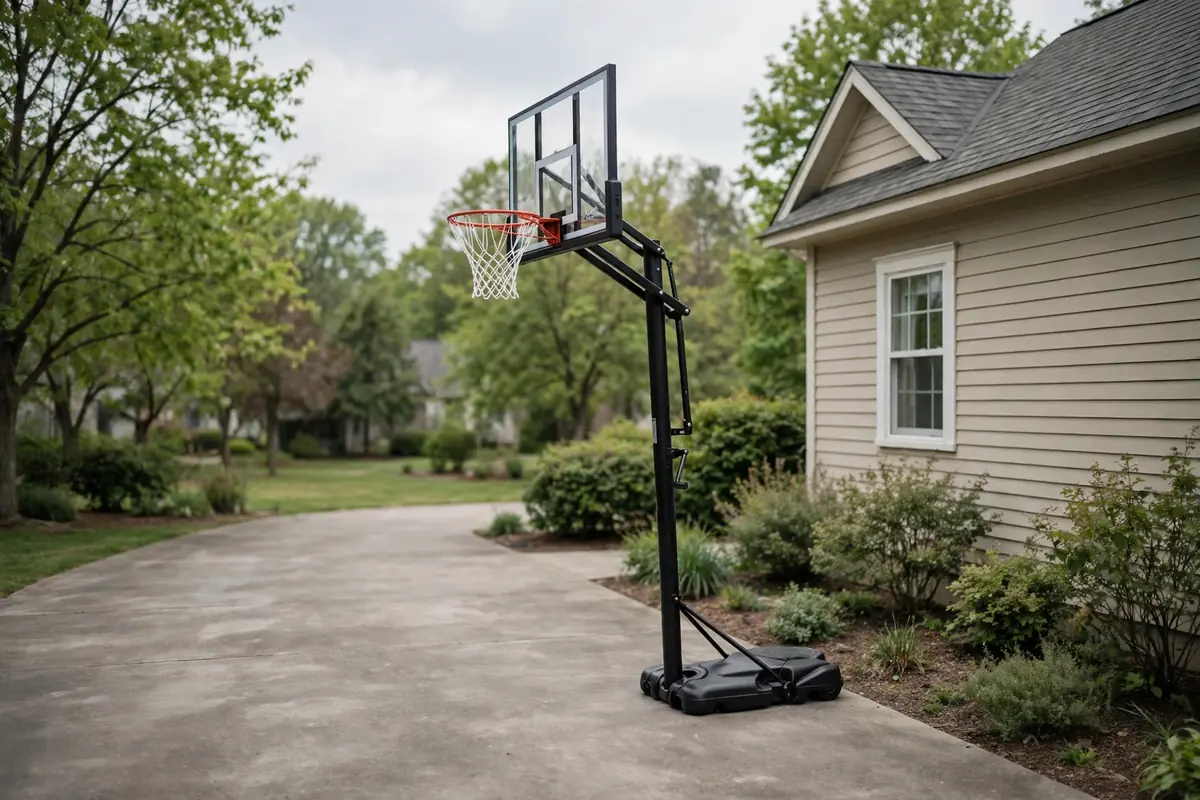
Most home hoops are adjustable, and the mechanism is usually one of three types. A telescoping pole slides up and down and locks with a pin or a bolt. A crank system uses a handle to wind the backboard up or down along the pole. A gas-assisted system lets you move the board with one hand and locks it in place.
To set the height, lower the rim to the target, measure it with a tape, and lock it. Then shoot a few shots and watch the form. If a young player is pushing the ball or shooting flat, the rim is too high. The right height is the one where the player has to work for the shot but can still make it with good form.
A practical ladder for a family hoop
A hoop that serves children of different ages should reach the full 10 feet and lower to about 7.5 feet. That range covers the official youth heights of 8 and 9 feet, the informal 6 to 7 feet for the youngest players, and the full 10 feet for teenagers and adults. Mark the pole at 8, 9 and 10 feet, so the children can set it themselves without a tape measure every time.
Our guide to the basketball basket net covers the net itself, from the types of net to how to fit and care for one, and it is a useful companion if you are setting up a hoop from scratch.
Choosing a Hoop for Home
A home hoop is a long-term buy, and the height adjustment is only one of the things to get right. The three main types are portable, in-ground and wall-mounted, and each suits a different home.
A portable hoop has a base filled with water or sand, and it can be moved around a driveway. It is the easiest to install, but also the least stable, and a hard dunk can tip it. An in-ground hoop is cemented into the ground, and it is the most stable and the most like a gym hoop, but it cannot be moved. A wall-mounted hoop bolts to a garage or a wall, and it saves floor space, but it needs a strong wall and a flat area in front of it.
What to look for
- Height range. It should reach 10 feet and lower to at least 7.5 feet.
- Backboard size. A 54-inch board is a good home size; a 60-inch board is closer to a gym board; a 44-inch board is fine for young children only.
- Backboard material. Tempered glass plays most like a gym board, acrylic is a good middle ground, and polycarbonate is the toughest and cheapest.
- Rim type. A breakaway rim flexes on a dunk and springs back, which protects the backboard and the player. A fixed rim is cheaper but can break under a hard dunk.
- Base size. A larger base, filled fully with sand rather than water, is more stable. Sand is heavier than water and does not freeze or leak.
- Pole shape. A square pole is stiffer than a round one, and a thicker pole wobbles less.
Price rises with backboard size and material, and with the quality of the adjustment mechanism. A hoop that will be used by teenagers and adults is worth spending more on, because it will take harder shots and harder dunks.
Common Mistakes When Setting Hoop Height
The most common mistake is setting the rim at 10 feet for a child who is not ready for it. The child learns to shoot with two hands, and those habits are hard to undo later. A lower rim is how a child learns the right shape of a shot.
The second mistake is leaving the rim too low for too long. A teenager who practises at 9 feet will find 10 feet strange when their league plays at regulation height, so the rim should go up as soon as the player can shoot well at the current height.
The third mistake is setting the height by eye. A rim that looks about right is often two or three inches out, so measure it with a tape and write the setting on the pole.
The fourth mistake is ignoring the ball. Match the ball to the age: size 5 for ages 7–8, size 6 for ages 9–11 and for girls from 12, and size 7 for boys from 12. Our guide to the Champion Sports junior rubber basketball looks at a ball made for young players.
How Height Affects Shooting
Shooting is an arc, and the rim height sets the arc. At 10 feet, a good shot leaves the hand, rises above the rim and drops down through it. The arc gives the ball a larger target, which is why coaches teach a high arc and why a flat shot rattles out more often.
At a lower rim, the same shooter can use a flatter arc and still score, which is why young players on low rims often shoot flat. Coaches teach the arc even at 8 feet, so the shot stays the same shape as the rim goes up.
Dunking is the other side of rim height. At 10 feet, a player needs to reach about 10 feet 6 inches to dunk comfortably, which means most players need a vertical jump of well over two feet. That is why dunking is rare below the professional game, and why a lower rim lets children experience a dunk without needing an adult’s jump.
For a wider look at the college game, where the rim is the same 10 feet but the players are still developing, the Utah Tech basketball guide follows one team through its season.
The NCAA tournament schedule explains how the college bracket works.

Safety, Care and Maintenance
A hoop is safe when it is stable, level and checked regularly. A portable base should be filled completely — sand is better than water, because it is heavier and does not leak or freeze. The base should sit flat on the ground, and the pole should be vertical. If the hoop wobbles when you shake it, tighten the bolts or add weight to the base.
Check the rim and the backboard for cracks, rust and loose bolts at the start of each season. A cracked backboard can shatter, and a loose rim can fall. Replace a worn net before it frays, because a frayed net can catch a finger.
Players should never hang on the rim unless it is a breakaway rim designed for dunking, and even then they should not swing on it. A rim is not a climbing frame, and a fall from a rim can cause a serious injury. Children should be supervised around a hoop, and the area under the basket should be kept clear of bikes, toys and other obstacles.
For the women’s professional game, the WNBA scores page tracks live results and standings.
The NBA mock draft guide explains how mock drafts work and how to read them.
Frequently Asked Questions About Basketball Hoop Height
How high is a regulation basketball hoop?
A regulation hoop is 10 feet high, measured from the floor to the top of the rim. The NBA, WNBA, NCAA, FIBA and high school basketball all use 10 feet.
What height should a hoop be for a 10-year-old?
Nine feet, under the NBA and USA Basketball guidelines for ages 9–11, paired with a size 6 ball. A 10-year-old who shoots well at 9 feet may practise at 10 feet, but league games for this age group use 9 feet.
What height should a hoop be for a 7-year-old?
Eight feet, under the NBA and USA Basketball guidelines for ages 7–8, paired with a size 5 ball. Children under 7 usually play on a rim of 6 to 7 feet, with no official standard.
Is the WNBA hoop lower than the NBA hoop?
No. The WNBA rim is 10 feet high, the same as the NBA. The WNBA uses a smaller ball, size 6 instead of size 7, but the rim height is identical.
How do I measure my hoop at home?
Hold a tape measure on the floor, run it straight up to the top edge of the rim, and read it there. Measure on level ground, and check the rim is level. A reading taken to the bottom of the rim, or on a slope, will be wrong.
What is the best adjustable hoop height range?
A range from about 7.5 feet to the full 10 feet covers the official youth heights and the regulation height. That lets one hoop serve children of different ages and grow with them.
Why is the rim 10 feet high?
The first basket was hung 10 feet above the floor in 1891, because that was the height of the running track in the Springfield YMCA gym where James Naismith invented the game. The height stuck, and the sport grew up around it.
Does a lower rim help children learn to shoot?
Yes. A lower rim lets a child shoot with proper form — one hand, elbow under the ball, a smooth arc — instead of heaving the ball with two hands. The rim should rise as the child grows and their form holds at the current height.
Share this article: X | Facebook | LinkedIn | Email
Written by Admin (Sports Flash Daily) | View All Articles
Facts checked on 14 November 2026. Sources: the NBA and USA Basketball youth guidelines, NBA and FIBA official rules for rim and backboard measurements, and Sports Flash Daily’s own basketball guides for the linked articles.



















