




Big 12 Championship Game: History, Format and Future
One game, two teams, and a conference title on the line, and the same live-score habit that helps with NFL scores helps here too. For three decades the Big 12 has settled its football championship on the field in early December, in front of a packed stadium and a national television audience. The winner takes the trophy, and in recent years it has usually taken a place in the College Football Playoff as well.
This guide explains the game in full: what it is, how the two teams are chosen, how tiebreakers work when records are level, where it is played, how it began, why it disappeared for seven seasons, and why the game played in December 2026 is the last one. It also covers the famous results, the 2008 controversy, the 2014 co-champion problem, and what replaces the game from 2027.
Quick Answer
Table of Contents
- What Is the Big 12 Championship Game?
- How the Two Teams Are Chosen
- Tiebreakers When Records Are Level
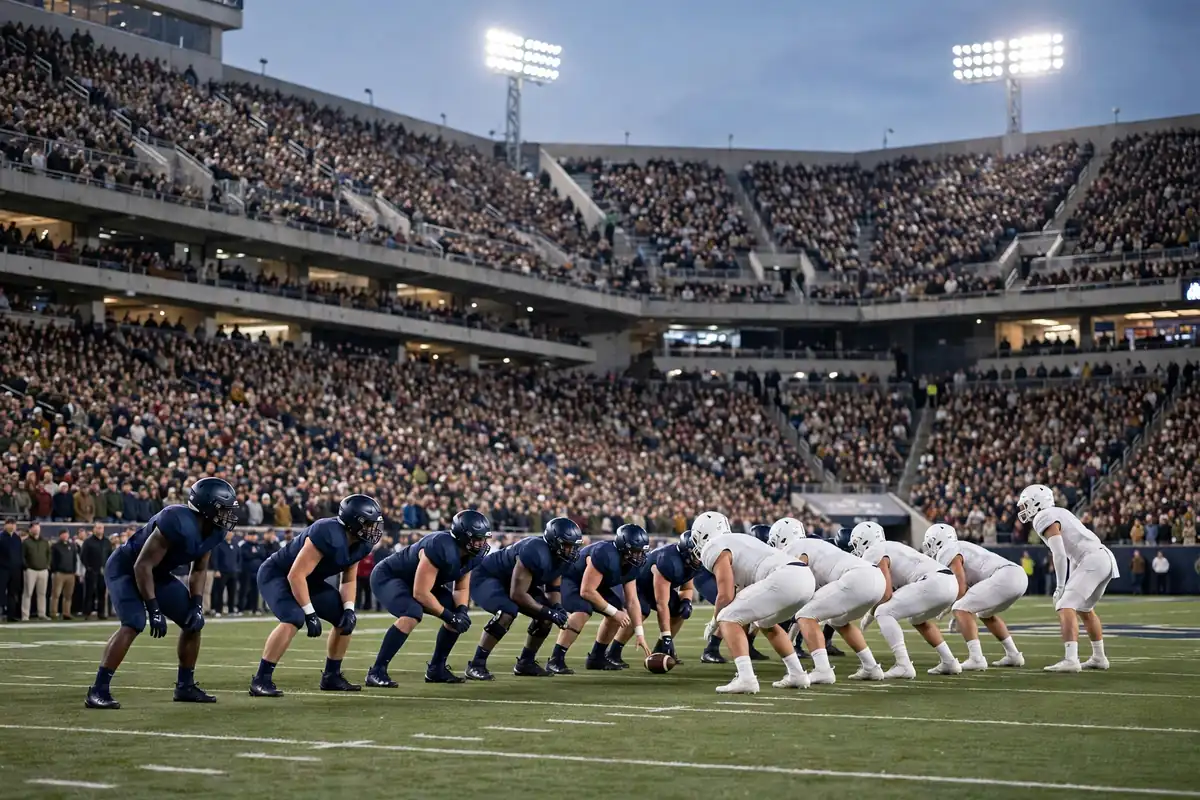
- Where the Game Is Played
- A Short History: 1996 to 2010
- The Seven-Year Gap: 2011 to 2016
- The Revival: 2017 to 2026
- Famous Games and Moments
- What Winning Means for the Playoff
- The Final Game and What Comes Next
- How to Follow the Game
- Frequently Asked Questions About the Big 12 Championship Game
What Is the Big 12 Championship Game?
The Big 12 Championship Game is the conference title game for Big 12 football. It is a single game, played after the regular season ends, and the winner is the outright Big 12 champion. There is no shared title from this game: one team wins, one team loses, and the trophy goes to the winner.
The conference was formed in 1996 from the merger of the Big Eight Conference and four teams from the Southwest Conference, and its playoff story is part of the wider college football playoff predictions picture each December. A championship game was part of the new league from the start, modelled on the SEC title game, which had been played since 1992. The format gave the new conference a showpiece weekend and a clear champion.
Why a title game matters
A regular season can end in a tie at the top. A title game removes that doubt. It also gives the conference a prime television slot in early December, when the whole country is watching championship weekend. For the teams, it is a second chance: a team that lost early in the season can still win the league by winning this game, and a team that won the regular season must win once more to claim the title outright.
The game also matters for the national picture. In the era of the four-team playoff, a Big 12 champion without a title game was at a disadvantage, because other conferences had a thirteenth game to impress the selection committee. That gap was one of the reasons the game came back in 2017, and it is one of the reasons the playoff now shapes its future.
How the Two Teams Are Chosen
Since 2017, the game has featured the two teams with the best conference records, a system our CFP rankings guide explains in the context of who the committee rewards. with the best conference records. There are no divisions. Every team plays a round-robin schedule against the other conference members, so the standings are a fair test, and the top two meet in Arlington.
That sounds simple, and most years it is. The two teams at the top are clear, and the game is a rematch of a regular-season meeting or a first meeting between the two best teams. The system rewards the whole season, not one weekend, and it means a team cannot win the league without beating the best team in the conference at least once.
The round-robin difference
The Big 12 plays a round-robin, which is unusual among large conferences. It means every team plays every other team, so there is no soft draw and no division winner who avoided the best team. That makes the standings honest, and it makes the top two a genuine reflection of the season. When two teams finish level, the league turns to tiebreakers, and those rules are where the detail lives.
Tiebreakers When Records Are Level
Ties are common in a large conference, and reading a standings race is a skill our Kansas State vs Arizona prediction guide shows in practice., so the Big 12 has a detailed tiebreaker system. The league publishes a Tiebreaker Central page in November, and it updates the scenarios each week as the final games approach. Fans who follow the race should check that page, because the scenarios change with every result.
For a two-team tie, the first step is head-to-head: if one team beat the other, that team goes through. If they did not play, or if the head-to-head does not settle it, the league looks at winning percentage against common conference opponents, then at the record against the next highest-placed common opponent, working down the standings until one team has a better record against that opponent.
The later steps
If the tie is still level, the league looks at strength of schedule, measured by the combined conference winning percentage of each team’s conference opponents. After that comes total wins in a twelve-game season, counting only one win against an FCS team. The full list is longer, and the league’s own page is the authority, because the rules are written to cover ties of three or more teams as well.
Where the Game Is Played
Since its revival in 2017, the game has been played every year at AT&T Stadium, and the NCAA tournament schedule guide shows how a fixed bracket weekend is built the same way in another sport. every year at AT&T Stadium in Arlington, Texas, home of the Dallas Cowboys. The Big 12 extended that arrangement in July 2023, keeping the game at AT&T Stadium through the 2030 season, although the game’s end in 2026 now cuts that deal short. The stadium is a natural home: it is in the heart of Big 12 country, it holds a huge crowd, and it gives the game a big-event feel.
The early years were different. The game moved around the Big 12 states, with Arrowhead Stadium in Kansas City hosting more often than any other venue. It was also played in St. Louis, at the Trans World Dome, in San Antonio at the Alamodome, in Houston, and in Irving, Texas. That travelling model spread the game around the league, but it made the event harder to build as a fixed destination.
A Short History: 1996 to 2010
The first championship game was played after the 1996 regular season, and the early history reads like a boxing schedule of champions defending a title year after year. regular season, the first year of Big 12 play. From 1996 to 2010, the game matched the North Division champion against the South Division champion, with six teams in each division. The format was clear, and it produced a run of memorable games.
The first eight games, from 1996 to 2003, followed a curious pattern: the North champion won in every odd-numbered year, and the South champion won in every even-numbered year. The divisions split those eight games four each. That pattern ended in 2003, when No. 13 Kansas State beat No. 1 Oklahoma 35-7, a major upset that gave the North its last win in the game. After that, the South won every remaining game in the division era, and the South led the series 11-4 overall, outscoring the North 463-324 across the fifteen games.
Oklahoma dominated the era. The Sooners reached the game often and won it often, and their presence in the game became a regular feature of December. Texas and other South teams also won, but the balance of power was clear: the South was the stronger division in the second half of the era, and the title game reflected that.
The 2008 controversy
The 2008 game is remembered for the argument before it, not the game itself. Oklahoma, Texas, and Texas Tech all finished with identical conference records in the South Division, and only one could go to the championship game. The league’s tiebreaker, which used the BCS standings, sent Oklahoma through, ahead of Texas, even though Texas had beaten Oklahoma in the regular season. Texas fans have never forgotten it, and the episode is still cited whenever tiebreakers are discussed. It showed that a rule can be correct on paper and still feel wrong to the team it leaves out.
The Seven-Year Gap: 2011 to 2016
After the 2010 season, the game stopped, and the gap years are a reminder that a college basketball scores table without a final is only half a story. Nebraska and Colorado left the conference, leaving it with ten members, and NCAA rules at the time required a conference to have twelve members to stage a championship game that was exempt from limits on regular-season games. The Big 12 dropped the game and crowned its champion by round-robin play instead.
That change created its own problems. Between 2011 and 2016, the championship was earned in regular-season play, and until 2014 the league had no tiebreaking procedure to decide a single champion. It was not unusual for a season to end with co-champions, and co-champions were a weak answer to a simple question: who won the league?
The 2014 problem
The 2014 season exposed the flaw. Baylor and TCU both finished with identical 8-1 conference records, and both were declared co-champions. TCU, ranked high and coming off a strong season, was left out of the first four-team College Football Playoff, and the co-champion label did not help its case. The lesson was clear: a league without a clear champion, decided on the field, was at a disadvantage in the playoff era.
The rules changed in January 2016. The NCAA allowed a conference with fewer than twelve teams to stage a championship game between its top two teams, so long as they played a round-robin schedule. In late 2016, the Big 12 decided to bring the game back in 2017, after a seven-year gap.
The Revival: 2017 to 2026
The revived game dropped divisions, and the top-two format is the same clean test you see in NBA scores races where the table, not a division, decides the seed. and used the top two teams in the standings. That was a fairer system for a round-robin league, and it produced a run of strong games at AT&T Stadium. The game became a fixed part of championship weekend, and the winner usually went on to the playoff or to a major bowl game.
The revival also gave the league a clear champion every year. No more co-champions, no more arguments about who deserved the title. The top two played, the winner took the trophy, and the loser went home knowing it had its chance on the field.

Famous Games and Moments
Kansas State’s 35-7 upset of No. 1 Oklahoma in 2003 remains the most famous result, and upsets of that size are why fans check NFL lines with care before trusting a favourite. remains the most famous result in the game’s history. Oklahoma was the top-ranked team in the country, and Kansas State was a heavy underdog. The Wildcats won by four touchdowns, broke the odd-year, even-year pattern, and gave the North its last championship-game win. It is the game every Big 12 fan cites when someone says the favourite always wins.
The 2008 tiebreaker race, described above, is the most famous off-field moment. Three teams, one spot, and a rule that sent the team that lost the head-to-head through. It changed how fans think about tiebreakers, and it is why the league now publishes its scenarios in detail each November.
The 2022 overtime game between TCU and Kansas State is the best of the revival era. An undefeated team, a one-score game, overtime, and a result that reshaped the playoff picture. It showed what the game is for: two good teams, a title on the line, and a finish that nobody could have scripted.
The 2025 game
The most recent game, in December 2025, saw Texas Tech beat BYU 34-7 for its first Big 12 championship. It was a decisive win, and it sent Texas Tech into the postseason as conference champion. For a programme that had waited a long time for a league title, it was a landmark night, and it set the stage for the final game a year later.
What Winning Means for the Playoff
Winning the Big 12 Championship Game has usually meant a place in the College Football Playoff, and the WNBA scores guide shows the same stakes in a different league’s final weeks. a place in the College Football Playoff, or at least a major bowl game. Under the twelve-team playoff, the Big 12 champion was virtually guaranteed a spot, and a highly ranked champion could earn a first-round bye. The title game was therefore more than a trophy: it was a gateway to the national championship.
The link between the title game and the playoff is also why the game is ending. When the playoff expands, the calendar changes, and there is no room for a conference title game after the regular season ends in the final week of November. The league’s automatic qualifier will go to the regular-season champion instead, and the title will be decided by the standings, not by a final game.
The Final Game and What Comes Next
On 9 November 2026, the Big 12 announced that the 2026 game will be the last, a change as big for college football as the UFC schedule shifts are for fight fans. that the 2026 game will be the last. The College Football Playoff will expand to 24 teams from the 2027 season, under a five-year agreement with ESPN, and the Power 4 conference championship games will end. The 25th and final Big 12 Football Championship is scheduled for Friday 4 December 2026 at AT&T Stadium in Arlington, with kickoff at 7 p.m. CT on ABC.
Under the new format, the Big 12’s automatic playoff berth will go to its regular-season champion. The playoff will begin in the first full week of December, and the top seeds will have open weeks before their first game. That schedule leaves no time to host a championship game after the regular season ends. The league plans to honour the game’s history during the farewell event, with tributes to former commissioners, coaches, and championship teams.
What the league gains, and what it loses
The gain is clear: more playoff places, more teams in the national picture, and a regular-season title that carries a direct reward. The loss is also clear: a showpiece game, a fixed weekend in Arlington, and a final on the field between the top two teams. The Big 12 commissioner has said he would like to replace the championship game with some type of conference football moment, but no format has been settled. For now, the final game is a farewell, and fans who want to see it should treat it as the end of an era.
How to Follow the Game
Follow the standings first. The top two teams are the story, and the tiebreaker scenarios in November are the detail that decides who plays. Our guide to college football scores explains how to follow live results, standings, and schedules, and the same approach works for the Big 12 race: check the table, check the remaining games, and check the head-to-head results.
Watch the final week closely. In a round-robin league, the last games decide the top two, and a result elsewhere can change the matchup. The league’s Tiebreaker Central page is the best source for scenarios, and the conference’s own schedule page lists every game. On the day, the game is on ABC, with kickoff in the evening, and the trophy presentation follows the final whistle.
Frequently Asked Questions About the Big 12 Championship Game
When is the Big 12 Championship Game played?
After the regular season, in early December. The 2025 game was played on 6 December, and the final game is scheduled for Friday 4 December 2026 at 7 p.m. CT on ABC.
Who plays in the Big 12 Championship Game?
Since 2017, the two teams with the best conference records. From 1996 to 2010, it was the North Division champion against the South Division champion.
Where is the Big 12 Championship Game played?
At AT&T Stadium in Arlington, Texas, since 2017. Earlier games were played in Kansas City, St. Louis, San Antonio, Houston, and Irving.
Why did the game stop between 2011 and 2016?
Nebraska and Colorado left the conference, and NCAA rules then required twelve members to stage an exempt championship game. The league crowned its champion by round-robin play instead.
Why is the 2026 game the last one?
The College Football Playoff expands to 24 teams from 2027, and the Power 4 championship games end. The Big 12 automatic qualifier will go to the regular-season champion.
How are ties for the top two decided?
By head-to-head, then record against common conference opponents, then record against the next highest-placed common opponent, then strength of schedule, then total wins. The league publishes full scenarios each November.
What happened in 2014?
Baylor and TCU both finished 8-1 in conference play and were declared co-champions. TCU was left out of the first four-team playoff, which showed the weakness of a system without a title game.
Who won the 2025 Big 12 Championship Game?
Texas Tech beat BYU 34-7 for its first Big 12 championship.
Share this article: X | Facebook | LinkedIn | Email
Written by MSUD | View all articles by MSUD
Facts checked on 14 November 2026. Sources: Wikipedia for the game’s history and results, and the Big 12 Conference announcement of 9 November 2026, reported by 247Sports and News9, for the final game and the 24-team playoff expansion.



















