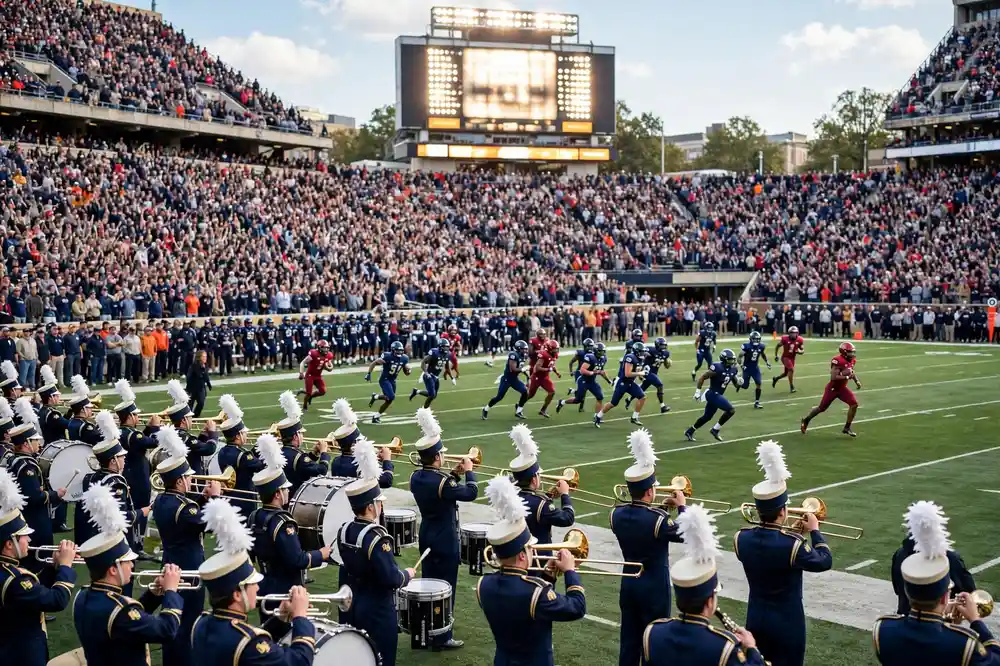




Score and Odds: How to Read NFL Betting Lines
A score-and-odds board puts two things side by side: the score of the game, and the betting line on it. Fans check it to follow the game. Bettors check it to see whether their pick is winning. Everyone else checks it because the numbers look like a secret code, and they want to know what the code means.
This guide decodes it: what a score-and-odds board shows, how to read a spread, a moneyline and a total, what the odds mean, why lines move, and how a final score settles every bet.
Quick Answer
Table of Contents
- What Is a Score-and-Odds Board?
- How to Read a Betting Line in 30 Seconds
- The Point Spread, Explained
- The Moneyline, Explained
- The Total (Over/Under), Explained
- American Odds: What -110 and +150 Mean
- The Vig: What the Bet Costs You
- Pushes, Hooks and Key Numbers
- Why Lines Move
- Checking a Final Score Against the Odds
- Live Scores and Live Odds
- Common Mistakes Beginners Make
- A Note on Betting Responsibly
- Frequently Asked Questions
What Is a Score-and-Odds Board?
A score-and-odds board is a page that lists games with two sets of numbers: the score as the game is played, and the odds set by sportsbooks. Sites built around this idea exist because fans want both numbers in one place. You can see that the Chiefs lead 24–17 in the third quarter, and that they were 3.5-point favourites before kickoff, without opening two pages.
Each game on the board usually shows four things: the teams, the point spread, the moneyline, and the total.
The board is a tool, not a tip sheet. It tells you what the market thinks, not what will happen. A team can be a heavy favourite and still lose. Our NFL scores page shows the same scores without the betting numbers, if you only want the football.
How to Read a Betting Line in 30 Seconds
Here is a typical line, using a teaching example with made-up numbers. Green Bay is playing Seattle.
| Team | Point Spread | Moneyline | Game Total |
|---|---|---|---|
| Seattle Seahawks | +3.5 (-110) | +160 | Over 47.5 (-110) |
| Green Bay Packers | -3.5 (-110) | -190 | Under 47.5 (-110) |
Read it like this. Green Bay is the favourite: the Packers must win by more than 3.5 points. Seattle is the underdog: the Seahawks can win outright, or lose by 3 or fewer. The -110 is the price: risk $110 to win $100. The moneyline is a separate bet on the winner, and the total is 47.5.
That is the whole board in one glance. Everything below explains each piece in detail, with worked examples so you can check a final score against the line yourself.
The Point Spread, Explained
The point spread is the most popular way to bet on the NFL. It levels the game by giving the underdog a head start: the favourite must win by more than the listed margin, and the underdog covers by winning outright or losing by less.
Take the example above. Green Bay -3.5 needs a win by 4 or more. At 27–20, the Packers win by 7, so Green Bay covers. At 24–21, the Packers win by 3, so Seattle +3.5 wins. The half point is the key: no team can win by half a point, so a 3.5-point spread can never tie.
The spread is set by oddsmakers to balance the betting. Their goal is roughly equal money on both sides, so the sportsbook profits from the commission either way. A spread of 3.5 does not mean Green Bay is exactly 3.5 points better; it means 3.5 splits the betting public most evenly.
Spreads also tell you how the market rates a team. A favourite of 7 or more is expected to win comfortably; a favourite of 1 to 3 is expected to win a close game. A pick’em, shown as PK, means neither team is favoured. Our NFL lines page explains the numbers behind each matchup.
The Moneyline, Explained
The moneyline is the simplest bet on the board: pick the team that wins the game outright. There is no spread and no margin to worry about. The price changes to reflect each team’s chance of winning.
In the example, Green Bay is -190 on the moneyline. That means you must risk $190 to win $100 on the Packers. Seattle is +160, which means a $100 bet wins $160 if the Seahawks win. The favourite costs more because it is more likely to win. The underdog pays more because it is less likely to win.
Moneyline prices move with the spread. A team favoured by 3.5 points is usually around -190; a team favoured by 7 is usually around -300. That is why most moneyline bettors back underdogs: the favourite’s price is often too short, while the underdog’s price pays well if the upset lands.
The moneyline is the bet new fans understand first, because it matches how fans think: who is going to win? Hockey fans face the same board in a different sport, and our NHL scores page shows how those games are tracked.
The Total (Over/Under), Explained
The total, also called the over/under, ignores who wins. It asks only how many points both teams will score combined. In the example, the total is 47.5. If the final score is Green Bay 28, Seattle 24, the teams combined for 52 points, so the Over wins and the Under loses. If the final score is Green Bay 24, Seattle 20, the total is 44, so the Under wins. The half point matters again: at 47.5 there is no tie, because two teams cannot combine for half a point.
Totals are set from the same ingredients as spreads: each offence, each defence, the weather, the pace of play, and injuries. A game between two fast, high-scoring teams might have a total of 51.5; a slow, defensive game might have 38.5.
The total is the best market for fans who have a view on the game but not on the winner. If both defences are weak, the Over is your bet. Basketball works the same way, and our NBA scores page tracks the totals market in that sport.
American Odds: What -110 and +150 Mean
American odds use the number 100 as the anchor. A minus sign tells you how much you must risk to win $100. A plus sign tells you how much profit a $100 bet wins. Hockey’s version of the same board is covered in our Boston Bruins lines guide.
| Odds | Risk | Profit on a win | Total returned |
|---|---|---|---|
| -200 | $200 | $100 | $300 |
| -150 | $150 | $100 | $250 |
| -110 | $110 | $100 | $210 |
| +100 | $100 | $100 | $200 |
| +150 | $100 | $150 | $250 |
| +200 | $100 | $200 | $300 |
The maths scales down. At -200, risking $20 earns $10 profit. At +150, a $20 bet earns $30. At -110, risking $11 earns $10.
American odds can be turned into an implied probability. For -110, that is 110 / 210, or 52.4%. For +150, it is 100 / 250, or 40%. The two sides always add up to more than 100%, and the extra is the sportsbook’s margin.
The Vig: What the Bet Costs You
The vig, short for vigorish and also called the juice, is the commission the sportsbook charges for taking your bet. It is built into the odds, which is why most spread and total bets are priced at -110 instead of even money. At even money, a $100 bet would win $100. At -110, a $100 bet wins about $91. That missing $9 is the vig. It means you must win more than half your bets to profit: at -110, you need to win 52.4% of your bets just to break even. Win half your bets at -110 and you lose money slowly. That is the single most important number in sports betting, and most beginners never learn it.
Pushes, Hooks and Key Numbers
Three words decide more bets than any others: push, hook and key number. A push happens when the final margin lands exactly on the spread, or the total lands exactly on the number. Green Bay -3 beats Seattle by exactly 3, and every bet on that spread is refunded. A total of 47 with a final combined score of 47 is also a push. Pushes only happen on whole-number lines. That is why oddsmakers love the half point.
The hook is the half point itself. At -3.5, a 3-point win loses for the favourite; at -3, the same result is a push.
Key numbers are the margins that happen most often. Three points is the most common margin in NFL history, occurring in roughly 15% of games, because so many games are decided by a field goal. Seven is next. That is why a move from -3 to -3.5 matters far more than a move from -4 to -4.5. Baseball has its own key numbers, and our MLB scores page shows how run lines work in that sport.
Why Lines Move
Lines rarely stay still from the moment they open to kickoff. They move for four reasons. First, money: when far more money lands on one side, the book moves the number to attract money the other way. Second, news: an injury to a starting quarterback can move a line by a touchdown. Third, weather: wind above 15 miles per hour pushes totals down, because passing gets harder. Fourth, sharp money: professional bettors place large bets early, and books move the line fast when they act.
First, money. When far more money lands on one side, the book moves the number to attract money the other way. A line that opens at -3 and moves to -4.5 has usually taken heavy action on the favourite. Second, news. An injury to a starting quarterback can move a line by a touchdown. A star receiver ruled out on Friday moves the total down. Third, weather. Wind above 15 miles per hour pushes totals down, because passing gets harder. Rain matters less than wind, and cold matters less than both. Fourth, sharp money. Professional bettors place large bets early in the week, and books respect their opinion enough to move the line fast when they act.
A line move is information, not a prediction. It tells you where the money went, not who will win. A line that moves toward the favourite can mean the favourite is the right side, or it can mean the public is overreacting to a headline. The move is worth noting. It is not worth following blindly.
To see which games are on where each week, our NFL coverage map shows the broadcast picture.

Checking a Final Score Against the Odds
The morning after a game, the board tells you who won and who covered. Here is how to check all three markets from one final score, using a teaching example. Green Bay was -3.5, -190 on the moneyline, and the total was 47.5. The final score is Green Bay 27, Seattle 20.
Spread: Green Bay won by 7, which is more than 3.5, so Green Bay covered. Moneyline: Green Bay won outright, so a moneyline bet on Green Bay wins. Total: 27 plus 20 is 47, which is under 47.5, so the Under wins. One score, three results, and they do not have to agree. To check the real results each week, our NFL scores page lists every final score.
Fantasy players should check our guide to how to rate your fantasy team before setting a lineup, because the same judgement that reads a line reads a roster.
Live Scores and Live Odds
Once a game starts, the board becomes a live board. The odds move with the score, the clock, and every big play. A favourite that falls behind by 14 points in the first quarter will see its live spread shrink and its live moneyline price rise. College football works the same way on Saturdays, and our college football scores page follows the live picture there.
Live odds move fast, on the same maths as the pre-game odds. The danger is speed: pre-game bets give you hours to think, live bets give you seconds. Motorsport has its own live picture too, explained in our NASCAR playoff standings guide.
Common Mistakes Beginners Make
Most beginners lose money the same few ways. Avoid these five, and you are already ahead of most of the board.
- Betting the favourite because it is the better team. The better team usually wins, but the spread already knows that. The question is not who wins, but whether the favourite wins by enough.
- Ignoring the vig. At -110 you need to win 52.4% of bets to break even. A 50% record loses money. Track your record against the break-even line, not against zero.
- Chasing a loss. Doubling your next bet to win back a loss is the fastest way to empty a bankroll. Every bet is a fresh decision, and the last result should not change the size of the next one.
- Betting every game. The board lists sixteen games a week, and most of them are not worth a bet. The best bettors pass on most games and wait for the few where they see value.
One more mistake is subtler: confusing a score-and-odds board with a prediction. The board shows what the market thinks, but it is a price, not a forecast. Only act when it disagrees with your own view in your favour.
A Note on Betting Responsibly
Sports betting is legal in many US states and not in others, and the rules change by state. Check your local law before you place a bet, and never bet money you need for rent, bills or food. Set a limit before the season starts, keep stakes small and flat, and stop when the limit is gone. If betting stops being fun, or if you are chasing losses, help is available from the National Council on Problem Gambling helpline in the US at 1-800-GAMBLER. The board is entertainment. Treat it that way, and it stays that way.
Frequently Asked Questions
What is a score-and-odds board?
A page that shows live scores next to the betting odds for each game: the point spread, the moneyline and the total, usually from several sportsbooks side by side.
What does -110 mean?
It means you must risk $110 to win $100. It is the standard price for a spread or total bet, and it means you need to win 52.4% of such bets to break even.
What is the point spread?
The expected winning margin. The favourite must win by more than the spread; the underdog covers by winning outright or losing by less than the spread.
What is the moneyline?
A bet on which team wins outright, with no spread. The favourite costs more and the underdog pays more.
What is the over/under?
A bet on the combined score of both teams. The Over wins if the teams combine for more than the total; the Under wins if they combine for fewer.
What is the vig?
The sportsbook’s commission, built into the odds. At -110, the vig means you need to win 52.4% of bets to break even.
Share this article: X | Facebook | LinkedIn | Email
Written by MSUD | View all articles by MSUD
Facts checked on 14 November 2026. Sources: EdgeLine NFL, CappersPicks, FreeSportsPicks and SportsHandle betting guides for line reading, odds maths and the vig, and Sports Flash Daily’s own NFL guides for the linked articles.