


CFB Playoff Schedule: Dates, Bracket and How It Works
Every college football season now ends the same way: a bracket, a set of dates fans circle months ahead, and a single game in January that crowns the champion. The 2026-27 edition runs from mid-December to late January, and it follows the 12-team format for the third straight season. Four teams get a bye, eight play on campus in the opening round, and the rest of the bracket runs through the famous New Year’s Six bowls.
This guide lays out the full cfb playoff schedule, round by round, with dates, venues, kickoff times, television details, and the rules that decide who gets in. It also explains how the bracket is built, what changed from the old four-team days, and how to follow each round without missing a game.
Quick Answer
Table of Contents
- What Is the College Football Playoff?
- The 2026-27 Schedule at a Glance
- Selection Day: How the 12 Teams Are Picked
- First Round: Dec. 18-19 on Campus
- Quarterfinals: Dec. 30 and Jan. 1
- Semifinals: Jan. 14 and Jan. 15
- National Championship: Jan. 25 in Las Vegas
- How the 12-Team Bracket Works
- The New Year’s Six Bowls, Explained
- How to Watch Every Round
- Past Champions and Recent Finals
- What Could Change Next Season
- Frequently Asked Questions About the CFB Playoff Schedule
What Is the College Football Playoff?
The College Football Playoff is the postseason tournament that decides the national champion of the Football Bowl Subdivision, the top level of college football. It replaced the Bowl Championship Series after the 2014 season. The first version used four teams, two semifinals, and a title game. That format lasted ten seasons before the field grew to 12 teams for the 2024-25 season.
Twelve teams now enter the bracket, and the tournament has four rounds. A selection committee of 13 people ranks the top 25 teams through the season, and the final ranking sets the field. The format rewards the strongest teams with byes and home games, while giving more conferences a real path into the bracket than the old system ever did.
Fans who follow live scores through the season will find the same habit useful in December. Our guide to college football scores explains how results, standings, and the playoff race fit together week by week.
The 2026-27 Schedule at a Glance
The dates below are the confirmed dates for this season’s tournament. Times are Eastern, and the venues for the later rounds are set long before the teams are known.
| Round | Dates | Venue | TV |
|---|---|---|---|
| Selection Day | Sun, Dec. 6, 2026 | ESPN broadcast | ESPN |
| First round | Fri, Dec. 18 – Sat, Dec. 19, 2026 | Campus sites | ESPN, ABC, TNT |
| Quarterfinals | Wed, Dec. 30, 2026 – Fri, Jan. 1, 2027 | Fiesta, Cotton, Rose, Peach Bowls | TNT, ABC, ESPN |
| Semifinals | Thu, Jan. 14 – Fri, Jan. 15, 2027 | Orange, Sugar Bowls | TNT, ABC, ESPN |
| National championship | Mon, Jan. 25, 2027 | Allegiant Stadium, Las Vegas | ABC, ESPN |
The tournament spans 38 days from the bracket reveal to the title game.
Why the dates sit where they do
The first round lands on the Friday and Saturday before Christmas, which gives campus crowds a weekend atmosphere and keeps the games clear of most final exams. The quarterfinals use the traditional New Year’s bowl window, with one game on Dec. 30 and three on New Year’s Day. The semifinals sit in mid-January, and the title game takes the Monday night slot that college football has used for its championship for years.
Selection Day: How the 12 Teams Are Picked
Selection Day falls on Sunday, Dec. 6, 2026. The committee releases its final ranking from noon Eastern, and the 12-team field and the full bracket come out at the same time. The weekly rankings that lead up to that day are released on Tuesday evenings: Nov. 10, Nov. 17, Nov. 24, and Dec. 1.
Five spots go to conference champions. The champions of the four power conferences — the ACC, Big Ten, Big 12, and SEC — receive automatic bids, along with the highest-rated team from the Group of Six leagues. Seven more teams enter as at-large picks, chosen from the best of the rest in the final ranking.
The committee weighs wins, losses, strength of schedule, head-to-head results, and conference titles. That is why the first Tuesday ranking in early November is only a starting point, not a prediction. For a worked example of reading one game, see our Kansas State vs Arizona prediction.
Our breakdown of college football playoff predictions explains how those weekly rankings move and what to watch for as Selection Day gets closer.
What the top four seeds get
The four highest-ranked teams in the final ranking earn a first-round bye and a direct place in the quarterfinals. The bye is based on ranking, not on conference titles alone, under the format used this season. College basketball runs a similar ranking race, covered in our NCAA basketball schedule guide.
First Round: Dec. 18-19 on Campus
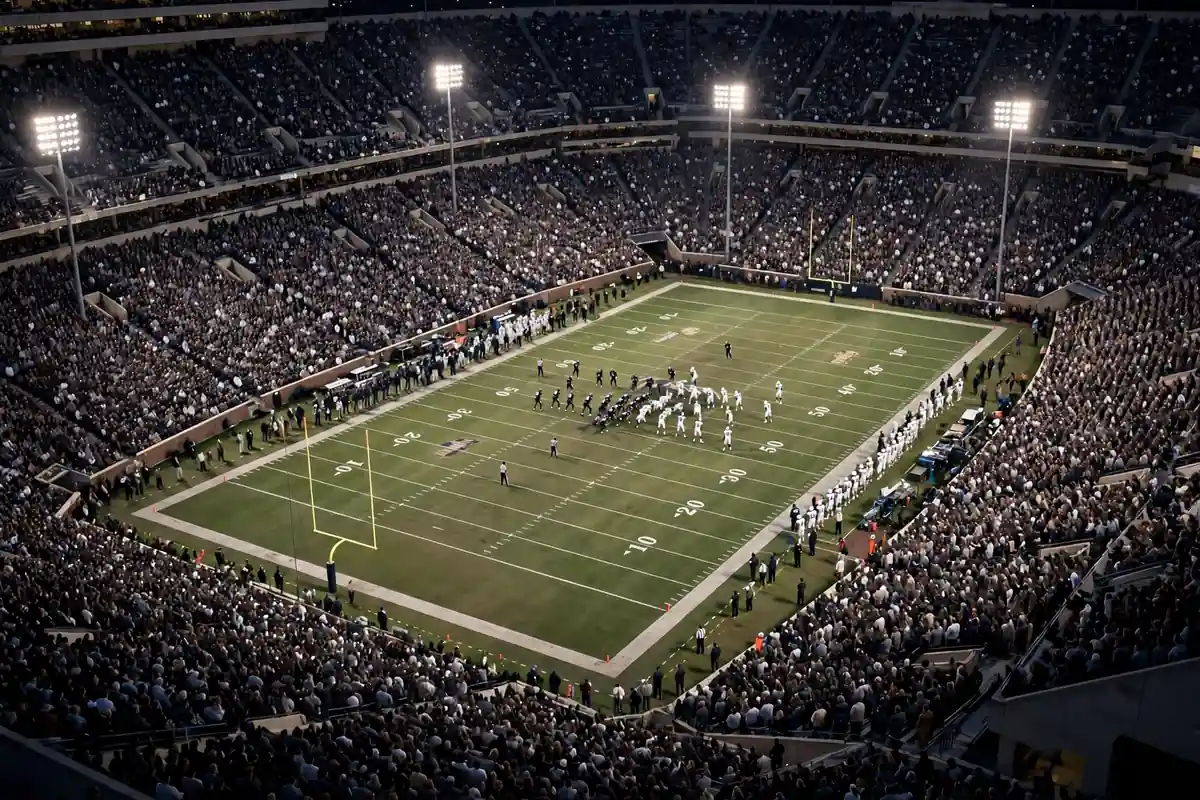
The opening round is the newest and loudest part of the tournament. Four games are played at the home stadiums of the higher seeds, and the campus setting gives the round a feel no neutral-site bowl can match. Cold weather, packed student sections, and a short week of preparation all shape the games.
- Friday, Dec. 18, 8:00 p.m. ET: No. 9 at No. 8, on ESPN.
- Saturday, Dec. 19, 12:00 p.m. ET: No. 10 at No. 7, on ABC and ESPN.
- Saturday, Dec. 19, 3:30 p.m. ET: No. 11 at No. 6, on TNT, truTV, and HBO Max.
- Saturday, Dec. 19, 7:30 p.m. ET: No. 12 at No. 5, on TNT, truTV, and HBO Max.
The pairings follow a fixed pattern: 5 plays 12, 6 plays 11, 7 plays 10, and 8 plays 9. The higher seed hosts, so a top-eight finish carries a home game as its reward. The winners move on to the quarterfinals, where the top four seeds are waiting.
Why home games matter
A home game in December can decide a close contest. Visiting teams travel on a short week, play in front of a hostile crowd, and often face weather they rarely see at home.
The campus round also gives smaller programs a stage they never had under the four-team format. A team seeded 11th or 12th still gets a playoff game, and a win on the road in that spot becomes one of the biggest results in school history.
Quarterfinals: Dec. 30 and Jan. 1
The quarterfinals move the tournament into the bowl system. Four games are played at four of the New Year’s Six bowls, and each one carries a top-four seed against a first-round winner. The bracket is not reseeded, so the matchups are fixed once the bracket is set on Dec. 6.
- Wednesday, Dec. 30, 7:30 p.m. ET: Vrbo Fiesta Bowl, State Farm Stadium, Glendale, Arizona.
- Friday, Jan. 1: Goodyear Cotton Bowl, AT&T Stadium, Arlington, Texas.
- Friday, Jan. 1: Rose Bowl Game, Rose Bowl Stadium, Pasadena, California.
- Friday, Jan. 1: Chick-fil-A Peach Bowl, Mercedes-Benz Stadium, Atlanta, Georgia.
Three quarterfinals share New Year’s Day, which keeps the oldest tradition in the sport at the centre of the playoff. The Cotton, Peach, and Fiesta Bowls each bring a large stadium, a warm-weather city, and a crowd that travels well.
How the quarterfinal pairings work
The No. 1 seed meets the winner of 8 vs. 9, the No. 2 seed meets the winner of 7 vs. 10, the No. 3 seed meets the winner of 6 vs. 11, and the No. 4 seed meets the winner of 5 vs. 12. Because the bracket stays fixed, a first-round upset can hand a top seed a much easier or much harder opponent than expected. That fixed shape is part of the drama: the path is known from the start, and every result reshapes the road ahead.
Fans who want to understand how brackets work in other sports can compare this setup with our guide to the NCAA tournament schedule, which explains how a college bracket is built and how teams advance through it.
Semifinals: Jan. 14 and Jan. 15
Two games decide the finalists. Both are played at New Year’s Six bowls, on back-to-back nights in mid-January, and each one is a standalone event with its own build-up.
- Thursday, Jan. 14, 7:30 p.m. ET: Capital One Orange Bowl, Hard Rock Stadium, Miami Gardens, Florida.
- Friday, Jan. 15, 7:30 p.m. ET: Allstate Sugar Bowl, Caesars Superdome, New Orleans, Louisiana.
The Orange Bowl in Miami and the Sugar Bowl in New Orleans are two of the oldest bowls in the sport, and both cities turn semifinal week into a full event. The winners get ten days to prepare for the title game, which is the longest break in the tournament and gives injured players a real chance to recover.
What decides a semifinal
Semifinals are usually won at the line of scrimmage. The teams left at this stage can all throw, run, and defend, so the difference often comes down to turnovers, field position, and which side handles the ten-day layoff better. A team that peaked in the quarterfinal can go flat, while a team that survived a scare can arrive with sharper focus. Coaches spend the extra days on rest, film, and a game plan built for one opponent, not a season.
National Championship: Jan. 25 in Las Vegas
The season ends on Monday, Jan. 25, 2027, at 7:30 p.m. ET, at Allegiant Stadium in Las Vegas, Nevada. The game airs on ABC and ESPN. It is the first time the title game has been played at Allegiant Stadium, and the first time Las Vegas has hosted the championship.
Las Vegas brings a domed stadium, a large neutral crowd, and a week of events around the game.
Planning around the title game
The Monday night slot means most fans watch from home, while a smaller group travels for the weekend. Anyone planning to attend should book travel early and check the stadium’s bag and entry rules, because a championship crowd fills the building well before kickoff. Pro bettors track the same game through our NFL lines page.
For fans who follow the professional game too, the college title game lands in the same month as the NFL’s playoff push. Our NFL scores page tracks the pro postseason race through January.
How the 12-Team Bracket Works
The bracket is single elimination. Lose once, and the season is over. That simple rule shapes every decision a coach makes, from going for it on fourth down to managing the clock in a tight fourth quarter.
The 12 teams are seeded 1 to 12 by the committee’s final ranking. Seeds 1 to 4 get byes. Seeds 5 to 8 host first-round games. Seeds 9 to 12 travel. The bracket does not reseed after any round, so the path each team faces is fixed on Selection Day.
The five-plus-seven model
Five automatic bids go to the highest-ranked conference champions, and seven at-large bids go to the next best teams. The model guarantees that every conference champion with a strong season gets a place, while still leaving most of the field open to the best teams regardless of league. A team from a smaller conference can earn a bid by winning its league and ranking highly enough, which is how the expanded field opened the door wider than the old four-team version.
Seeding vs. ranking
Seeding follows the final ranking, with the top four getting byes. That means a conference champion ranked fifth does not get a bye, while a team ranked fourth without a title does. The distinction matters for fans who assume a title guarantees rest: it guarantees a place, not a bye.
The committee’s weekly top 25 is the best guide to how the field is shaping up. Our CFP rankings page tracks the rankings and explains what each release means for the bracket.
The New Year’s Six Bowls, Explained
The six bowls that host the quarterfinals and semifinals are the Rose, Sugar, Orange, Cotton, Peach, and Fiesta Bowls. They rotate through the later rounds each season, so the pairings change from year to year. In 2026-27, the Fiesta hosts a quarterfinal, the Cotton, Rose, and Peach host the other three, and the Orange and Sugar host the semifinals.
Each bowl has its own history. The Rose Bowl is the oldest, first played in 1902. The Sugar Bowl dates to 1935, the Orange Bowl to 1935, the Cotton Bowl to 1937, the Peach Bowl to 1968, and the Fiesta Bowl to 1971. Their stadiums range from the open-air Rose Bowl in Pasadena to the domed Caesars Superdome in New Orleans, and each one brings a different climate and crowd.
Why bowls still matter
The playoff kept that structure when it expanded, rather than moving every round to campus sites or neutral stadiums, because the bowls already had the dates, the cities, and the audiences.
How to Watch Every Round
Television coverage is split across the ESPN family of networks. The first round uses ESPN, ABC, TNT, truTV, and HBO Max. The quarterfinals and semifinals use a mix of TNT, ABC, and ESPN. The title game airs on ABC and ESPN, with the main broadcast on ABC and alternate feeds on the ESPN platforms.
- Check kickoff times in Eastern. All published times use Eastern time, so fans in other zones should convert before setting a reminder.
- Streaming needs a subscription. The games stream on the ESPN app and on HBO Max for the TNT games, and each one needs a valid login.
- Radio is a solid backup. National radio carries every round, and local radio covers the home team in the first round.
- Replays are easy to find. Full replays and condensed versions appear on the ESPN platforms within hours of the final whistle.
Fans who track the pro game on Sundays can use the same routine here. Our NFL coverage map shows how broadcast maps work for the NFL, and the same idea applies to finding which channel carries each playoff game in your area.
Following the bracket live
The bracket is fixed, so a fan can print it on Dec. 6 and fill it in by hand as results come in. Keeping a copy of the bracket on the wall is the simplest way to follow a tournament that stretches across five weeks.
Past Champions and Recent Finals
The playoff began with four teams in the 2014-15 season, and Ohio State won the first title by beating Oregon 42-20. The four-team era produced champions from Ohio State, Alabama, Clemson, LSU, Georgia, and Michigan. The field grew to 12 teams for the 2024-25 season, and Ohio State won that first expanded title by beating Notre Dame 34-23.
The most recent final, for the 2025-26 season, saw Indiana beat Miami 27-21 at Hard Rock Stadium in Miami Gardens. Indiana finished the season 16-0, the first undefeated run through the expanded format, and the win gave the school its first playoff-era national championship. That result is a reminder that the expanded field can produce a champion from outside the usual group of favourites.
What history says about the format
The first two expanded seasons both rewarded teams that won four games in a row. Ohio State entered the 2024-25 bracket as the eighth seed and beat Tennessee, Oregon, Texas, and Notre Dame. Indiana entered the next season as a top seed and held its place through the bracket. Both paths show that seeding helps, but it does not decide the title: the team that plays best across four rounds wins.
College basketball runs a much larger bracket, and the comparison is useful. Our college basketball scores page shows how a 68-team field handles the same single-elimination idea on a bigger scale.
What Could Change Next Season
The 12-team format may not last much longer. On Nov. 9, 2026, the playoff approved a 24-team bracket starting with the 2027-28 season, according to a Ticketmaster update on the playoff that month. Reports through the autumn had said a deal with ESPN to double the field was close, and the approval makes the 2026-27 tournament the last one played with 12 teams if that plan holds.
A 24-team field would change the dates, the number of byes, and the number of campus games. Fans should treat the 24-team plan as approved in principle, not as a finished schedule, and check the official announcement before making plans for next season.
What stays the same
Whatever the field size, the core of the event is unlikely to move: a committee picks the teams, the bowls host the later rounds, and the title game takes a Monday night in January. The dates will shift to fit the larger bracket, but the shape of the season — regular season, conference titles, Selection Day, then the tournament — will stay recognisable. Tennis follows a fixed calendar too, as our Wimbledon schedule shows.

Frequently Asked Questions About the CFB Playoff Schedule
When does the 2026-27 College Football Playoff start?
The first round starts Friday, Dec. 18, 2026, with one game that night and three more on Saturday, Dec. 19. All four first-round games are played on campus at the higher seed’s stadium.
When is the national championship game?
Monday, Jan. 25, 2027, at 7:30 p.m. ET, at Allegiant Stadium in Las Vegas, Nevada. The game airs on ABC and ESPN.
How many teams make the College Football Playoff?
Twelve teams. Five are conference champions with automatic bids, and seven are at-large picks. The top four seeds get a first-round bye.
When is Selection Day?
Sunday, Dec. 6, 2026. The committee releases its final ranking from noon Eastern, and the 12-team field and full bracket are revealed at the same time.
Where are the quarterfinals played?
At four New Year’s Six bowls: the Fiesta Bowl on Dec. 30, and the Cotton, Rose, and Peach Bowls on Jan. 1. The semifinals are the Orange Bowl on Jan. 14 and the Sugar Bowl on Jan. 15.
Do the top seeds get a bye?
Yes. The four highest-ranked teams skip the first round and go straight to the quarterfinals. The bye is based on ranking, not on winning a conference title.
Is the bracket reseeded after each round?
No. The bracket is fixed on Selection Day, so each team’s path to the title is known from the start. A first-round upset changes who a top seed faces, not the shape of the bracket.
Who won the last College Football Playoff?
Indiana won the 2025-26 title, beating Miami 27-21 and finishing 16-0. Ohio State won the first 12-team title the season before, beating Notre Dame 34-23.
Share this article: X | Facebook | LinkedIn | Email
Written by MSUD | View all articles by MSUD
Facts checked on 14 November 2026. Sources: NCAA.com for the 2026-27 dates, venues and kickoff times; Britannica and Bet365 for the format history and past champions; and Sports Flash Daily’s own college football guides for the linked articles.