




What Is a Power Play in Hockey? Rules, 5-on-4 and 5-on-3
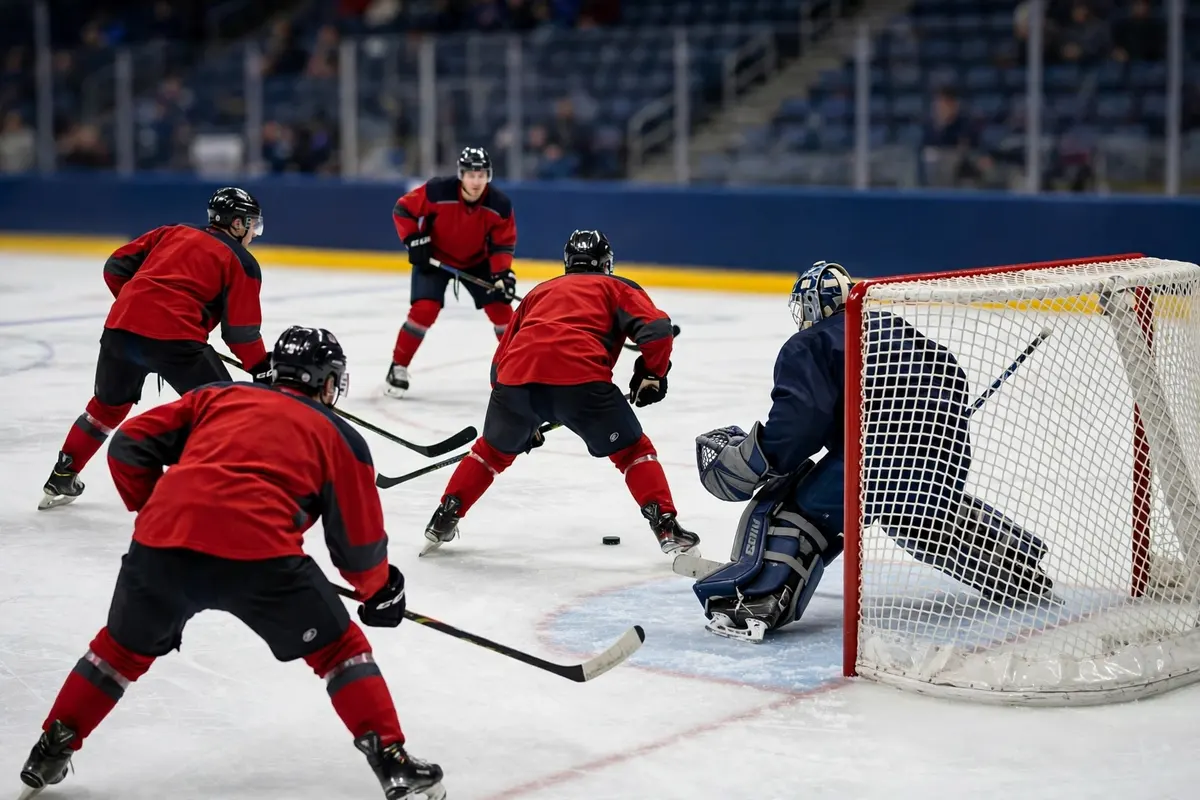
Watch a hockey game for ten minutes and you will see it: a whistle, a player skating to a small box at the side of the rink, and suddenly one team has an extra skater. The crowd rises. The team with the extra man sets up in the attacking zone and starts passing the puck around the outside, looking for a shot. That is a power play, and it is the single best scoring chance in the sport.
This guide explains it from the ground up: what causes it, how long it lasts, when it ends early, what a 5-on-3 is, how teams set up to score, how the short-handed team survives, and why the best teams in the league live and die by their power play.
Quick Answer
Table of Contents
- What Is a Power Play in Hockey?
- What Causes a Power Play?
- How Long Does a Power Play Last?
- When Does a Power Play End Early?
- The 5-on-3: Hockey’s Biggest Advantage
- The Delayed Penalty: Play Carries On
- The Penalty Kill: Surviving Short-Handed
- Power Play Formations: Umbrella, 1-3-1 and Overload
- How a Power Play Is Run, Step by Step
- Power Play Percentage: The Number That Matters
- Overtime and Special Cases
- The History: Why Goals End Penalties
- Frequently Asked Questions About the Power Play in Hockey
What Is a Power Play in Hockey?
A power play is a numbers advantage. In ice hockey, each team normally has five skaters and a goalie on the ice. When a player breaks a rule, the referee sends him to the penalty box, and his team cannot replace him. The other team now has five skaters against four, plus its goalie, and that advantage is the power play.
The team with the extra skater is said to be “on the power play” or “on the man advantage”. The team playing short is “short-handed” or “on the penalty kill”. Both phrases describe the same two minutes from opposite sides.
The advantage matters because hockey is a game of space and time. One extra skater means an extra passing option, more room to move the puck, and a defender who cannot cover everyone. NHL teams convert roughly one in five power plays into a goal, and the best units score on close to a third of their chances.
If you are new to the sport, our ice hockey rules for beginners covers the game from the first faceoff, and our how long is a hockey game guide explains periods, overtime and real time.
What Causes a Power Play?
A power play starts with a penalty. The referee sees a rule broken, raises an arm to signal the call, and sends the offending player to the penalty box. The common minor penalties that create power plays are hooking, tripping, holding, interference, slashing, cross-checking and high-sticking.
Each of those is a two-minute minor penalty under the NHL rulebook. The player sits for two minutes, his team plays short, and the other team gets its advantage.
Not every penalty creates a power play. If both teams take penalties at the same time, the players go to the box but the teams stay at even strength, usually 4-on-4, because both sides lost a skater. Those are called coincidental penalties, and they cancel each other out. A misconduct penalty, usually ten minutes, also does not create a power play, because the team is allowed to put a replacement on the ice.
The goalie is a special case. If a goalie commits a minor penalty, he does not go to the box. Another player who was on the ice at the time serves the penalty instead.
How Long Does a Power Play Last?
How long a power play lasts depends entirely on which penalty caused it. The NHL rulebook sets out four cases, and each one behaves differently when the power-play team scores.
| Penalty type | Time served | Does a power-play goal end it early? |
|---|---|---|
| Minor (Rule 16) | 2 minutes | Yes, the penalty ends the instant the power-play team scores |
| Double minor (Rule 18) | 4 minutes, in two 2-minute blocks | Only the current block ends; the second block still starts |
| Major (Rule 20) | 5 minutes, in full | No, the full five minutes plays out no matter how many goals are scored |
| Match penalty (Rule 21) | 5 minutes, served by a substitute; offender ejected | No, the same as a major, except in overtime |
The minor is the everyday case: two minutes, and a goal ends it. The double minor is really two minors back to back, usually called for a high stick that draws blood. A goal in the first two minutes ends only the first block, and the second block starts after play resumes.
The major is the heavy case: five minutes, usually for fighting or a dangerous hit, and goals do not shorten it. A team that takes a major penalty can give up two or three goals and still sit short for the full five minutes.
If a power play is still running at the end of a period, it carries into the next period. It does not carry into the next game.
When Does a Power Play End Early?
A power play ends in one of two ways: the penalty clock runs out, or the power-play team scores. For a minor penalty, a goal sends the penalised player straight back onto the ice, and the teams return to even strength.
If two minors are running at the same time against the same team, a goal ends only the penalty with the least time left. The other penalty keeps running, and the power play continues.
A short-handed goal does not end a power play. If the team killing the penalty scores while short-handed, the penalty keeps running until its time expires or the power-play team scores. A power play also ends if the team on the power play takes a penalty of its own, and the numbers even up.
The 5-on-3: Hockey’s Biggest Advantage
A 5-on-3 happens when two players from the same team are serving penalties at the same time, so their opponent attacks with five skaters against three defenders and a goalie. It is the biggest advantage in the sport, and it is also the most dangerous moment for the team that is short.
Two extra skaters means the attacking team can move the puck around the outside faster than the three defenders can cover, and the goalie faces shots from angles he cannot protect on his own. Coaches call a timeout before a long 5-on-3, because the chance to score is so high and the cost of wasting it is so visible.
There is a floor to how short a team can go. A team can never have fewer than three skaters on the ice. If a third player is penalised while two teammates are already serving time, he goes to the box at once, but his penalty clock does not start until one of the first two penalties expires.
Fans who follow the league’s big clubs should read our Boston Bruins lines guide for how to read a team like a fan, and the Pittsburgh Penguins rumors guide for how to follow trade talk around a contender.
The Delayed Penalty: Play Carries On
Sometimes the referee raises an arm but does not blow the whistle. That is a delayed penalty, and it is one of the cleverest wrinkles in the game.
When the team that is about to be penalised has the puck, the referee signals the penalty but lets play continue, because stopping the game would punish the innocent team by taking the puck away from it. The non-offending team keeps the puck, and it will usually pull its goalie for an extra attacker, playing 6-on-5 while it tries to score. The moment the penalised team touches the puck, the whistle blows and the penalty starts.
If the team with the delayed penalty scores before the whistle, the goal counts and the penalty is wiped out. If it does not score, the player goes to the box and the power play begins as normal. The delayed penalty is why you sometimes see a goalie skate to the bench in the middle of play, with no stoppage and no obvious reason.
The Penalty Kill: Surviving Short-Handed
The penalty kill is the other half of the power play, and it is where games are often won. The short-handed team has one job: survive two minutes without giving up a goal. The tools are simple and brutal.
- Clear the puck. The short-handed team can ice the puck, firing it all the way down the ice without a whistle. The power-play team cannot ice it.
- Block shots. Penalty killers throw their bodies in front of shots, because a blocked shot is as good as a save.
- Pressure the puck carrier. One forward chases the puck hard, forcing quick decisions and bad passes.
- Stay in shooting lanes. The defenders hold a tight box or diamond shape, keeping the middle of the ice closed and forcing shots from the outside.
- Win the faceoff. A lost defensive-zone faceoff at the start of a kill is the worst possible beginning, because the power play sets up instantly.
A good penalty kill is a point of pride for a team. The best penalty-killing teams allow a goal on fewer than one in five kills, and their goalies are often the difference.
For the numbers behind the league, our NHL scores page covers live results, standings and the playoff race, and the NHL salary cap guide explains how teams build the rosters that kill penalties and run power plays.

Power Play Formations: Umbrella, 1-3-1 and Overload
Once the power-play team gets set up in the attacking zone, it runs a formation, a set shape that creates passing lanes and shooting chances.
The umbrella
The umbrella puts one player high at the blue line, two players on the half-walls at the sides, and two players near the net. It is built for point shots: the puck moves around the outside, and the net-front players screen the goalie and look for tips and rebounds.
The 1-3-1
The 1-3-1 is the most widely used formation in modern hockey. One player at the point, two on the half-walls, one in the middle as the “bumper”, and one in front of the net. The bumper is the key: he sits in the slot, takes passes in the middle, and can shoot, pass or deflect. The shape gives the power play many passing options and one-timer chances from both sides.
The overload
The overload stacks three or four players on one side of the ice, usually the side with the team’s best shooter. The idea is to create a numbers advantage on that side, force the defence to collapse toward it, and then move the puck quickly to the open man on the far side for a one-timer.
How a Power Play Is Run, Step by Step
A power play follows the same steps almost every time.
- Win the faceoff. The faceoff moves into the penalised team’s end, and the power-play team picks the dot. Winning it means instant setup.
- Enter the zone cleanly. The team carries the puck in with control or dumps it in and wins the race to it. A failed entry wastes 20 seconds.
- Set up the formation. The five skaters take their spots, the puck moves to the point or the half-wall, and the shape forms.
- Move the puck quickly. Fast passes pull the penalty killers out of position. Slow passes let them reset.
- Get shots through. Shots need a screen in front of the goalie and a player looking for tips and rebounds.
- Win the retrieval. After a shot, the power-play unit must win the puck back along the boards to keep possession.
The players who run the unit are usually a team’s best. Our NHL players guide explains positions, rosters and stats, so you can see which names run the power play for each club.
Power Play Percentage: The Number That Matters
Power play percentage is the share of power plays a team converts into goals. In the 2025-26 NHL regular season, teams scored on about 21 percent of their power plays, with 1,595 goals on 7,555 chances.
The number matters because power plays are frequent. A team gets two or three chances most nights, and over 82 games that adds up to hundreds of chances. A team that converts 25 percent instead of 20 percent scores roughly a dozen extra goals a season.
Minor league hockey works the same way, with the same rules and the same stakes. Our American Hockey League tickets guide is a complete buying guide for fans who want to watch the next generation learn the power play up close.
Overtime and Special Cases
Overtime changes the power play. In the NHL regular season, overtime is 3-on-3, so a minor penalty gives the non-offending team a fourth skater and the game is played 4-on-3. That is an enormous advantage in open ice, and most overtime penalties end the game quickly. In the playoffs, overtime is 5-on-5, so a power play looks like a normal one, except that the next goal wins the game.
The History: Why Goals End Penalties
The rule that a goal ends a minor penalty has not always existed. Until 1956, a player served all two minutes of a minor penalty no matter what happened, even if the other team scored three times. The rule changed because the game was becoming a shooting gallery: a good power play could score again and again against a team that could not get its player back. The change made the penalty fairer and the game more competitive. The five-minute major still works the old way, on purpose: a major is called for a serious offence, and goals do not shorten it.
Hockey fans who follow other sports will recognise the pattern. The NFL scores page and the MLB scores page cover the same kind of momentum swings in football and baseball.
Frequently Asked Questions About the Power Play in Hockey
What is a power play in hockey?
A power play is when one team has more skaters on the ice than its opponent because an opposing player is serving a penalty. The usual form is 5-on-4 for two minutes, after a minor penalty.
How long does a power play last?
It lasts as long as the penalty that caused it. A minor penalty gives a two-minute power play, a double minor gives four minutes in two blocks, and a major penalty gives a full five minutes.
Does a goal end a power play?
A goal by the power-play team ends a minor penalty early. It ends only the current block of a double minor. It does not end a major penalty, which runs its full five minutes.
What is a 5-on-3 power play?
It is when two players from the same team are serving penalties at the same time, so their opponent attacks with five skaters against three defenders and a goalie. It is the biggest advantage in the sport.
What is the penalty kill?
The penalty kill is the short-handed team’s effort to survive a power play without giving up a goal, by clearing the puck, blocking shots and pressuring the puck carrier. The team killing the penalty can ice the puck freely.
What is a short-handed goal?
A goal scored by the team that is killing a penalty, while it is short-handed. It does not end the penalty, but it counts on the scoreboard and swings momentum hard.
What is a delayed penalty?
It is when the referee signals a penalty but lets play continue because the team about to be penalised has the puck. The other team will usually pull its goalie for an extra attacker, and the whistle blows the moment the penalised team touches the puck.
How good are NHL teams on the power play?
In the 2025-26 regular season, NHL teams scored on about 21 percent of their power plays, with 1,595 goals on 7,555 chances. The best units in the league score on close to a third of their chances.
Share this article: X | Facebook | LinkedIn | Email
Written by Saadi | View all articles by Saadi
Facts checked on 14 November 2026. Sources: Wikipedia and NHL rulebook summaries for penalty lengths and the 1956 rule change, plus 2025-26 NHL power-play data, and Sports Flash Daily’s own hockey guides for the linked articles.



















